
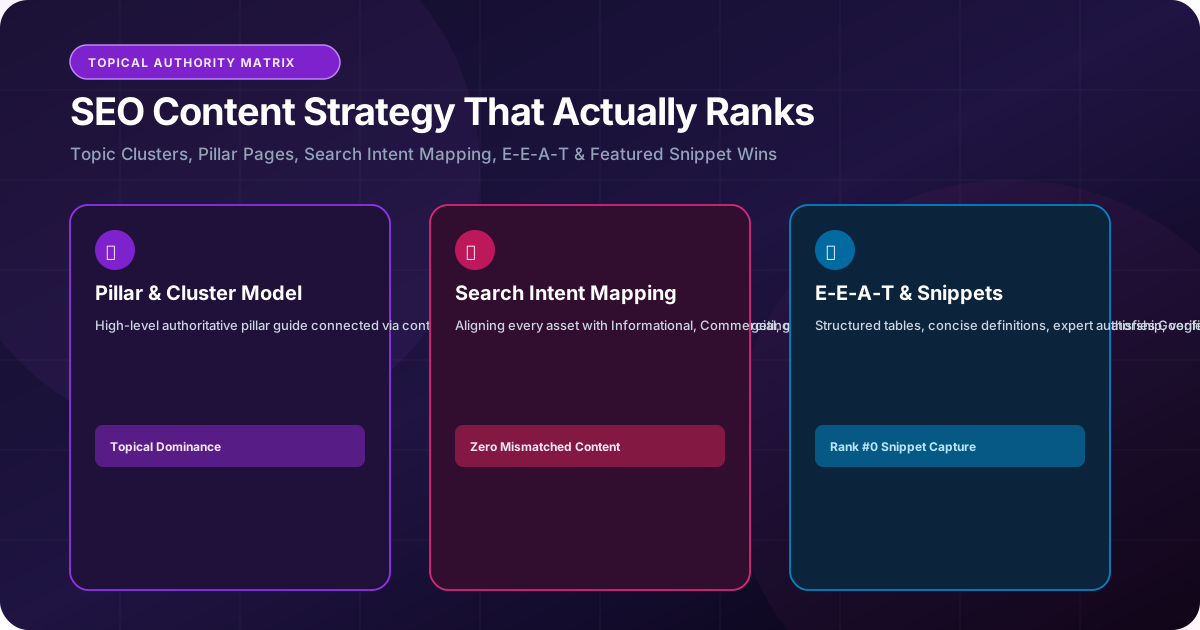
SEO Content Strategy: How to Create Content That Actually Ranks on Google
A masterclass in topic clusters, search intent mapping, semantic entity coverage, E-E-A-T, and winning Featured Snippets.

- 1. The Death of Isolated Keywords: Topical Authority & Neural Search
- 2. Decoding Search Intent: Formatting Content to Win the SERP
- 3. The Topic Cluster Model: Pillar Pages and Supporting Spokes
- 4. Real-World Topic Cluster Blueprint: Custom Web Applications
- 5. Engineering Data-Driven Content Briefs
- 6. On-Page Semantic Optimization & Scannability
- 7. Capturing Featured Snippets & People Also Ask (PAA)
- 8. Content Decay Management & Performance Attribution
The era of publishing generic 600-word blog posts stuffed with repetitive keywords is permanently over. With Google's Helpful Content System, core algorithmic refinements, and AI Overviews processing trillions of queries through neural matching models, search engines no longer evaluate content as isolated text documents. Instead, Google evaluates your domain's topical authority: does your website demonstrate comprehensive, trustworthy, and deep expertise across an entire subject ecosystem? If your articles are written primarily to capture search impressions without satisfying real human intent, your rankings will inevitably plummet. This actionable guide provides the complete blueprint for architecting an SEO content strategy that builds topical dominance, earns first-page Google rankings, and generates qualified commercial leads.
An SEO content strategy is a systematic framework for researching, creating, optimizing, and organizing digital content to build topical authority and earn top organic search rankings. Rather than producing disconnected blog posts, a modern strategy organizes content into topic clusters: a comprehensive pillar page that establishes domain authority, supported by tightly interlinked cluster articles that target long-tail search intent and answer specific user questions.
1. The Death of Isolated Keywords: Topical Authority & Neural Search
Why Google ranks topical experts rather than individual articles
In early search engine optimization, agencies wrote separate articles for minor keyword variations ('best CRM software', 'top CRM tools', 'CRM software for business'). Today, Google's semantic models (like BERT and MUM) understand that these queries share identical underlying search intent.
More importantly, Google assesses whether your domain has established 'topical authority'. If an accounting blog publishes an isolated article on 'best web hosting', Google's algorithms discount the article because the domain possesses no topical credibility in server infrastructure.
To rank sustainably, you must demonstrate comprehensive coverage across your core business domain. Every article must fit into a structured content cluster that systematically educates prospective buyers at every stage of their customer journey.
Google thinks in entities (concepts, technologies, organizations) and relationships between them. Your content strategy must map these entity relationships, connecting primary concepts with relevant industry terminology, parent topics, and common user problems.
2. Decoding Search Intent: Formatting Content to Win the SERP
Matching the exact content layout and depth Google expects
Search intent is the single most critical ranking factor in modern SEO content marketing. If your content fails to provide the exact information format the searcher desires, no amount of technical optimization or backlinks will save it.
Before writing a single sentence, analyze the top 5 ranking results on Google for your target keyword to identify the prevailing SERP format:
Informational Intent: Searchers want a clear explanation, tutorial, or definition (e.g., 'what is technical SEO'). Deliver structured headings, step-by-step numbered guides, and concise quick answers.
Commercial Investigation Intent: Searchers are comparing options, pricing, and vendors (e.g., 'Next.js vs WordPress for SEO'). Deliver comparison tables, pros/cons lists, and objective evaluation criteria.
Transactional Intent: Searchers are ready to buy or engage (e.g., 'hire technical SEO specialist'). Direct them to a high-converting service landing page with clear pricing, proof points, and inquiry forms.
3. The Topic Cluster Model: Pillar Pages and Supporting Spokes
The architectural framework that builds unstoppable domain authority
The topic cluster model organizes your website's content into cohesive semantic hubs consisting of three core elements: a Pillar Page, Cluster Spokes, and Contextual Two-Way Internal Links.
Pillar Page: A comprehensive, 2,500+ word master guide that provides a high-level overview of a broad core topic (e.g., 'The Complete Guide to Custom Web Application Development').
Cluster Spokes: 4 to 8 specialized, in-depth articles that explore specific subtopics introduced on the pillar page (e.g., 'Web Application Development Costs', 'Web App Security Architecture', 'Web Apps vs Mobile Apps').
Internal Hyperlinks: The pillar page links out to every supporting spoke article, and every spoke article links contextually back to the pillar page using descriptive anchor text. This bidirectional link graph signals to Google that your website is a definitive authority on the entire topic.
4. Real-World Topic Cluster Blueprint: Custom Web Applications
An empirical example of topical mapping for enterprise software
To visualize how topic clusters function in practice, review this concrete example designed for a modern software engineering and web development agency.
| Asset Type | URL Path / Topic | Target Keyword | Role in Customer Funnel |
|---|---|---|---|
| Pillar Page | /blogs/custom-web-application-development | custom web application development | High-level authority anchor; covers architecture, tech stack, and lifecycle |
| Cluster Spoke 1 | /blogs/custom-web-application-development-cost | custom web application development cost | Commercial investigation; detailed pricing tiers, labor hours, and ROI |
| Cluster Spoke 2 | /blogs/secure-web-application-development | secure web application development | Technical deep dive; OWASP standards, authentication, and data compliance |
| Cluster Spoke 3 | /blogs/scalable-web-application-development | scalable web application development | Architectural blueprint; microservices, database sharding, and caching |
| Cluster Spoke 4 | /blogs/website-vs-web-application | website vs web application | Foundational informational; helps non-technical founders choose the right path |
| Cluster Spoke 5 | /blogs/third-party-api-integration | third party API integration | Specialized engineering; payment gateways, CRM sync, and webhooks |
| Target Service | /services/web-application-development | web application development services | Transactional conversion landing page; captures qualified RFQs and leads |
5. Engineering Data-Driven Content Briefs
Eliminating guesswork before writing begins
High-performing SEO articles are never written off-the-cuff. They are built from detailed, data-driven content briefs that outline every structural requirement before copywriting commences.
A professional content brief includes: primary and secondary keyword entities, target word count benchmarked against the top 3 ranking URLs, a strict H2/H3 outline that addresses all 'People Also Ask' questions, required technical definitions, internal linking targets, and conversion CTA placement.
By establishing clear architectural specifications in the brief, your content writers can focus on delivering exceptional subject matter depth without missing critical semantic entities.
6. On-Page Semantic Optimization & Scannability
Writing for human readers first while providing clear signals to algorithms
Modern search engines evaluate reader engagement signals, including time on page and scroll depth. If your content is presented as massive, intimidating walls of unbroken text, users will click the back button immediately.
Structure your content for effortless scannability: keep paragraphs between 2 and 4 sentences, use bold text strategically to emphasize key insights, integrate responsive comparison tables, and employ bulleted lists to break down complex concepts.
Place your primary keyword naturally within the H1 title, the introductory 100 words, and at least one H2 heading, but strictly avoid artificial repetition that disrupts editorial flow.
7. Capturing Featured Snippets & People Also Ask (PAA)
Securing 'Position Zero' at the very top of Google search results
Featured snippets occupy the prime visual real estate at the very top of the SERP, appearing above standard organic listings. Capturing featured snippets requires structuring direct, concise answers to specific questions.
To win paragraph snippets: provide a clear, authoritative 40-to-60 word definition immediately beneath an H2 or H3 question heading (e.g., 'What is full-stack web development?').
To win list snippets: use ordered `<ol>` or unordered `<ul>` lists with concise bullet points outlining a step-by-step process or ranking.
To win table snippets: format structured comparative data into clean HTML tables with clear `<th>` column headers, which Google frequently extracts directly into search results.
8. Content Decay Management & Performance Attribution
Protecting rankings over time and connecting content to revenue
An SEO content strategy does not end upon publication. Over time, all content experiences 'content decay' as competitors publish newer guides, statistics become outdated, and search algorithms shift.
Conduct quarterly content audits in Google Search Console. Identify pages that experienced a 15%+ drop in impressions or CTR over the trailing 6 months. Refresh these articles by updating outdated data, expanding thin sections, improving internal links, and re-optimizing the meta title.
Measure content success through commercial attribution: evaluate which blog posts generate assisted conversions, newsletter signups, and high-value lead submissions in GA4, doubling down on the topic clusters that drive tangible revenue.
The Bottom Line & Next Steps
Creating content that ranks on Google is an architectural discipline combining semantic keyword mapping, topical cluster design, human-first editorial craftsmanship, and relentless intent satisfaction. When you build comprehensive topic clusters that demonstrate verified E-E-A-T, Google rewards your domain with compounding authority and dominant organic rankings. At RankVRA, we engineer data-driven content marketing architectures and full-funnel SEO strategies that position your company as the undisputed leader in your industry. Contact our content strategists today to build an organic engine that scales your business.
Questions Business Leaders Ask About SEO content strategy
What is a topic cluster and why is it important for SEO?▾
A topic cluster is an architectural model where a central, comprehensive 'pillar page' is linked to a series of specialized 'cluster spoke' articles covering related subtopics. This structure organizes content logically for users and signals deep topical authority to Google's semantic search algorithms.
How long should an SEO blog post be to rank on Google?▾
There is no universal word count requirement; your article should be as long as necessary to comprehensively answer the user's search intent without unnecessary fluff. For competitive commercial and technical topics, high-ranking guides typically range between 1,500 and 2,500 words.
How do I optimize content for Google's Helpful Content System?▾
To satisfy the Helpful Content System, create original, people-first content written by experienced subject matter experts. Provide unique insights, avoid regurgitating common search results, avoid deceptive clickbait titles, and ensure visitors leave your site feeling fully satisfied without needing to search elsewhere.
What is the best way to win Google Featured Snippets?▾
Identify questions with existing snippet boxes in Google SERPs. Structure your answer directly beneath an H2 or H3 heading with a clear, factual 40-to-60 word definition, a clean bulleted list, or a structured HTML comparison table.
How often should I update existing SEO content?▾
Audit your core commercial articles every 6 to 12 months. Refresh outdated statistics, replace dead links, expand sections with new industry developments, and refine title tags to maintain high Click-Through Rates.
How does RankVRA engineer SEO content strategies for clients?▾
RankVRA combines technical SEO with deep content architecture: our specialists conduct entity research, build interconnected topic clusters, draft data-driven briefs, and produce high-authority technical content that generates qualified B2B leads.

Written by Naveen Panchal
AuthorFounder & Lead Technical Architect, RankVRA
Naveen Panchal is the Founder and Technical Director of RankVRA. He specializes in full-stack web engineering, Next.js architecture, and algorithmic search optimization for high-growth enterprises.
Explore Core Commercial Capabilities
- Google Search Central: Google Search Central: Creating Helpful ContentOfficial Reference
- Google: Google Quality Rater Guidelines: E-E-A-TOfficial Reference
- HubSpot: HubSpot: What Is a Topic Cluster?Official Reference
Build a High-Ranking Content Engine That Drives Real Pipeline
Stop publishing disconnected blog posts that get zero traffic. Partner with RankVRA to architect an authoritative topic cluster strategy that captures dominant search rankings and qualified buyer leads.
Related Growth Blueprints
Explore more strategic articles from the RankVRA engineering desk.
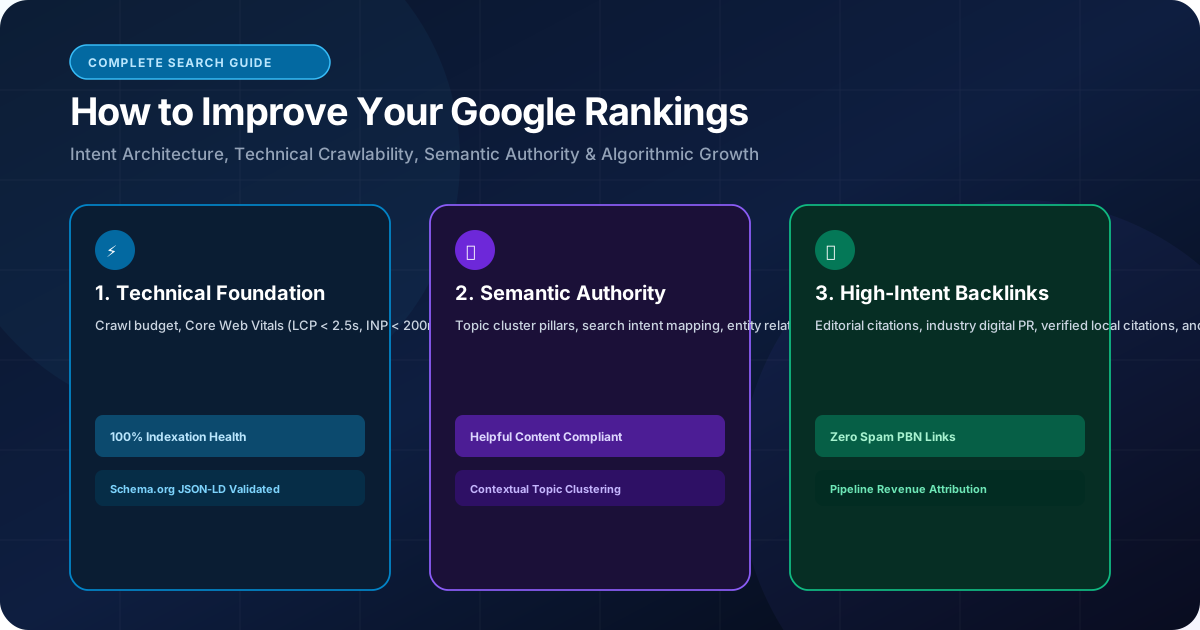
How to Improve Your Google Rankings: A Complete SEO Guide for Businesses
Learn how to improve Google rankings with this complete SEO guide for businesses. Discover proven strategies for technical SEO, content quality, and backlinks.
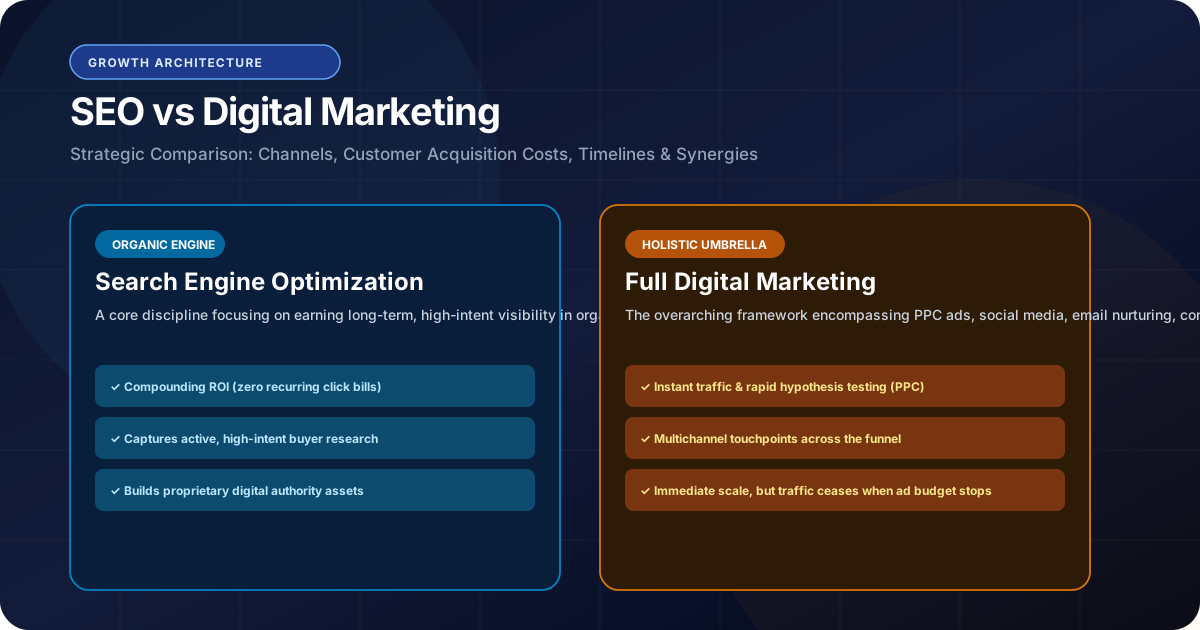
SEO vs Digital Marketing: What's the Difference and Which Does Your Business Need?
Understand SEO vs digital marketing. Learn the differences in cost, timelines, and strategy, and discover which approach drives the highest ROI for your business.
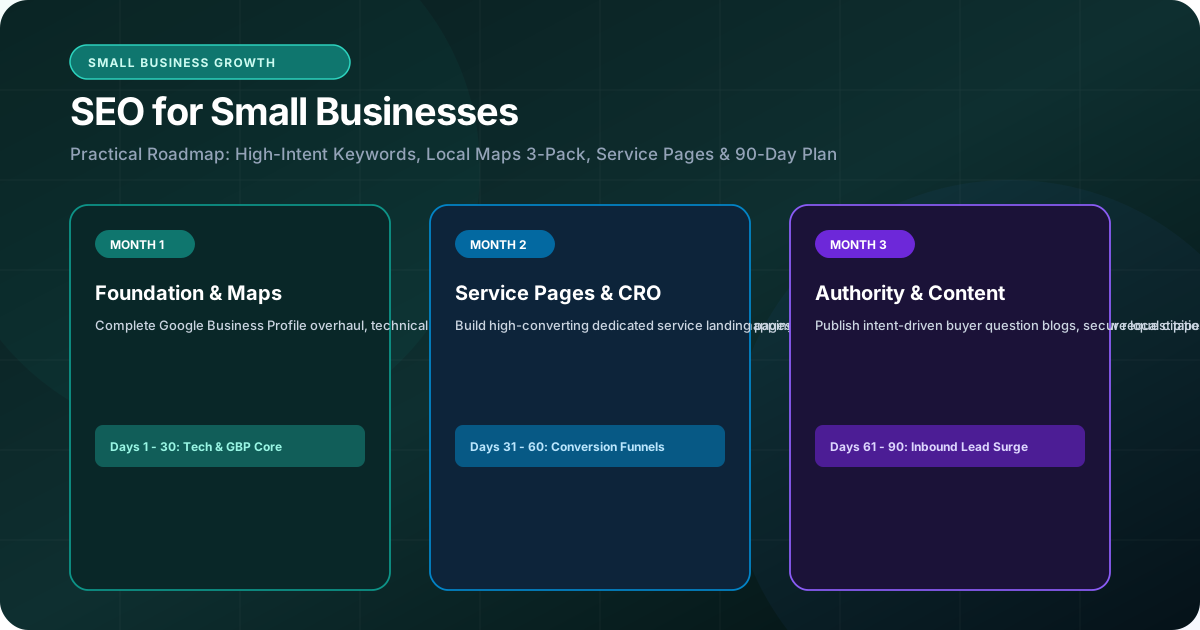
SEO for Small Businesses: A Practical Strategy to Get More Customers from Google
Discover a practical, affordable SEO strategy for small businesses. Follow our 90-day plan to optimize Google Business Profile, rank for local searches, and get leads.

Technical SEO Checklist: 25 Critical Fixes for Your Website
Use this comprehensive 25-point technical SEO checklist to fix crawl errors, optimize Core Web Vitals, resolve indexation issues, and boost Google rankings.