
SEO for Small Businesses: A Practical Strategy to Get More Customers from Google
A founder's step-by-step roadmap to winning high-intent local and commercial searches without enterprise budgets.

- 1. Why SEO Is the Highest-ROI Channel for Small Businesses
- 2. Pragmatic Keyword Research on a Modest Budget
- 3. Dominating Local Search & Google Business Profile
- 4. Building Dedicated, High-Converting Service Pages
- 5. Pragmatic Blogging: Answering Customer Buying Questions
- 6. Automated Review Acquisition & Local Citations
- 7. Lead Attribution: Tracking Phone Calls, Forms & WhatsApp
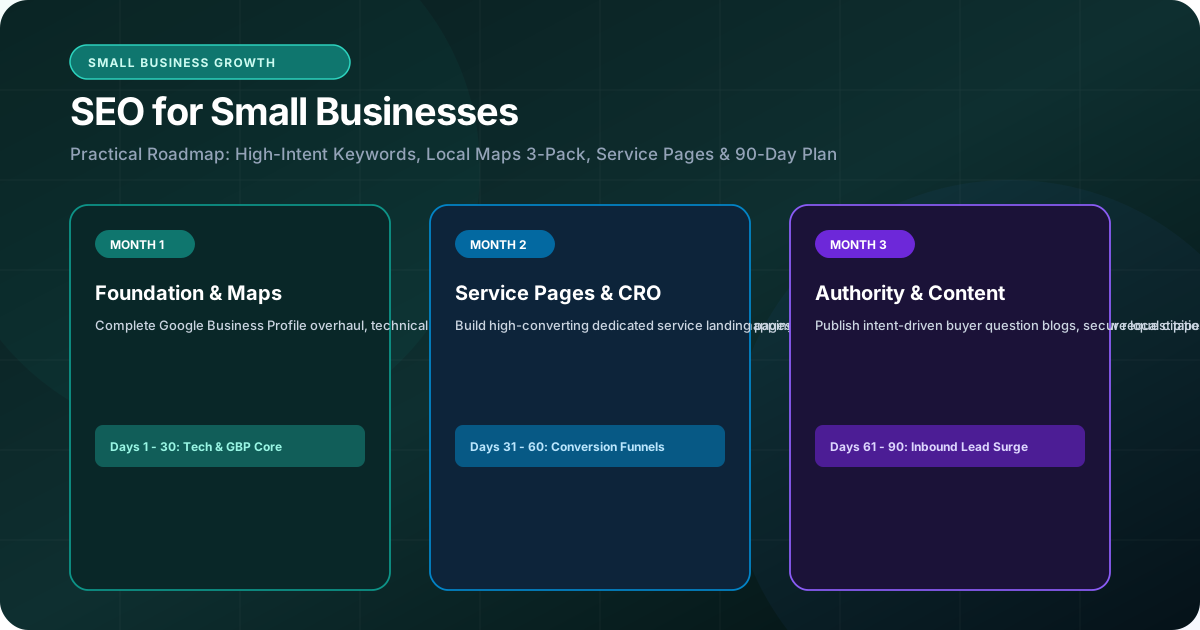
- 8. The 90-Day Small Business SEO Action Plan
For small business owners, allocating marketing capital is a high-stakes challenge. Unlike massive corporations with eight-figure advertising budgets, small businesses cannot afford to pour endless cash into escalating Google Ads pay-per-click auctions or vanity social media campaigns that produce zero sales. Fortunately, Google search does not simply award top rankings to the company with the deepest pockets. Through strategic local optimization, high-intent keyword targeting, and authoritative technical execution, small and mid-sized enterprises can routinely outrank established corporate giants in regional and specialized commercial searches. This guide cuts through the technical jargon to deliver a lean, actionable small business SEO strategy and a realistic 90-day implementation plan designed to turn Google into your most profitable sales channel.
SEO for small businesses is a targeted growth strategy designed to capture high-intent local and regional search queries without competing head-to-head with multi-million-dollar enterprise budgets. By dominating the Google Maps 3-Pack, building dedicated service pages for specific offerings, publishing customer buying guides that answer real commercial questions, and maintaining a steady flow of verified customer reviews, small businesses can achieve compounding inbound customer acquisition.
1. Why SEO Is the Highest-ROI Channel for Small Businesses
Building proprietary organic equity vs renting expensive ad space
Every small business owner understands the frustration of paid advertising: the moment you pause your ad budget, your customer inquiries drop to zero immediately. You are essentially renting visibility on someone else's platform.
In contrast, SEO for small businesses represents an investment in proprietary digital real estate. A well-optimized service page, an authoritative local presence, and an optimized Google Business Profile continue generating qualified customer phone calls and form inquiries month after month without recurring click fees.
Furthermore, organic search visitors exhibit vastly higher purchase intent. A prospect searching for 'commercial air conditioning installation contractor near me' or 'custom ERP software developers in Rajasthan' is not browsing casually—they have an immediate commercial need and are actively searching for a vendor.
Small businesses that consistently invest in search authority over 12 months regularly see their blended customer acquisition cost (CAC) drop by 40% to 60% compared to competitors who rely solely on paid advertising.
2. Pragmatic Keyword Research on a Modest Budget
Targeting high-intent long-tail keywords that competitors overlook
The most common mistake small business owners make is targeting ultra-competitive, broad keywords like 'accounting services' or 'web development'. Competing against multinational portals for generic terms wastes time and capital.
Instead, focus on long-tail keywords that combine specific service offerings with geographic modifiers or commercial intent phrases (e.g., 'payroll tax accountant for medical practices' or 'industrial marble fabrication exporter in Udaipur').
These long-tail phrases have lower search volume, but their conversion rates are exponentially higher because the searcher's intent is razor-sharp. Use free tools like Google Search Console, Google Autocomplete, and 'People Also Ask' to identify the exact questions prospective clients ask before hiring.
3. Dominating Local Search & Google Business Profile
Capturing the top 3 spots on Google Maps where 60%+ of calls happen
For brick-and-mortar stores, professional service firms, contractors, and regional providers, local SEO is the cornerstone of new customer acquisition.
Begin by thoroughly optimizing your Google Business Profile (GBP). Select the most accurate primary category, upload 15 to 20 authentic high-resolution photos of your team, facilities, and completed projects, and publish weekly updates highlighting current offers and case studies.
Ensure strict NAP (Name, Address, Phone) consistency across Tier-1 directories like Bing Places, Apple Maps, Yelp, and local trade directories. Inconsistent phone numbers or addresses confuse Google's algorithms and suppress your Maps ranking.
4. Building Dedicated, High-Converting Service Pages
Why a single generic 'Services' page is costing you thousands in lost sales
Many small business websites list all their services on a single, cluttered 'Our Services' page. This makes it impossible for Google to rank the page for any specific offering.
Create a dedicated, in-depth landing page for each distinct service you offer. For example, rather than a generic 'Dentistry' page, build individual pages for 'Teeth Whitening', 'Dental Implants', and 'Emergency Tooth Extraction'.
Each page must be engineered for conversion: clear headline stating the value proposition, verified customer testimonials, transparent pricing ranges, an embedded FAQ section, and prominent call-to-action buttons (including direct Click-to-Call and WhatsApp chat integration for mobile visitors).
5. Pragmatic Blogging: Answering Customer Buying Questions
Publishing pricing guides, comparisons, and process breakdowns
Small businesses should not write generic, superficial blog posts about industry news. Instead, adopt a pragmatic editorial strategy that directly addresses the questions, hesitations, and pricing considerations prospective clients evaluate before buying.
Write comprehensive articles such as: 'How Much Does [Service] Cost in [Year]?', '[Service A] vs [Service B]: Which Is Right for Your Company?', and '7 Things to Check Before Hiring a [Service Provider]'.
These decision-stage articles attract prospects in the final evaluation phase of their buying journey, positioning your business as a trusted, transparent authority.
6. Automated Review Acquisition & Local Citations
Building a customer feedback engine that algorithms reward
Customer reviews are both a critical Google ranking factor and the ultimate trust trigger. A steady velocity of authentic 5-star reviews signals to Google that your business is active, reliable, and popular.
Implement a frictionless post-service review request process. Send a personalized SMS or WhatsApp message immediately after delivering an excellent service with a direct link to your Google review submission form.
Always reply to every review received. Thank positive reviewers and address negative feedback with professionalism and a genuine desire to resolve issues, demonstrating credibility to prospective buyers reading your profile.
7. Lead Attribution: Tracking Phone Calls, Forms & WhatsApp
Focusing on verified inbound inquiries rather than vanity impressions
Vanity metrics like total page impressions or social shares do not pay payroll. Small businesses must configure rigorous conversion tracking in Google Analytics 4 (GA4) and Google Search Console.
Track three primary conversion actions: direct phone call clicks from mobile devices, completed contact form inquiries, and direct WhatsApp chat initiations.
By attributing these inbound inquiries to the specific landing pages or blog posts that generated them, you know precisely which marketing assets produce paying clients and where to allocate future optimization efforts.
8. The 90-Day Small Business SEO Action Plan
A realistic, structured three-month roadmap to revenue growth
Follow this phased 90-day implementation plan to build an enduring organic customer acquisition engine.
| Phase / Month | Strategic Focus | Core Action Items | Expected Milestones |
|---|---|---|---|
| Month 1 (Days 1–30) | Technical & GBP Foundation | • Audit & claim Google Business Profile • Fix mobile speed & SSL errors • Resolve NAP directory inconsistencies • Set up GA4 & Search Console tracking | Profile verified; baseline tracking live; technical crawl errors resolved |
| Month 2 (Days 31–60) | Service Pages & Conversion Tuning | • Build dedicated individual service pages • Implement LocalBusiness Schema markup • Add Click-to-Call & WhatsApp hooks • Launch automated review request SMS | Service pages indexed; initial review velocity established; mobile inquiries begin |
| Month 3 (Days 61–90) | Content Authority & Citations | • Publish 3–4 high-intent buyer guides • Secure local Chamber of Commerce citation • Interlink blog guides to service pages • Optimize for Google Maps 3-Pack signals | Google Maps rankings improve; impressions surge; compounding inbound leads accelerate |
The Bottom Line & Next Steps
SEO is the great equalizer for small businesses. By focusing on technical soundness, dominating local search signals, building high-converting individual service pages, and addressing prospective buyers' real purchasing questions, small companies can consistently outperform competitors with ten times their marketing budget. At RankVRA, we engineer custom SEO blueprints and high-performance websites specifically tailored to help small and growing enterprises scale inbound customer inquiries. If you are ready to stop wasting money on empty promises and start generating verified leads from Google, request a free growth strategy session with RankVRA today.
Questions Business Leaders Ask About SEO for small businesses
Can a small business really compete with large corporations in Google search?▾
Yes, absolutely. In localized searches ('near me' or city-specific queries) and specialized long-tail commercial queries, Google heavily favors local relevance, proximity, and authentic customer reviews over broad corporate brand size.
How much does SEO cost for a typical small business?▾
Affordable, professional small business SEO typically ranges between $1,000 and $3,000 per month (or ₹25,000 to ₹60,000 per month in India). Be cautious of dirt-cheap packages (under $200 / ₹5,000) as they rely on automated spam tactics that can trigger algorithmic penalties.
How soon can a small business expect leads from SEO?▾
Most small businesses begin seeing initial local phone calls and form inquiries within 60 to 90 days following Google Business Profile optimization and technical fixes. Compounding organic traffic growth generally matures between months 4 and 9.
Is blogging necessary for small business SEO?▾
Blogging is essential when it directly answers commercial customer buying questions, compares service options, or explains pricing. Generic 'lifestyle' or news blogging is ineffective; pragmatic, customer-focused content builds topical authority that drives sales.
What is the biggest SEO mistake small businesses make?▾
The single biggest mistake is targeting broad, unrealistic keywords while neglecting local Google Business Profile optimization and failing to build dedicated, conversion-focused individual service pages.
How does RankVRA support small business growth?▾
RankVRA provides lean, high-impact search strategies: we optimize your Google Maps presence, engineer lightning-fast modern websites, and build conversion-focused content assets designed to generate qualified inbound customer inquiries.

Written by Naveen Panchal
AuthorFounder & Lead Technical Architect, RankVRA
Naveen Panchal is the Founder and Technical Director of RankVRA. He specializes in full-stack web engineering, Next.js architecture, and algorithmic search optimization for high-growth enterprises.
Explore Core Commercial Capabilities
Targeted organic search optimization engineered for regional and growing enterprises.
Dominate the Google Maps 3-Pack and capture high-intent local customer calls.
Request an actionable analysis of your small business's search potential and ranking gaps.
- Google Search Central: Google Search Central: SEO Starter GuideOfficial Reference
- Google: Google for Small Business ResourcesOfficial Reference
- U.S. SBA: U.S. Small Business Administration: Marketing GuideOfficial Reference
Ready to Turn Google into Your #1 Customer Acquisition Channel?
Stop relying on unpredictable word-of-mouth or expensive ad clicks. Let RankVRA build a custom, affordable SEO roadmap designed to generate consistent, qualified customer inquiries for your small business.
Related Growth Blueprints
Explore more strategic articles from the RankVRA engineering desk.
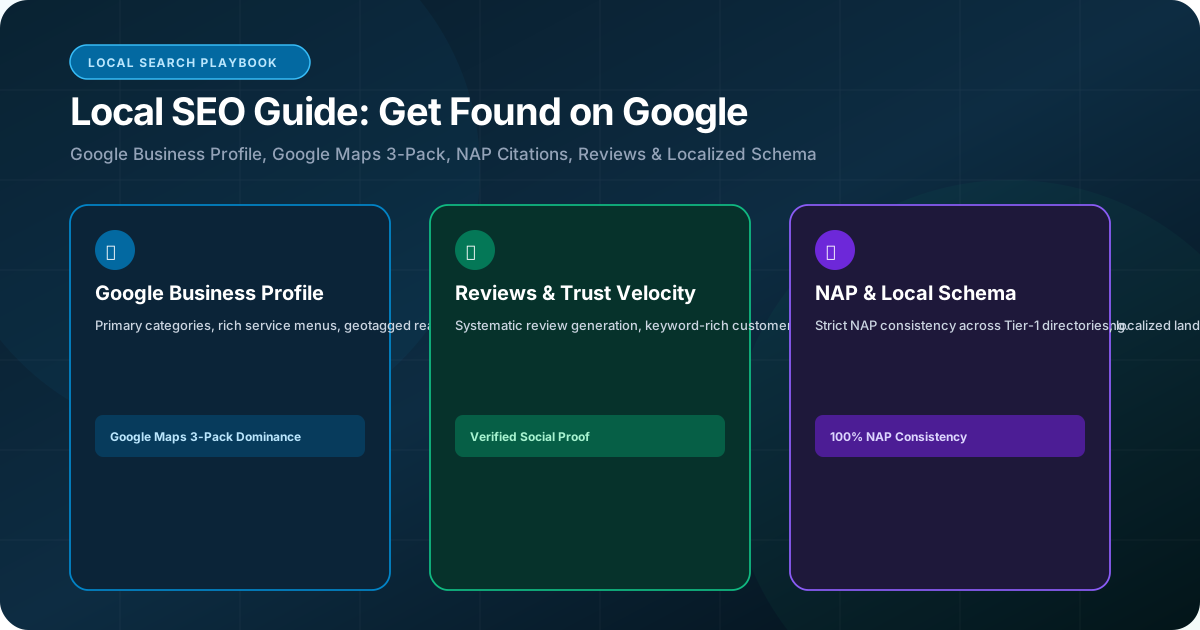
Local SEO Guide: How to Get Your Business Found on Google Maps & Search
Master local SEO with this comprehensive guide. Learn how to optimize your Google Business Profile, build local citations, and rank in the Google Maps 3-Pack.
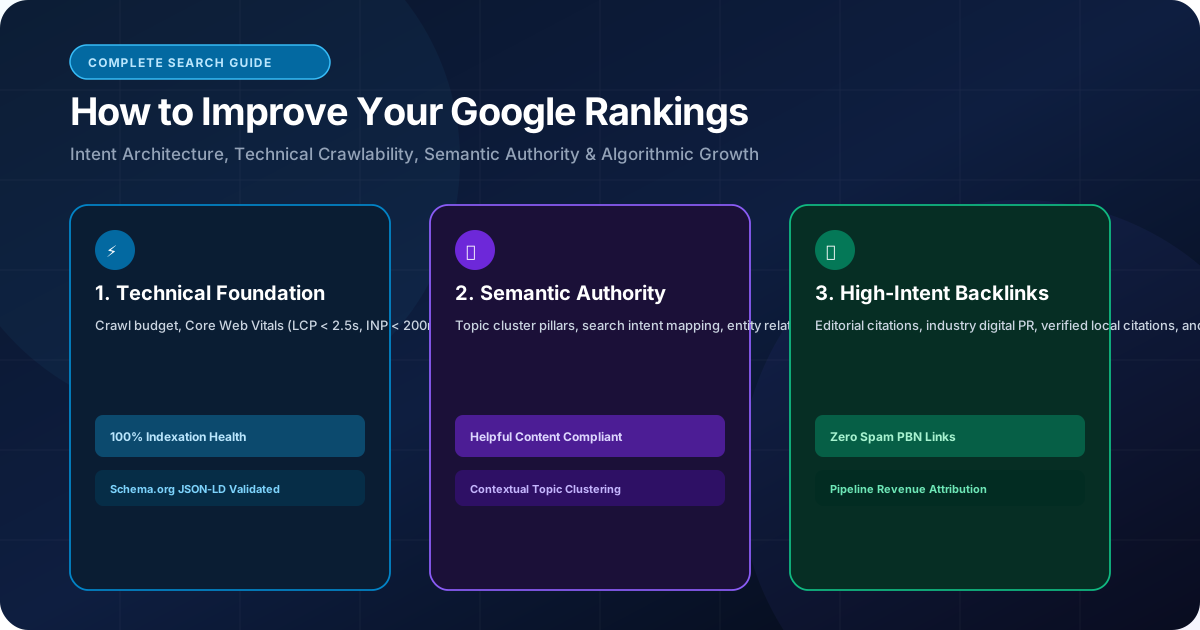
How to Improve Your Google Rankings: A Complete SEO Guide for Businesses
Learn how to improve Google rankings with this complete SEO guide for businesses. Discover proven strategies for technical SEO, content quality, and backlinks.
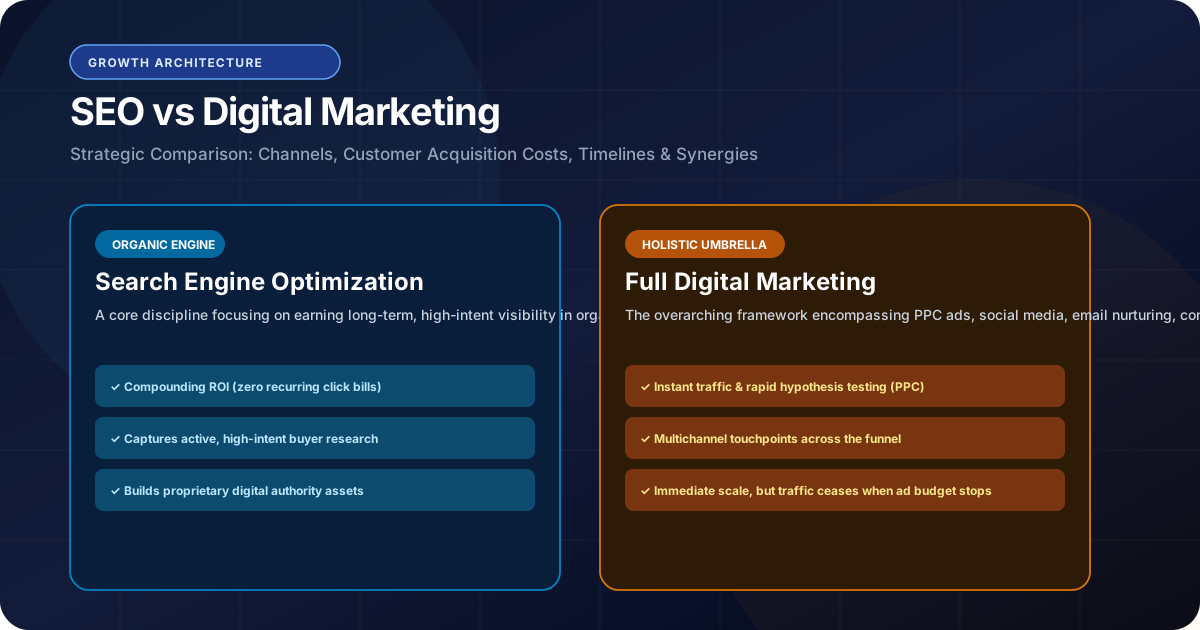
SEO vs Digital Marketing: What's the Difference and Which Does Your Business Need?
Understand SEO vs digital marketing. Learn the differences in cost, timelines, and strategy, and discover which approach drives the highest ROI for your business.
How to Choose the Right SEO Agency for Your Business: The Complete Selection Guide
Learn how to choose the right SEO agency for your business. Discover the essential questions to ask, dangerous red flags to avoid, and realistic pricing models.