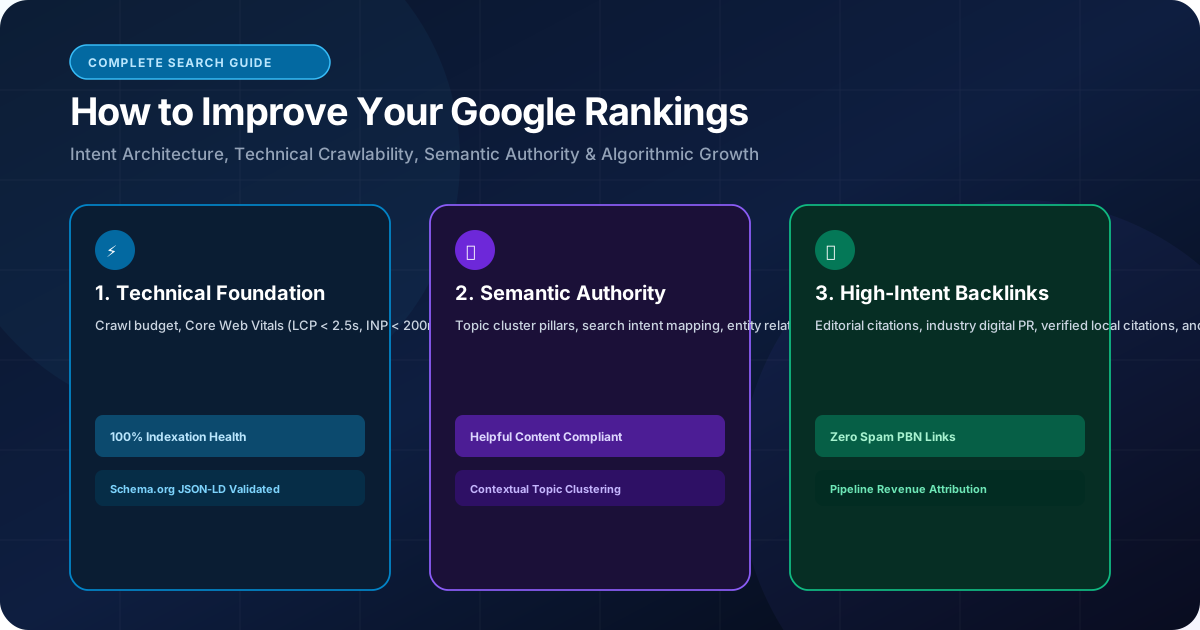
How to Improve Your Google Rankings: A Complete SEO Guide for Businesses
A founder's master blueprint for mastering search intent, Core Web Vitals, semantic authority, and technical crawlability to rank higher on Google.

- 1. How Google Search Ranking Actually Works in 2026
- 2. Intent-Driven Keyword Research & Entity Mapping
- 3. On-Page SEO Architecture & Semantic Signals
- 4. Technical SEO Infrastructure & Core Web Vitals
- 5. Content Quality, Topical Authority & E-E-A-T
- 6. Internal Linking & Strategic PageRank Distribution
- 7. Sustainable Backlink Acquisition vs Spam Networks
- 8. Realistic SEO Timelines & Lead Attribution
Every day, millions of prospective buyers turn to Google searching for solutions to their most urgent business problems. Yet, most company websites remain virtually invisible on page 3 or 4 of the Search Engine Results Pages (SERPs), losing qualified inquiries to competitors with superior organic positioning. Improving your website ranking is not about gaming an algorithm with secret hacks or pumping out hundreds of generic AI-generated articles. In modern search, Google operates via sophisticated neural matching, entity recognition models, and helpful content evaluations that reward genuine expertise and technical excellence. This comprehensive guide walks you step-by-step through the exact framework required to rank higher on Google, capture qualified organic traffic, and convert that visibility into high-value pipeline revenue for your business.
To improve Google rankings, businesses must execute across four interconnected pillars: establish flawless technical crawlability (fast TTFB, valid canonicals, Core Web Vitals compliance), map content strictly to user search intent with deep topical clusters, demonstrate genuine E-E-A-T (Experience, Expertise, Authoritativeness, Trustworthiness), and acquire high-intent editorial backlinks through digital PR rather than automated link networks.
1. How Google Search Ranking Actually Works in 2026
Understanding the journey from crawling and rendering to semantic indexing
Before you can improve search engine rankings, you must understand the mechanical pipeline Google uses to discover, evaluate, and rank web pages. The process begins with automated crawlers known as Googlebot traversing the web by following links, reading robots.txt rules, and parsing XML sitemaps.
Once raw HTML is fetched, Google's Web Rendering Service (WRS) processes client-side JavaScript, executes stylesheets, and constructs the visual Document Object Model (DOM). After rendering, Google extracts semantic entities, examines page metadata, and indexes the content within its massive Caffeine index. When a user submits a query, algorithms like RankBrain, BERT, and MUM evaluate hundreds of Google ranking factors in milliseconds to present the most helpful, authoritative, and frictionless result.
Many businesses mistakenly treat SEO as a checklist of isolated tasks. In reality, modern Google SEO is a holistic digital engineering ecosystem. If your server response time is delayed, your crawl budget suffers. If your content fails to address user search intent, bounce rates soar. Winning on Google demands continuous alignment across technical hygiene, editorial depth, and user trust.
Google no longer matches queries solely by exact keyword repetition. Instead, its natural language models map relationships between 'entities' (people, places, concepts, technologies). To rank higher, your content must comprehensively cover the related subtopics, terminology, and real-world questions that define the subject.
2. Intent-Driven Keyword Research & Entity Mapping
Moving beyond search volume to identify commercial buyer intent
Traditional keyword research focused almost exclusively on high search volume. Business owners targeted broad, generic terms like 'software' or 'marketing agency', only to discover that ranking for these terms was either impossible or generated visitors who immediately bounced without converting.
Modern SEO strategies begin with decoding search intent. Google classifies user intent into four primary buckets: Informational (learning how something works), Commercial Investigation (comparing platforms, pricing, and vendors), Transactional (ready to buy or request a quote), and Navigational (seeking a specific brand URL). Ranking higher on Google requires matching the exact format the searcher expects—whether that is an in-depth guide, an interactive calculator, a comparison table, or a dedicated service page.
When conducting keyword research, prioritize long-tail variations that reflect urgent commercial need. For instance, while 'SEO' is saturated, phrases like 'how to improve Google rankings for B2B website' or 'technical SEO audit checklist' attract decision-makers actively evaluating professional solutions.
- Analyze the top 5 ranking URLs on Google to identify whether the prevailing intent is a step-by-step tutorial, product page, or tool.
- Identify semantic keyword co-occurrences, including synonyms, parent categories, and industry-standard technical specifications.
- Examine Google's 'People Also Ask' (PAA) and 'Related Searches' to uncover real questions prospective clients are asking during their evaluation journey.
- Map primary and secondary keywords to specific URLs within your site architecture to prevent keyword cannibalization.
3. On-Page SEO Architecture & Semantic Signals
Structuring titles, headings, and copy for both humans and search engines
On-page SEO transforms your keyword research into structured, scannable web pages that communicate unambiguous topical relevance to search crawlers. Your title tag remains one of the single most influential on-page Google ranking factors. Keep your title within 50 to 60 characters, position your primary keyword near the beginning, and include a compelling value proposition that maximizes organic Click-Through Rate (CTR).
Maintain strict heading hierarchy. Every page must feature exactly one H1 tag defining the primary topic, followed by logical H2 sections and nested H3 subheadings. Never skip heading levels for visual styling; use CSS classes to control typography while keeping your HTML semantic tree pristine.
Incorporate your primary keyword naturally within the first 100 words of your introduction, within your descriptive URL slug (e.g., `/blogs/how-to-improve-google-rankings`), and throughout image alt attributes. Avoid archaic keyword stuffing, which triggers algorithmic spam filters and destroys reader trust.
| HTML Element | Optimal Length | SEO Objective | Best Practice |
|---|---|---|---|
| Title Tag | 50–60 characters | Primary ranking signal & SERP CTR hook | Front-load primary keyword; include brand suffix |
| Meta Description | 150–160 characters | Click-through inducement | Summarize unique value; incorporate primary keyword naturally |
| H1 Heading | One per page | Defines the core topical entity | Align with title tag intent; avoid generic headings |
| URL Slug | 3–6 words | Crawl clarity & link sharing | Lowercase, hyphen-separated, clean of stop words |
| Image Alt Text | 4–10 words | Accessibility & image search ranking | Describe visual content contextually without stuffing |
4. Technical SEO Infrastructure & Core Web Vitals
Why search engines refuse to rank slow, unstable, or uncrawlable websites
You cannot out-write a broken website architecture. Even the most insightful content will fail to rank if search engine bots struggle to crawl your pages or if users abandon your site due to sluggish performance. Technical SEO is the structural engineering foundation upon which all organic rankings depend.
Google has made page experience an explicit ranking signal through Core Web Vitals. The three critical metrics every web team must monitor include Largest Contentful Paint (LCP < 2.5s), which measures perceived loading speed; Interaction to Next Paint (INP < 200ms), which tracks page responsiveness to user clicks; and Cumulative Layout Shift (CLS < 0.1), which evaluates visual stability during page render.
Furthermore, modern technical SEO requires clean server-side rendering (SSR) or static generation using frameworks like Next.js, an error-free XML sitemap submitted to Google Search Console, robust HTTPS encryption, and self-referencing canonical tags to eliminate duplicate content issues.
Heavy client-side JavaScript single-page apps (SPAs) often delay Google's rendering queue by days or weeks. Transitioning to server-rendered architectures like Next.js guarantees that search bots receive fully populated HTML on the first request, maximizing crawl efficiency.
5. Content Quality, Topical Authority & E-E-A-T
Complying with Google's Helpful Content System and Quality Evaluator Guidelines
Google's Helpful Content System and core algorithmic updates have permanently altered the content landscape. In the past, companies could churn out surface-level 500-word blog posts targeting individual keywords and achieve short-term rankings. Today, Google actively demotes content written primarily for search engines rather than humans.
To build enduring topical authority, your website must demonstrate E-E-A-T: Experience (first-hand, real-world execution), Expertise (verifiable technical depth), Authoritativeness (industry recognition and citations), and Trustworthiness (transparent authorship, secure infrastructure, and accurate sourcing).
Rather than creating isolated articles, organize your knowledge into topic clusters. A comprehensive pillar page covers the broad topic, while interlinked cluster articles dive deep into specialized subtopics. When Google observes that your domain provides thorough, authoritative answers across an entire subject domain, your domain authority accelerates across all related queries.
6. Internal Linking & Strategic PageRank Distribution
Guiding both users and search spiders through contextual link architecture
Internal links are one of the most underutilized levers in website SEO. While external backlinks provide raw domain equity, your internal link architecture controls how that equity (PageRank) circulates throughout your website, signaling to Google which pages are the most commercially critical.
Avoid generic anchor text like 'click here' or 'read more'. Instead, use descriptive, keyword-rich anchor text that clearly informs both search engines and users about the destination page's topic. For instance, linking contextually to a local SEO guide or a technical SEO checklist reinforces semantic relevance for both assets.
Ensure that high-converting service landing pages receive prominent internal links from your navigation header, footer, and relevant informational blog posts. Routinely audit your site for orphan pages—valuable URLs that have no internal links pointing to them and are therefore effectively invisible to search engine crawlers.
7. Sustainable Backlink Acquisition vs Spam Networks
Building real digital PR, editorial citations, and brand mentions
Backlinks remain one of Google's foundational ranking signals, functioning as third-party votes of confidence. However, the quality of your link profile matters infinitely more than sheer volume. A single editorial backlink from an established industry publication or university carries vastly more algorithmic weight than hundreds of directory spam links.
Avoid low-cost link schemes, private blog networks (PBNs), and automated link-building services. Google's SpamBrain AI system routinely detects and neutralizes unnatural link patterns, and severe algorithmic or manual penalties can wipe out a website's organic visibility overnight.
Sustainable backlink acquisition relies on creating linkable assets—original industry research, authoritative frameworks, technical benchmarks, and insightful tools that other journalists, developers, and bloggers naturally reference as authoritative sources.
- Produce proprietary data studies, industry survey reports, and technical benchmarks that naturally attract editorial citations.
- Engage in targeted digital PR by contributing expert quotes, architectural insights, and commentary to reputable industry publications.
- Partner with authorized vendor directories, client ecosystem portals, and verified trade associations to secure contextual business citations.
- Reclaim broken links and unlinked brand mentions by reaching out to webmasters with helpful resource replacements.
8. Realistic SEO Timelines & Lead Attribution
How long SEO takes to produce measurable commercial revenue
One of the most frequent questions business executives ask is: 'How long does SEO take to produce results?' Unlike paid advertising, which generates immediate traffic that evaporates the moment ad budgets cease, SEO is an investment in compounding digital equity.
For a new domain or a website overcoming technical debt, noticeable movement in search impressions and keyword rankings typically begins between months 2 and 4. Meaningful organic traffic growth and qualified commercial inquiries generally materialize between months 4 and 9, with substantial compounding returns flourishing in months 10 through 18.
Measure your progress using Google Search Console and Google Analytics 4 (GA4). Focus on metrics that reflect true commercial impact: organic pipeline revenue, qualified form submissions, scheduled discovery calls, and Click-to-Call conversions—not merely vanity keyword positions.
Configure GA4 custom events for contact form completions, WhatsApp chat initiations, and whitepaper downloads. Correlating organic landing page traffic with closed sales ensures your SEO strategy targets high-intent buyers rather than casual browsers.
The Bottom Line & Next Steps
Improving your Google rankings is a systematic discipline combining software engineering, content craftsmanship, and brand authority. By diagnosing technical bottlenecks, aligning every page with user search intent, demonstrating transparent E-E-A-T, and building a cohesive internal linking network, your business can consistently outrank competitors and capture high-margin inbound inquiries. If you want an expert evaluation of your website's search performance, RankVRA provides comprehensive technical audits and data-backed growth strategies engineered to scale your pipeline.
Questions Business Leaders Ask About how to improve Google rankings
How long does it typically take to see ranking improvements on Google?▾
Most businesses begin seeing measurable shifts in impressions and long-tail keyword rankings within 60 to 90 days. Significant organic traffic and commercial inbound inquiries typically materialize between months 4 and 9 as domain authority and indexation depth mature.
What are the most critical Google ranking factors in 2026?▾
The most impactful ranking factors include search intent fulfillment, Core Web Vitals performance (sub-second LCP and INP), mobile usability, high-quality editorial backlinks, comprehensive topical authority, and strong E-E-A-T signals across author profiles and technical citations.
Can I improve my Google rankings without building backlinks?▾
In low-competition local niches or hyper-specific long-tail queries, flawless technical SEO and exceptional content depth can achieve first-page rankings. However, for competitive commercial keywords, high-quality authoritative backlinks remain essential to outrank entrenched competitors.
Why did my website suddenly drop in Google rankings?▾
Sudden ranking drops typically stem from one of four causes: a Google Core Update penalizing low-effort or unhelpful content, technical errors (such as accidental noindex tags or broken canonicals), loss of critical backlinks, or aggressive new competitors out-optimizing your content.
What is the difference between on-page and technical SEO?▾
On-page SEO focuses on visible page elements and content relevance (title tags, heading hierarchy, keyword optimization, and copy depth), whereas technical SEO focuses on backend infrastructure (server response times, Core Web Vitals, crawl budget, robots.txt, XML sitemaps, and structured data).
How can I request a professional SEO audit for my business?▾
You can request a comprehensive, engineering-led website audit directly through RankVRA's Free Website Audit portal. Our technical team evaluates your codebase, crawl errors, Core Web Vitals, and search intent gaps to provide an actionable optimization roadmap.

Written by Naveen Panchal
AuthorFounder & Lead Technical Architect, RankVRA
Naveen Panchal is the Founder and Technical Director of RankVRA. He specializes in full-stack web engineering, Next.js architecture, and algorithmic search optimization for high-growth enterprises.
Explore Core Commercial Capabilities
- Google Search Central: Google Search EssentialsOfficial Reference
- Google Search Central: Creating Helpful, Reliable, People-First ContentOfficial Reference
- web.dev by Google: Core Web Vitals MetricsOfficial Reference
Ready to Accelerate Your Organic Google Rankings?
Stop guessing why your competitors are outranking you. Request a comprehensive technical SEO audit and bespoke growth blueprint from the search engineering specialists at RankVRA.
Related Growth Blueprints
Explore more strategic articles from the RankVRA engineering desk.

Technical SEO Checklist: 25 Critical Fixes for Your Website
Use this comprehensive 25-point technical SEO checklist to fix crawl errors, optimize Core Web Vitals, resolve indexation issues, and boost Google rankings.
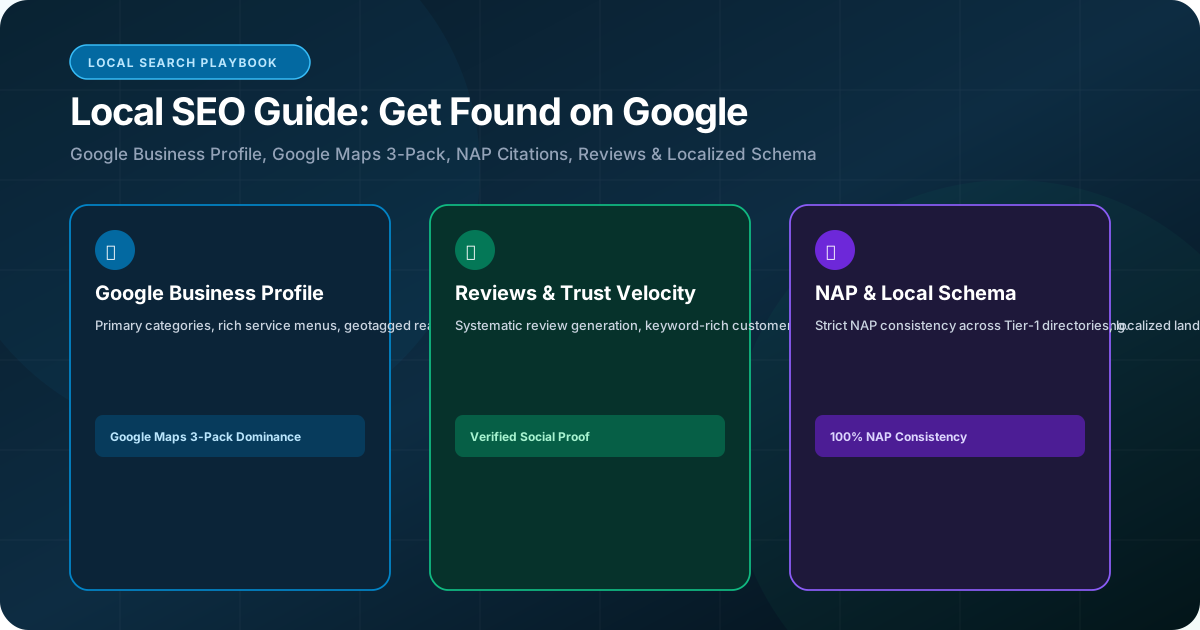
Local SEO Guide: How to Get Your Business Found on Google Maps & Search
Master local SEO with this comprehensive guide. Learn how to optimize your Google Business Profile, build local citations, and rank in the Google Maps 3-Pack.
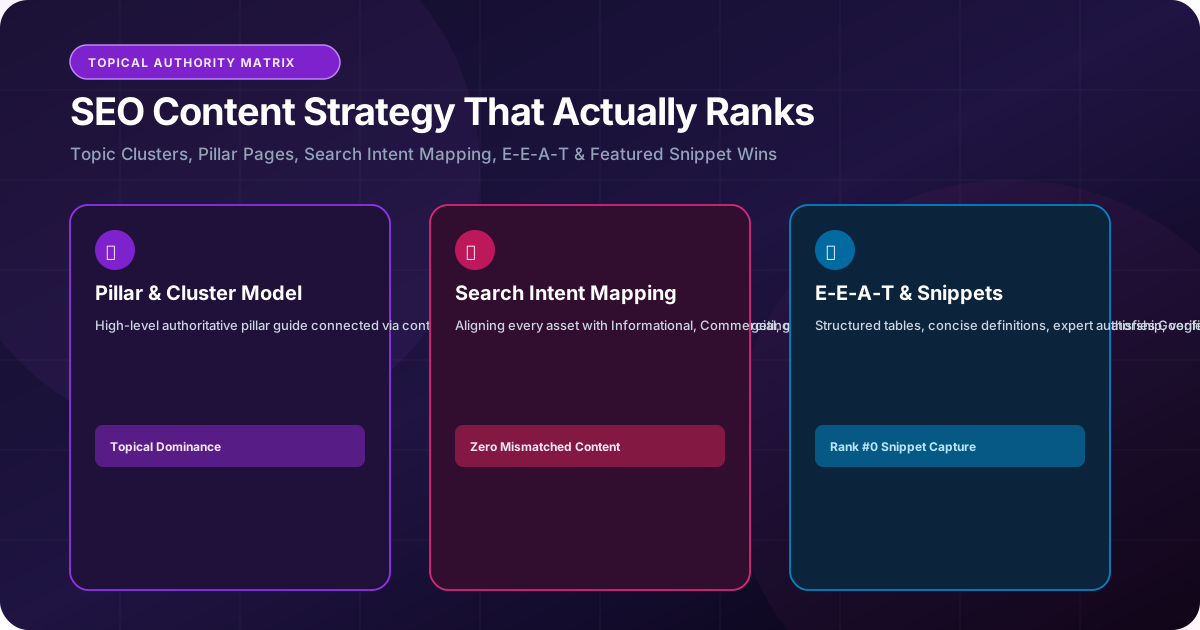
SEO Content Strategy: How to Create Content That Actually Ranks on Google
Learn how to build an SEO content strategy that ranks on Google. Master topic clusters, search intent mapping, pillar pages, and E-E-A-T authority.
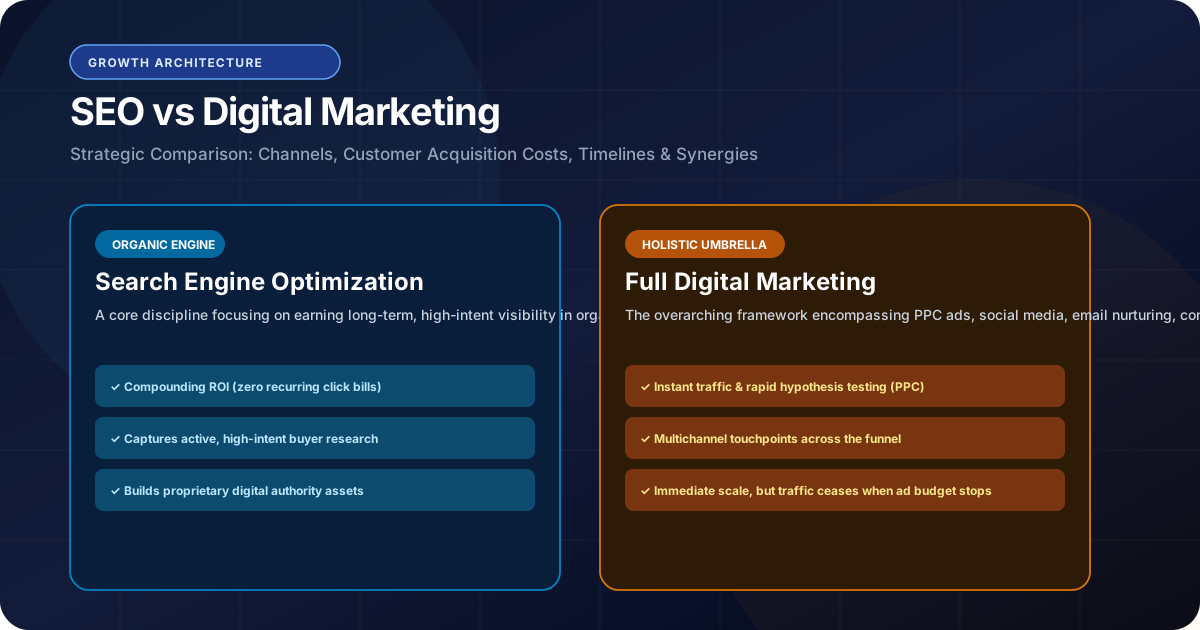
SEO vs Digital Marketing: What's the Difference and Which Does Your Business Need?
Understand SEO vs digital marketing. Learn the differences in cost, timelines, and strategy, and discover which approach drives the highest ROI for your business.