
eCommerce SEO India: The Ultimate Playbook to Scale Organic Revenue in 2026
How ambitious Indian D2C brands, Shopify stores, and multi-brand retailers outrank marketplace giants and scale profitable organic sales.

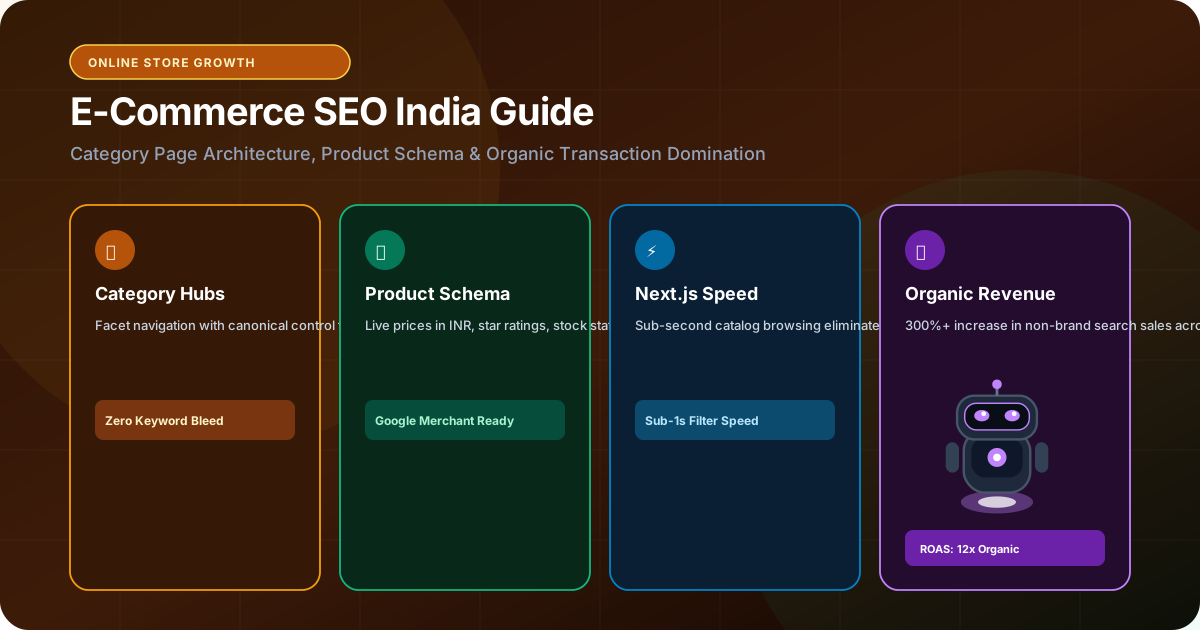
- 1. The Indian eCommerce Search Landscape: Brand vs Marketplace
- 2. Technical Architecture & Faceted Navigation Crawling
- 3. Product & Category Page Schema Markup (JSON-LD)
- 4. Outranking Amazon & Flipkart on High-Intent Queries
- 5. Speed & Core Web Vitals for Indian Mobile Shoppers
- 6. Measuring eCommerce SEO Revenue & Attribution
The Indian digital commerce ecosystem is experiencing explosive growth, projected to surpass $300 billion by 2030. Yet, for independent direct-to-consumer (D2C) brands and online store owners across India, running an eCommerce business has never been more expensive. Customer Acquisition Costs (CAC) on Meta Ads and Google Ads have surged by over 60% in the last three years, eating away operating margins. Relying solely on third-party marketplaces like Amazon, Flipkart, and Myntra strips brands of their customer data and subjects them to 20% to 35% platform commissions. The only sustainable path to defensible profitability is building a dominant, organic customer acquisition engine through high-performance eCommerce SEO. This comprehensive guide outlines the exact technical architecture, schema strategies, and keyword blueprints required to turn your store into an organic sales machine in 2026.
1. The Indian eCommerce Search Landscape: Brand vs Marketplace
Why direct customer acquisition is the only path to sustainable D2C profitability in India
Indian consumers are increasingly sophisticated searchers. While casual discovery often occurs on Instagram or marketplace homepages, high-intent purchase searches—especially for specialized apparel, organic wellness, luxury decor, ethnic fashion, and artisanal goods—take place on Google.
Marketplaces naturally dominate broad head terms like 'cotton shirts' or 'leather shoes' due to their astronomical domain rating and massive crawl budgets. However, high-margin, high-converting searches are increasingly long-tail and problem-centric. When a buyer searches for 'pure handblock print cotton kurtis for summer' or 'solid teak wood bedside tables Udaipur', dedicated brand stores with focused semantic authority consistently outrank generic marketplace listings.
Capturing these buyers on your own website doesn't just eliminate marketplace commissions—it gives you 100% of the customer relationship, enables repeat purchase retention via email/WhatsApp funnels, and increases company enterprise valuation.
- Rising paid ad CAC in India makes organic search retention the primary driver of e-commerce EBITDA.
- Third-party marketplaces retain customer ownership and restrict retargeting; your website builds compounding brand equity.
- Long-tail, solution-specific queries yield 3x to 5x higher purchase intent than generic category searches.
Don't fight Amazon on 'running shoes'. Win on 'barefoot wide-toe running shoes for road running India'. Specificity wins search intent and conversions every single time.
3. Product & Category Page Schema Markup (JSON-LD)
Winning rich snippets, pricing badges, and Google Merchant Center organic inclusions
Structured data is the primary bridge connecting your store's inventory with Google's shopping graph. Without proper schema markup, Google treats your product page as flat text rather than an actionable commercial entity.
Every single product URL must contain valid JSON-LD structured data incorporating @type: 'Product', with detailed nested 'offers' (@type: 'Offer'), 'aggregateRating', 'brand', 'sku', and 'hasMerchantReturnPolicy'.
When structured data is implemented flawlessly, your search listing transforms from a standard blue link into an eye-catching rich snippet displaying real-time pricing in INR (₹), in-stock availability, review star badges, and shipping details directly in search results, increasing click-through rate (CTR) by up to 40%.
| Schema Type | Required Properties | SERP Visual Benefit |
|---|---|---|
| Product Schema | name, image, description, sku, brand | Identifies product entity in Google Shopping Graph |
| Offer Schema | price, priceCurrency (INR), availability, priceValidUntil | Displays live price badge and 'In Stock' green status |
| AggregateRating | ratingValue, reviewCount, bestRating | Gold 5-star review rating badge beneath title |
| MerchantReturnPolicy | applicableCountry, returnPolicyCategory, returnFees | Displays 'Free 7-day returns' snippet directly on Google SERP |
| BreadcrumbList | itemListElement, position, name, item | Replaces messy URL strings with clean navigational trail |
4. Outranking Amazon & Flipkart on High-Intent Queries
How D2C stores beat corporate giants through deep topical authority and buyer education
Marketplaces have authority, but they lack soul, depth, and genuine editorial curation. Amazon's category pages are walls of unsorted thumbnails with generic bullet points scraped from supplier feeds.
To outrank marketplaces, your category pages must function as comprehensive buying guides. Supplement product grids with 300 to 500 words of expert editorial context explaining how to choose the right variant, sizing charts, fabric care instructions, and comparison tables.
Furthermore, create dedicated editorial comparison and styling guides that link internally to your collections. When an authoritative guide on 'How to Style Handcrafted Cotton Kurtis for Office Wear' ranks, it funnels qualified, purchase-ready readers directly into your product pages.
- Embed educational buying guides and sizing advice directly on collection category pages.
- Implement internal linking hubs connecting blog comparisons to commercial product collections.
- Collect and feature verified photo and video reviews that signal authentic customer satisfaction.
5. Speed & Core Web Vitals for Indian Mobile Shoppers
Converting 4G and 5G mobile traffic into instant checkout completions
Over 82% of eCommerce transactions in India originate from mobile devices. However, many mobile shoppers browse on mid-tier Android smartphones or fluctuating cellular network conditions.
If your store takes more than 2.5 seconds to load, bounce rates skyrocket past 50%. A slow website doesn't just lose sales—it suffers algorithmic ranking demotions under Google's Core Web Vitals mobile-first indexing guidelines.
Modern eCommerce engineering requires migrating away from bloated monolithic templates loaded with 30 separate Shopify apps. By adopting modern Next.js or headless storefront architectures, serving WebP/AVIF images with explicit dimensions, and streaming HTML from Indian edge nodes (Mumbai/Delhi), page load times drop to under 800 milliseconds, doubling mobile checkout conversions.
Key Strategic Takeaways
- Mobile-first load speeds under 1.5s are mandatory for high conversion rates in the Indian market.
- Minimize third-party tracking scripts, chat widgets, and popups that block the mobile browser main thread.
- Ensure checkout buttons and add-to-cart triggers sit within natural mobile thumb-reach zones.
6. Measuring eCommerce SEO Revenue & Attribution
Tracking first-click and multi-touch organic sales in Google Analytics 4
Measuring organic search solely by keyword rankings or sessions is a relic of the past. Modern eCommerce SEO must be measured by attributable top-line revenue, blended Customer Acquisition Cost, and Customer Lifetime Value (LTV).
Set up enhanced eCommerce conversion tracking in Google Analytics 4 (GA4) and Google Search Console. Analyze assisted conversions: frequently, a buyer discovers your brand via an organic search guide on Monday, reviews your Instagram page on Wednesday, and completes a purchase via a direct visit on Saturday.
When you accurately attribute revenue across the full purchase cycle, SEO consistently proves to be the highest-ROI marketing channel in your entire growth portfolio.
The Bottom Line & Next Steps
eCommerce SEO in India is not about keyword stuffing or buying cheap backlinks; it is an engineering discipline that harmonizes clean crawl architectures, structured data, sub-second speed, and deep commercial content. At RankVRA, we engineer high-performance eCommerce platforms and execute surgical organic growth campaigns for Indian brands looking to build lasting, profitable digital storefronts. Explore our web development services, discover our SEO blueprints, or request a Free Growth Audit today.
Questions Business Leaders Ask About eCommerce SEO India
Can an independent Indian D2C brand really outrank Amazon and Flipkart on Google?▾
Yes. While marketplaces dominate broad head terms, independent stores consistently outrank them for specific, long-tail commercial queries, problem-solving buyer guides, and specialized product niches by providing superior editorial content, rich schema markup, and focused topical authority.
How does faceted navigation harm my eCommerce website's SEO?▾
Faceted navigation allows users to filter by attributes like size or color. If every filter combination generates an indexable URL, it creates thousands of thin duplicate pages that deplete Google's crawl budget and dilute your domain authority. Proper canonicalization and robots directives resolve this issue.
How important is product schema markup for online stores in India?▾
Product schema (JSON-LD) is essential. It enables Google to display rich snippets including live pricing in INR (₹), in-stock availability, and gold review stars directly in search results, increasing search click-through rates by up to 35% to 40%.
Why should an eCommerce store choose Next.js over a standard Shopify theme?▾
Standard themes often suffer from heavy JavaScript bloat, slow server response times, and poor Core Web Vitals caused by numerous installed apps. A custom Next.js storefront pre-renders pages as static HTML on edge servers, achieving sub-second load times and superior mobile SEO rankings.

Written by Naveen Panchal
AuthorFounder & Lead Technical Architect, RankVRA
Naveen Panchal is the Founder and Technical Director of RankVRA. He specializes in full-stack web engineering, algorithmic search optimization, and performance funnels for hospitality, manufacturing, and local service enterprises across Rajasthan and internationally.
Want to implement these strategies for your business?
RankVRA engineers high-speed web platforms, localized Google Maps dominance, and algorithmic SEO funnels that turn searchers into long-term clients.
Related Growth Blueprints
Explore more strategic articles from the RankVRA engineering desk.
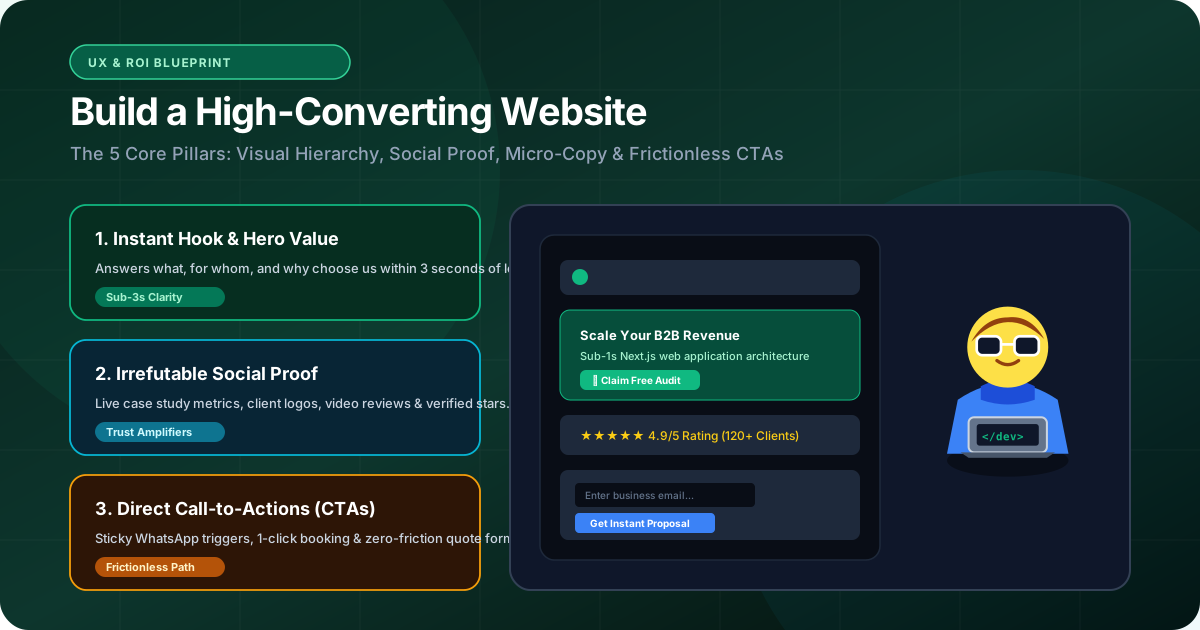
How to Build a High-Converting Website: The Blueprint That Turns Google Traffic Into Paying Customers
Learn how to build a high-converting website from scratch. Discover the exact engineering, UX design, copy structure, and speed optimizations that convert traffic into revenue.
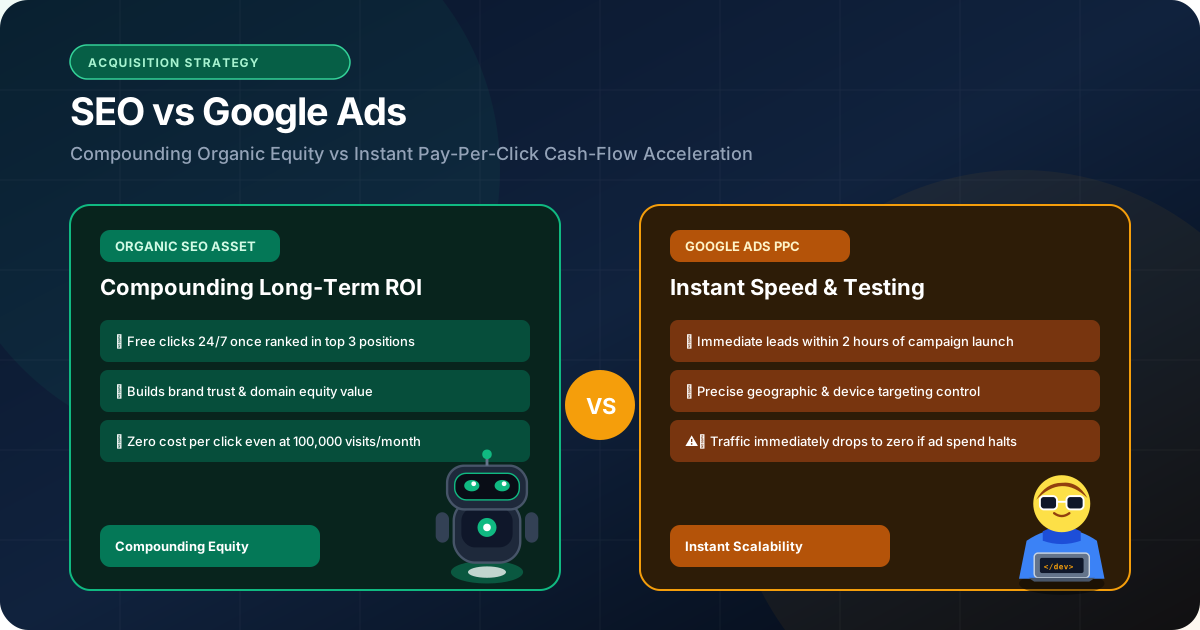
SEO vs Google Ads: Which Strategy Generates Higher ROI for Your Business? (2026 Comparison)
Struggling to choose between SEO and Google Ads? Compare costs, revenue timelines, customer acquisition economics, and learn how to run both in synergy for maximum ROI.
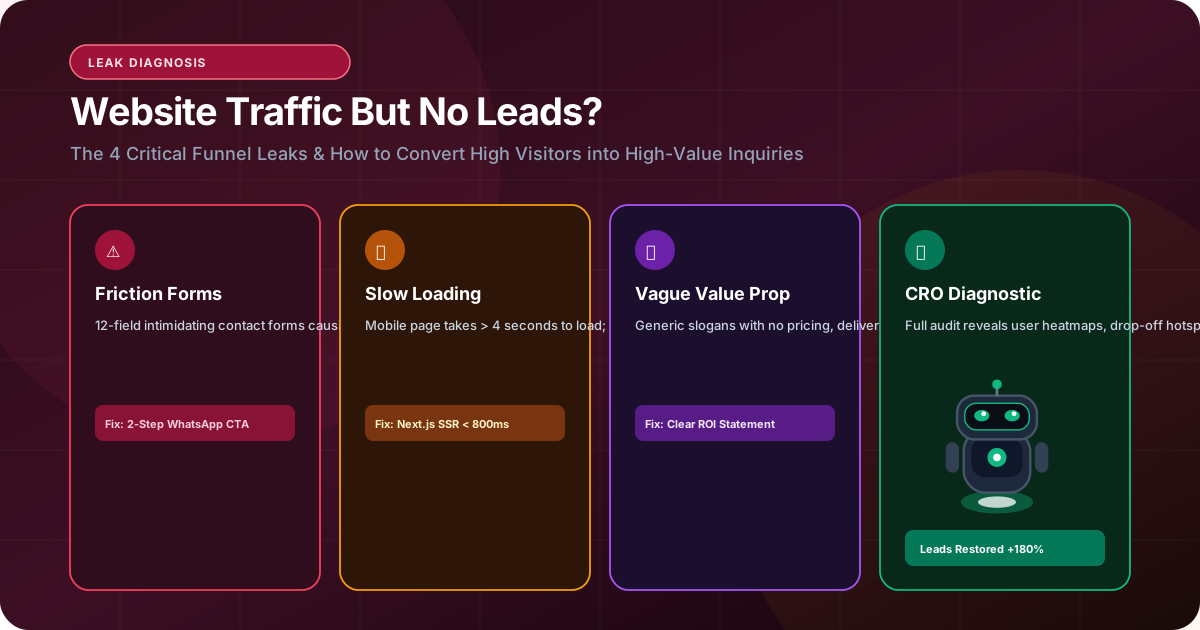
Why Your Website Gets Traffic but No Leads: 10 Conversion Fixes That Generate Inquiries
Experiencing steady website traffic but zero leads? Discover the top 10 conversion leaks—from slow mobile LCP to intimidating forms—and learn the exact fixes to drive inquiries.