
SEO vs Google Ads: Which Strategy Generates Higher ROI for Your Business? (2026 Comparison)
An executive guide comparing organic search engine optimization and Google Ads pay-per-click (PPC) advertising to help you allocate your marketing budget with maximum profitability.

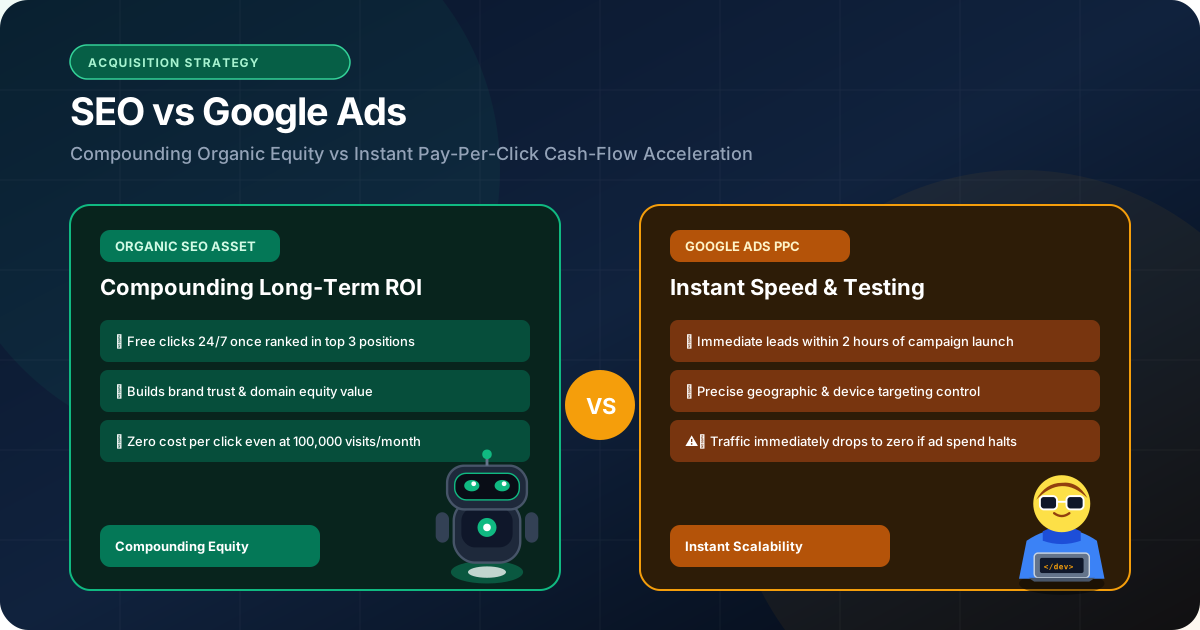
- 1. The Search Marketing Dilemma: Renting vs Owning Traffic
- 2. Head-to-Head Comparison: SEO vs Google Ads
- 3. When Google Ads (PPC) Is the Superior Choice
- 4. When Organic SEO Is the Superior Long-Term Investment
- 5. Customer Acquisition Cost (CAC) Curves Over 24 Months
- 6. The Search Arbitrage Model: How to Combine Both
Every business owner and marketing director evaluating customer acquisition channels eventually faces the core debate: 'Should we invest our budget into Search Engine Optimization (SEO) or pay-per-click Google Ads (PPC)?' Marketing agencies frequently take ideological positions. Performance ad agencies argue that SEO takes too long, while traditional SEO firms claim paid advertising is a waste of money because clicks vanish the moment you stop paying. The reality is far more pragmatic. SEO and Google Ads are not opposing philosophies; they are distinct financial instruments designed for different stages of business growth. Deciding between them depends on your cash flow runway, timeline requirements, and customer lifetime value. This comprehensive guide breaks down the economic trade-offs of both channels and explains how leading companies combine them to dominate search results.
1. The Search Marketing Dilemma: Renting vs Owning Traffic
The fundamental economic distinction between paid and organic acquisition
The simplest way to understand the economic distinction between Google Ads and SEO is the difference between renting and owning an asset.
Google Ads is renting traffic. You pay Google every time a user clicks on your link. The moment you pause your daily ad budget, your website traffic and lead flow drop to zero immediately. You build no permanent equity, but you can generate leads within 24 hours of launching a campaign.
SEO is building equity in a digital asset. Achieving top rankings requires upfront engineering, content development, and authority accrual. However, once your domain establishes topical authority, it generates high-intent visits and qualified inquiries day and night without paying for individual clicks. Over time, your effective cost-per-acquisition steadily decreases.
2. Head-to-Head Comparison: SEO vs Google Ads
An objective evaluation across key business metrics
Below is a direct comparison examining how each channel performs across core commercial dimensions.
| Evaluation Factor | Search Engine Optimization (SEO) | Google Ads (PPC) |
|---|---|---|
| Speed to Results | 3 to 6 months for compounding growth | Immediate (Within 24 to 48 hours of campaign launch) |
| Cost Dynamics | Fixed monthly retainer; marginal cost per click is ₹0 | Variable spend; you pay for every single click (CPC) |
| Long-Term Asset Value | Permanent digital equity and sustained authority | Zero residual value; traffic halts when ad budget stops |
| User Trust / Click Share | Captures ~65-70% of organic search clicks | Captures ~20-30% of commercial clicks; some users avoid ads |
| Testing Agility | Slow to test new offers (Requires re-indexing) | Rapid A/B testing of headlines, copy, and landing pages |
| Best For | Compounding customer acquisition and brand authority | Immediate promotions, seasonal spikes, and rapid testing |
3. When Google Ads (PPC) Is the Superior Choice
Scenarios where paid search provides an undeniable advantage
Immediate Cash Flow or Fast Turnaround Requirements: If you are launching a new enterprise or service that requires immediate sales inquiries within days to sustain operations, Google Ads is the only channel that can deliver qualified traffic instantly.
Highly Time-Sensitive Offers & Seasonal Demand: Hotels promoting a specific New Year Eve gala dinner in Udaipur, or retailers hosting a 5-day holiday clearance sale cannot wait four months for an SEO article to rank. Google Ads captures immediate intent.
Testing New Value Propositions: Running ₹20,000 worth of Google Ads allows you to test whether a new service offering or headline resonates with buyers before investing months of engineering and content resources into ranking organically.
- Immediate pipeline creation for newly established companies
- Hyper-targeted geographic bidding (down to specific neighborhoods or pin codes)
- Accurate validation of conversion rates and audience messaging
4. When Organic SEO Is the Superior Long-Term Investment
Scenarios where organic search delivers vastly superior ROI
High-CPC Keyword Sectors: In competitive industries—such as luxury hospitality, specialized legal counsel, enterprise software, and international B2B export—Google Ads cost-per-click can exceed ₹200 to ₹800+ per click. Paying those rates indefinitely erodes profit margins. Organic search captures those identical buyers at a fraction of the long-term cost.
Building Compounding Enterprise Value: When seeking funding, expanding, or eventually selling an enterprise, having an authoritative organic search presence that generates hundreds of organic leads each month significantly increases overall business valuation compared to a business reliant entirely on paid media.
High-Intent Research and Consideration Journeys: B2B buyers, resort guests, and patients conduct thorough research before purchasing. They read guides, compare alternatives, and seek authoritative perspectives where organic content builds deep credibility.
5. Customer Acquisition Cost (CAC) Curves Over 24 Months
The mathematical proof behind organic compounding
In Month 1 of an organic SEO campaign, your Customer Acquisition Cost (CAC) appears high because you are funding upfront technical architecture, audits, and content creation without immediate rankings.
However, by Month 12 and Month 24, as dozens of high-intent keywords achieve top-tier rankings, your traffic and lead volume multiply while your monthly retainer remains flat. Your effective acquisition cost per lead drops sharply.
With Google Ads, your cost per lead remains relatively constant (or increases as ad auction competition intensifies). Doubling your inquiries on Google Ads requires nearly doubling your ad spend.
6. The Search Arbitrage Model: How to Combine Both
How forward-thinking brands use paid search data to fuel organic search dominance
The most sophisticated businesses do not choose between SEO and Google Ads; they deploy them in synergy through a search arbitrage strategy:
Step 1: Launch targeted Google Ads to identify exactly which specific search terms generate actual paying customers versus tire-kickers.
Step 2: Take those verified, high-converting commercial search terms and develop authoritative, dedicated landing pages to rank for them organically through SEO.
Step 3: Once your domain achieves top 3 organic rankings for those terms, gradually reduce your paid ad bids on those exact keywords and reallocate that budget toward other experimental opportunities, permanently lowering your blended acquisition cost.
When your brand occupies both the #1 Google Ad spot and the #1 organic search result simultaneously, you capture over 50% of the entire page's click volume while signaling undisputed authority.
The Bottom Line & Next Steps
Choosing between SEO and Google Ads comes down to time horizon and capital efficiency. For immediate leads, Google Ads delivers quick results; for compounding profitability and sustainable margins, organic SEO is the ultimate digital asset. At RankVRA, we help ambitious businesses engineer both paid media campaigns and technical SEO strategies. Explore our Google Ads management services, check out our SEO solutions, or request a Free Growth Audit today.
Questions Business Leaders Ask About SEO vs Google Ads
Can I run Google Ads while building up our SEO foundation?▾
Yes, and this is frequently our recommended strategy for growing businesses. Google Ads provides immediate lead flow and generates valuable real-world conversion data that directly informs our long-term organic content and keyword strategy.
Does spending money on Google Ads help our website rank higher in organic search?▾
No. Google maintains an absolute algorithmic separation between paid ads and organic rankings. Spending budget on Google Ads will not artificially boost your organic position. However, the traffic and brand awareness generated can lead to indirect benefits like brand-name searches and natural citations.
What is the minimum budget recommended to test Google Ads effectively?▾
For local service businesses and regional enterprises in Rajasthan, we typically recommend a minimum ad spend of ₹25,000 to ₹45,000 per month for a 60-day test. This provides sufficient click volume to identify winning keywords, test ad copy, and optimize conversion funnels.
Which channel delivers a higher return on investment (ROI) over a 2-year period?▾
In almost all industries, organic SEO delivers a substantially higher ROI over a 24-month horizon because organic traffic compounds over time without incurring incremental cost-per-click charges on each visitor.

Written by Naveen Panchal
AuthorFounder & Lead Technical Architect, RankVRA
Naveen Panchal is the Founder and Technical Director of RankVRA. He specializes in full-stack web engineering, algorithmic search optimization, and performance funnels for hospitality, manufacturing, and local service enterprises across Rajasthan and internationally.
Want to implement these strategies for your business?
RankVRA engineers high-speed web platforms, localized Google Maps dominance, and algorithmic SEO funnels that turn searchers into long-term clients.
Related Growth Blueprints
Explore more strategic articles from the RankVRA engineering desk.
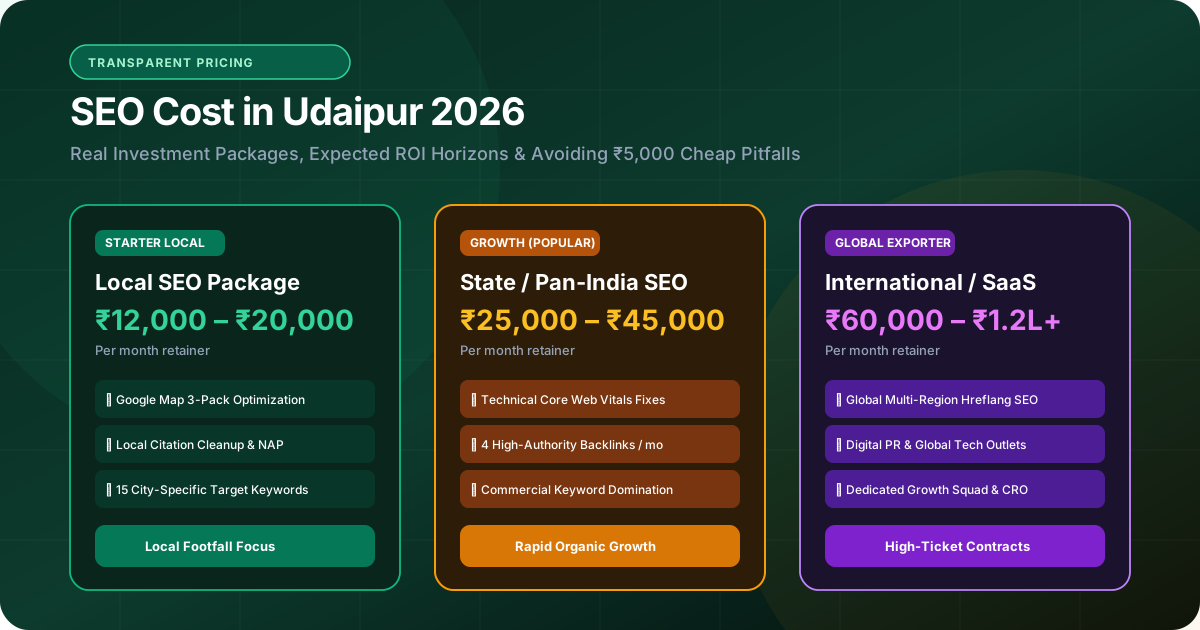
How Much Does SEO Cost in Udaipur? Practical Pricing Guide & ROI Analysis (2026)
Wondering how much SEO services cost in Udaipur? Explore realistic pricing tiers (₹15,000 to ₹80,000+), deliverables, red flags of cheap SEO, and how to forecast organic ROI.
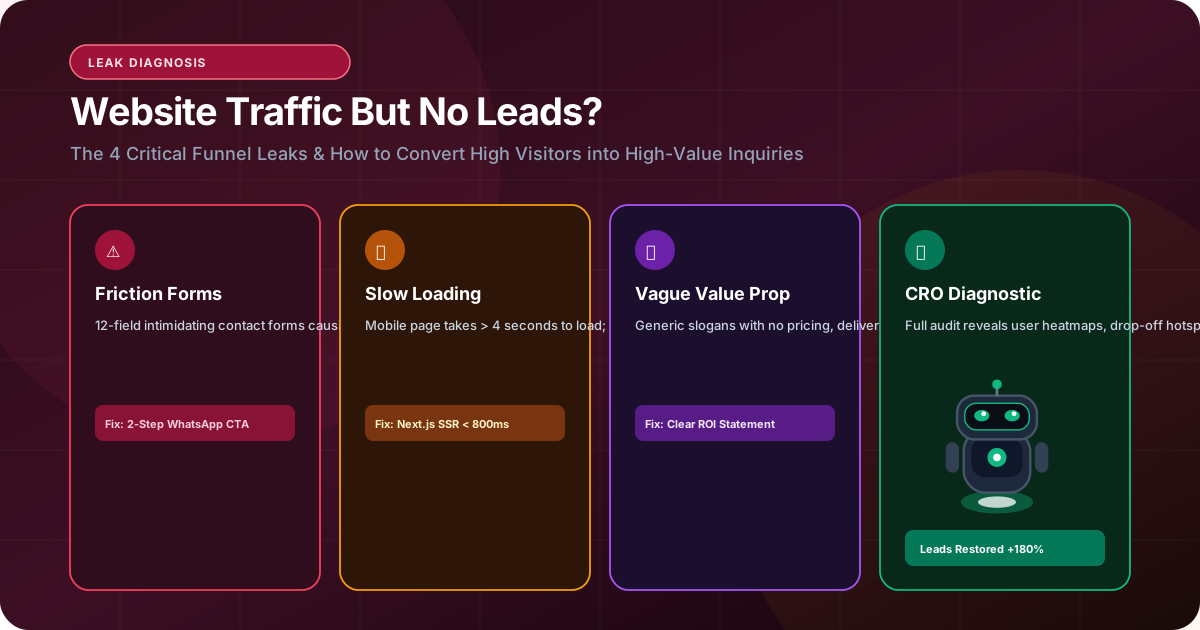
Why Your Website Gets Traffic but No Leads: 10 Conversion Fixes That Generate Inquiries
Experiencing steady website traffic but zero leads? Discover the top 10 conversion leaks—from slow mobile LCP to intimidating forms—and learn the exact fixes to drive inquiries.
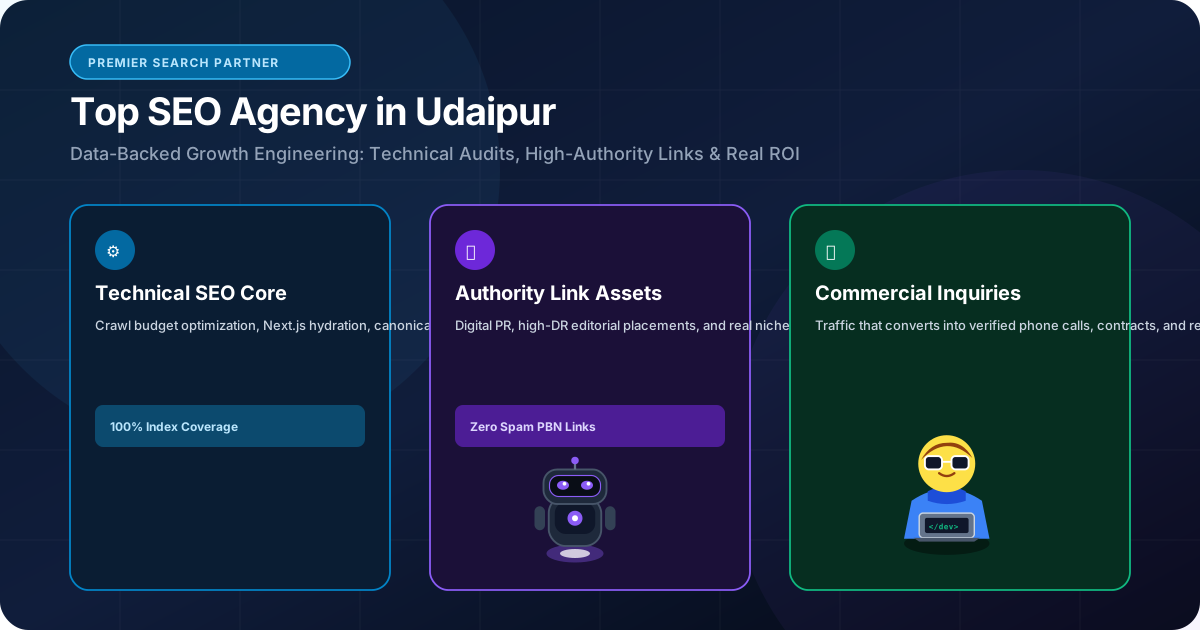
SEO Agency in Udaipur: How to Choose the Right Partner for Real Business Growth
Looking for an SEO agency in Udaipur? Discover the exact criteria, essential technical capabilities, red flags to avoid, and the questions to ask before signing a retainer.