
How to Build a High-Converting Website: The Blueprint That Turns Google Traffic Into Paying Customers
A comprehensive engineering and copywriting manual on structuring modern websites for sub-second speeds, psychological clarity, and relentless lead generation.

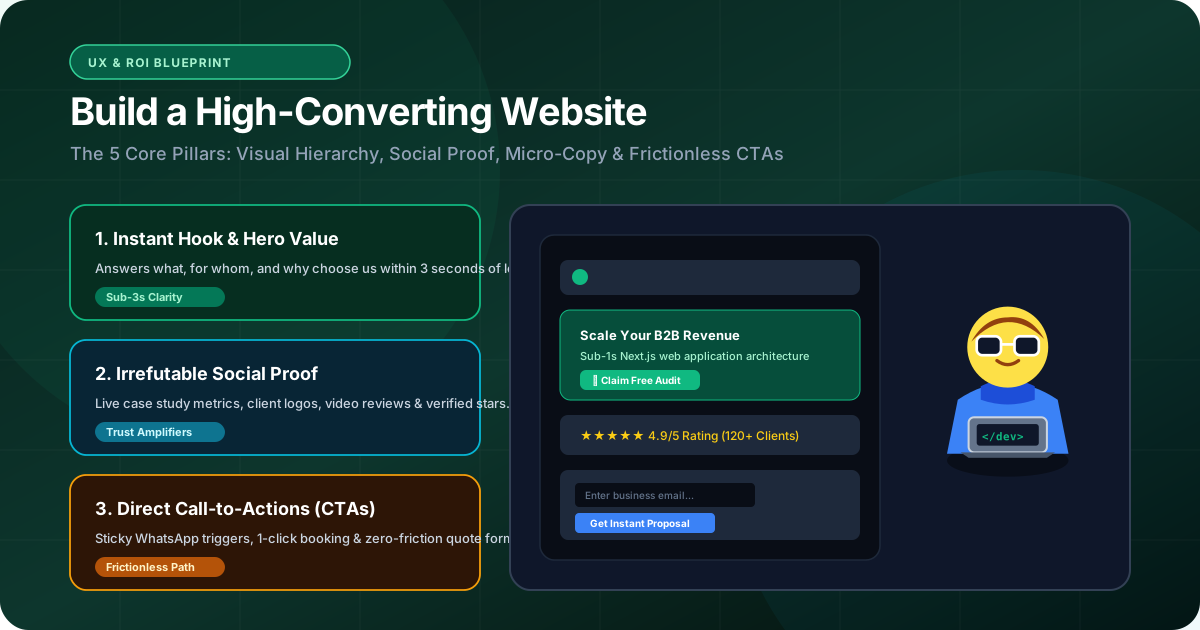
Most websites fail not because the business lacks great products or services, but because the website is designed like an art project rather than a sales instrument. Web designers often focus on trendy animations, abstract decorative elements, and complex interactive sliders. Meanwhile, the prospective customer lands on the page, feels confused, waits four seconds for assets to load, and leaves without a trace. A high-converting website is an intentional piece of software engineering and persuasive copywriting. Every headline, button, image, and line of code exists to serve one goal: answering user questions, building trust, and guiding them smoothly toward a commercial interaction. Whether you are building a new corporate platform, an eCommerce store, or a local service website, this master blueprint explains how to build a website that consistently turns visitors into paying customers.
1. The Fundamental Website Conversion Equation
Understanding the psychological mechanics of user action
In digital psychology, the probability of a visitor taking action can be expressed through a simple relationship: Conversion = (Perceived Value × Trust) - (Friction + Anxiety).
To maximize inquiries, you must aggressively increase perceived value and trust while minimizing friction and user anxiety.
Friction is anything that slows the user down: slow page loads, confusing menus, long forms, or broken links. Anxiety is the hesitation a user feels: 'Are these prices fair?', 'Will they spam my inbox?', 'Are they a legitimate business?' High-converting websites systematically eliminate friction and soothe anxiety at every interaction point.
2. The Anatomy of a High-Converting Hero Section
The exact framework for your page's most critical real estate
Your above-the-fold hero section accounts for over 70% of a visitor's decision to stay or leave. A high-converting hero layout must contain six specific elements:
1. Clear Benefit-Driven Headline: State plainly what tangible problem you solve. Avoid vague corporate slogans.
2. Supporting Sub-Headline: Explain in two concise sentences how you accomplish this, who you work with, and what makes your approach distinct.
3. Primary Action CTA: A high-contrast, prominent button leading directly to your primary conversion action.
4. Secondary Low-Commitment CTA: A secondary option for visitors who are not yet ready to speak with sales (e.g., 'View Case Studies' or 'Read Technical Specs').
5. Contextual Hero Visual: A crisp, real product screenshot, authentic service photograph, or interactive demo rather than generic stock imagery.
6. Immediate Social Proof Snippet: A compact row displaying 5-star review ratings, verified customer counts, or trusted client logos placed directly beneath the primary call to action.
Show your homepage hero section to someone outside your company for five seconds, then close the screen. If they cannot explain what your business offers and what action they should take next, your hero copy needs revision.
3. Speed as a Feature: Sub-Second Engineering
Why modern technical stacks outperform legacy templates every time
Speed is not an afterthought; it is a foundational feature. Google research confirms that when mobile load times stretch from 1 second to 3 seconds, the probability of a bounce increases by 32%. By 5 seconds, it increases by 90%.
High-converting modern platforms abandon heavy database queries and bloated legacy themes in favor of static site generation (SSG), edge caching, responsive image compression, and modern frameworks like Next.js.
When your pages load instantaneously, visitors feel an immediate sense of modern professionalism and competence that reflects positively on your brand.
4. Visual Hierarchy & Cognitive Load Reduction
Guiding the visitor's eyes naturally down the page
Online users do not read web pages word for word; they scan them in an F-pattern or Z-pattern. If your layout presents dense walls of uninterrupted text, readers will skip over it.
Structure your content using scannable subheadings, informative bullet points, high-contrast callout boxes, and comparative data tables.
Maintain generous whitespace around key conversion sections. Clutter increases cognitive load, confusing the visitor and dampening their inclination to take action.
| Common Design Mistake | Why It Hurts Conversions | Engineering Solution |
|---|---|---|
| Auto-rotating image carousels | Users ignore them as banner blindness kicks in; sliders slow LCP | Static, high-impact hero visual with one clear value statement |
| Low-contrast text colors (e.g., light gray on white) | Severe readability issues on mobile screens outdoors | Dark, accessible typography meeting WCAG AA contrast standards |
| Excessive animation effects on scroll | Distracts from copy and introduces noticeable scrolling lag | Subtle micro-animations that emphasize interactive elements |
5. Frictionless Inquiries: Forms, WhatsApp & Booking
Making it ridiculously easy for prospects to reach you
Every extra form field reduces completion rates. Ask only for information you require to conduct a productive initial discovery call.
Provide multi-modal communication choices: some buyers prefer submitting a form with project requirements, while others want immediate answers via WhatsApp or direct phone calls. Offering multiple friction-free options expands your total inquiry volume.
6. The Proof Architecture: Earning Immediate Credibility
Stacking layers of undeniable proof throughout the user journey
Integrate verifiable proof elements across the entire page rather than isolating reviews on an unvisited testimonials page:
Data-Backed Case Studies: Summarize tangible before-and-after results (e.g., 'How We Doubled Direct Bookings in 90 Days').
Video Testimonials & Client Quotes: Authentic commentary directly from real customers explaining the specific outcomes they achieved.
Certifications & Accreditations: Industry quality standards, secure payment badges, and recognized trade affiliations.
The Bottom Line & Next Steps
Building a high-converting website is a disciplined engineering and copywriting process that directly compounds your business growth. At RankVRA, we build modern Next.js web applications that combine high performance with sharp conversion architecture. Explore our custom web development services or book a technical discovery call today to turn your website into a reliable revenue engine.
Questions Business Leaders Ask About build high converting website
What is the most important element of a high-converting website?▾
A clear, compelling above-the-fold value proposition. If your visitors do not immediately understand what problem you solve and why you are uniquely qualified to solve it, they will bounce before ever seeing your features, pricing, or forms.
How many form fields should our contact form include?▾
For standard lead generation, 2 to 4 fields is ideal: Name, Email or Phone/WhatsApp, and a brief description of the project or need. For complex B2B RFQs, multi-step forms that break questions into manageable steps convert far better than single long forms.
Why does RankVRA emphasize sub-second page speeds for conversion optimization?▾
Because page speed sets the baseline for user experience. If a page loads slowly, users experience immediate frustration and are far more likely to leave before reading your message or interacting with your calls to action.
Can an existing website be redesigned to improve conversions without starting from scratch?▾
Yes. In many cases, we can conduct a conversion rate optimization (CRO) overhaul that refines page copy, optimizes CTAs, reorganizes visual hierarchy, and cleans up mobile layouts to achieve immediate conversion gains.

Written by Naveen Panchal
AuthorFounder & Lead Technical Architect, RankVRA
Naveen Panchal is the Founder and Technical Director of RankVRA. He specializes in full-stack web engineering, algorithmic search optimization, and performance funnels for hospitality, manufacturing, and local service enterprises across Rajasthan and internationally.
Want to implement these strategies for your business?
RankVRA engineers high-speed web platforms, localized Google Maps dominance, and algorithmic SEO funnels that turn searchers into long-term clients.
Related Growth Blueprints
Explore more strategic articles from the RankVRA engineering desk.
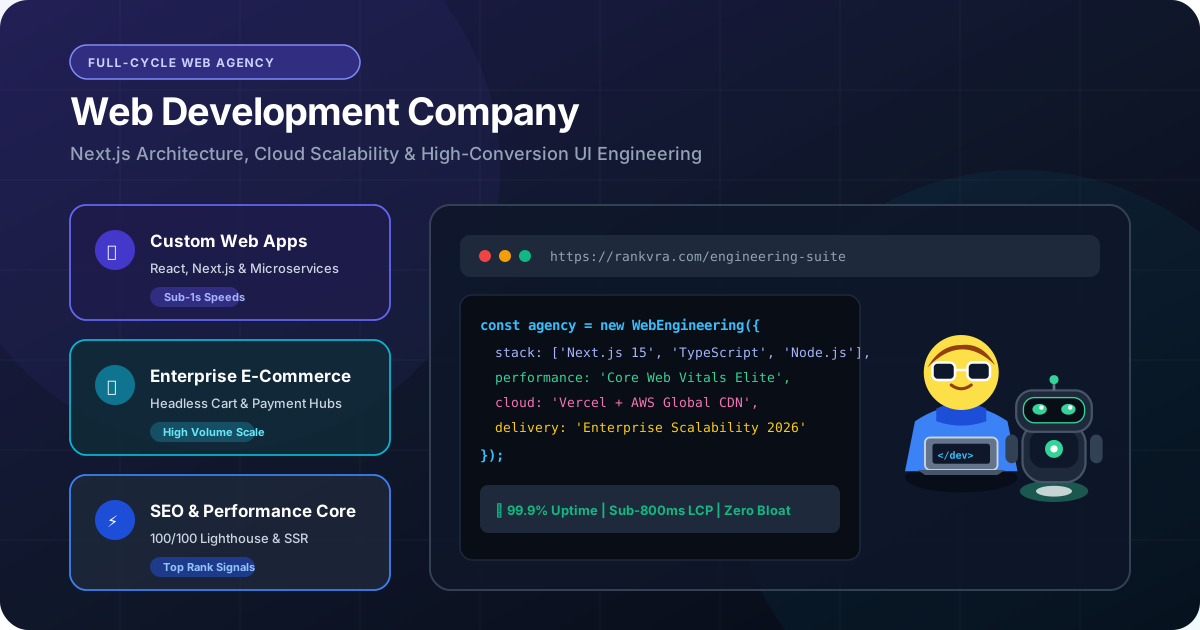
Web Development Company in Udaipur: What Modern Businesses Must Demand in 2026
Looking for a web development company in Udaipur? Learn why modern engineering, Next.js architecture, sub-second speeds, and conversion UX are essential for business growth.
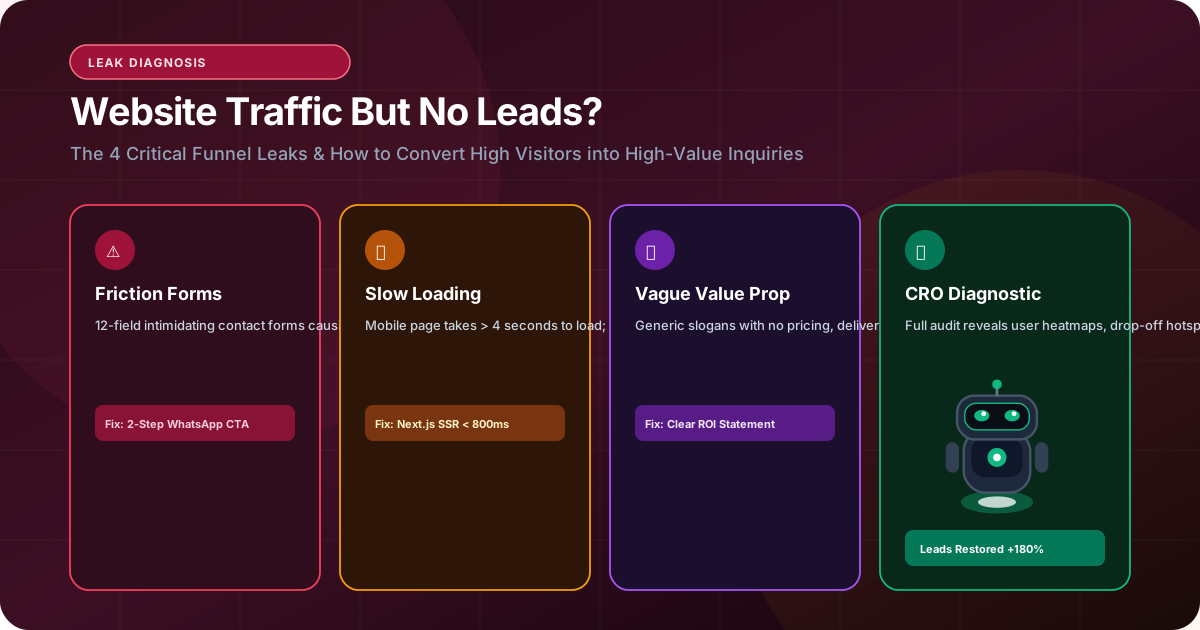
Why Your Website Gets Traffic but No Leads: 10 Conversion Fixes That Generate Inquiries
Experiencing steady website traffic but zero leads? Discover the top 10 conversion leaks—from slow mobile LCP to intimidating forms—and learn the exact fixes to drive inquiries.
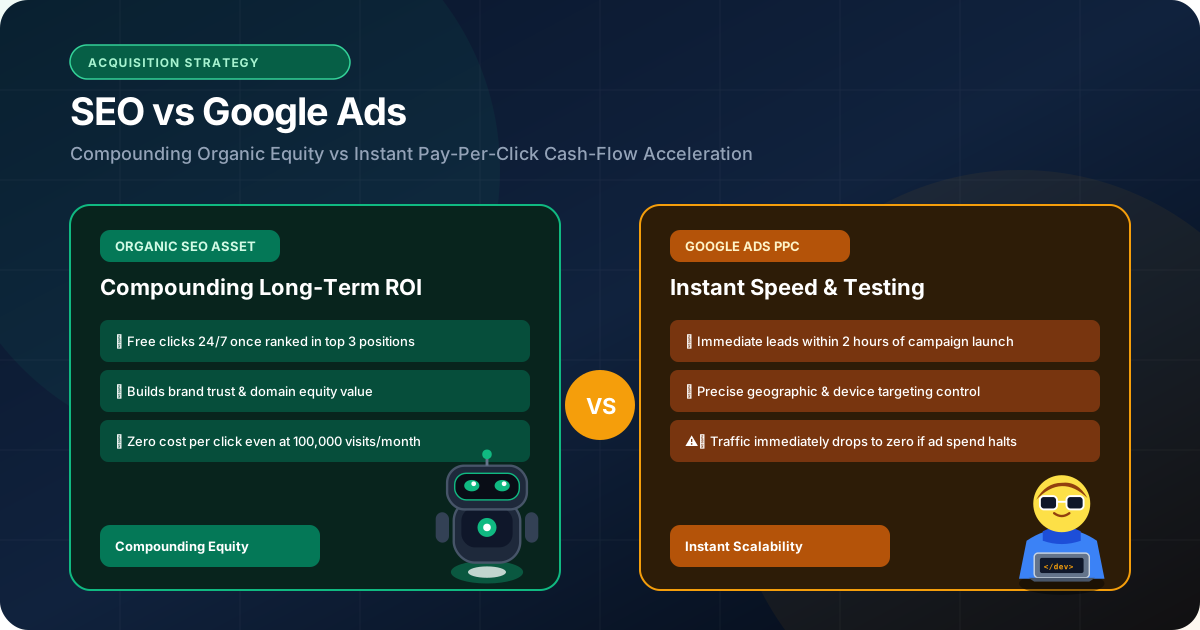
SEO vs Google Ads: Which Strategy Generates Higher ROI for Your Business? (2026 Comparison)
Struggling to choose between SEO and Google Ads? Compare costs, revenue timelines, customer acquisition economics, and learn how to run both in synergy for maximum ROI.