
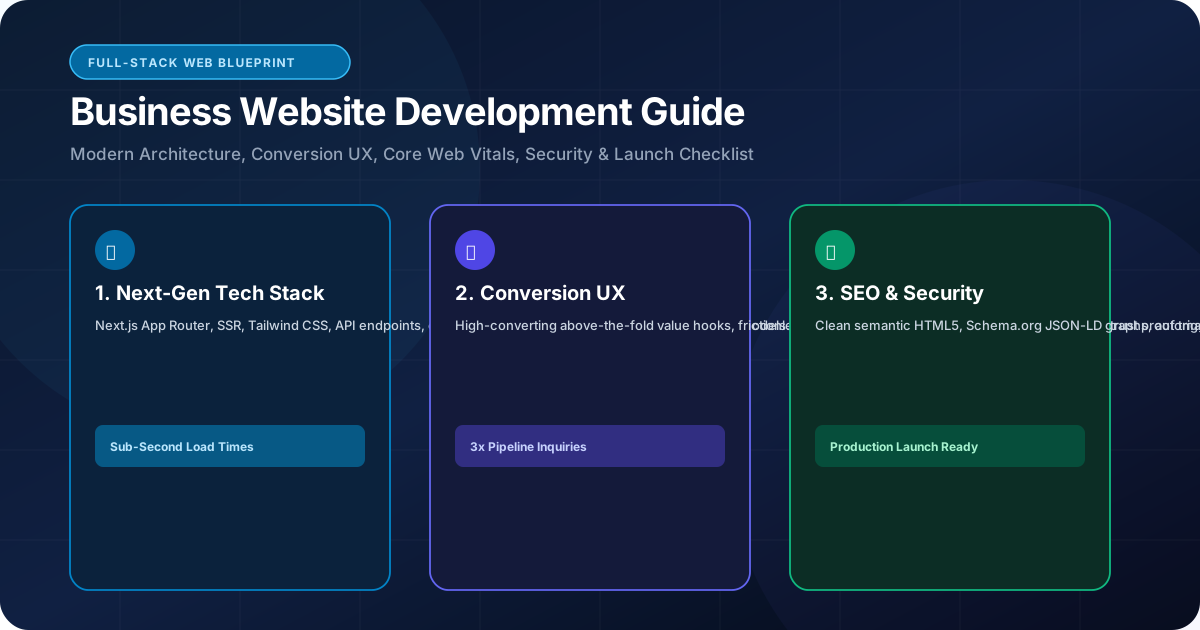
Website Development Guide: How to Build a High-Converting Business Website
A founder's master engineering framework for UX/UI, modern Next.js architecture, Core Web Vitals, enterprise security, and conversion optimization.

- 1. What Makes a Business Website Truly Succeed in 2026?
- 2. Conversion UX & Visual Hierarchy: Guiding the Buyer's Journey
- 3. Mobile Responsiveness & Thumb-Zone Ergonomics
- 4. The Modern Tech Stack: Next.js & React vs Legacy WordPress
- 5. SEO-Friendly Information Architecture & Schema Markup
- 6. Engineering High-Converting Forms, CTAs & WhatsApp Hooks
- 7. Enterprise Security, WCAG Accessibility & GA4 Tracking
- 8. The Comprehensive Business Website Launch Checklist
Your company's website is the single most critical commercial asset your business owns. It is your 24/7 digital storefront, your primary brand ambassador, and the ultimate destination where all your marketing investments—SEO, paid ads, social media, and word-of-mouth referrals—converge to generate revenue. Yet, an alarming percentage of business websites operate merely as digital brochures: visually uninspired, painfully slow to load, difficult to navigate on mobile devices, and structurally incapable of converting traffic into qualified inquiries. Building a high-converting business website is not a graphic design exercise; it is an engineering discipline that balances technical speed, behavioral psychology, search engine crawlability, and frictionless conversion funnels. This comprehensive guide details the modern architectural framework required to engineer a business website that dominates search rankings and drives consistent pipeline revenue.
A high-converting business website is engineered around four core pillars: modern technical architecture (sub-second server-side rendering with Next.js, Core Web Vitals compliance), conversion-focused UX/UI (clear above-the-fold value propositions, strategic social proof, frictionless forms), SEO-first information architecture (semantic HTML, Schema.org structured data, logical URL hierarchies), and enterprise-grade security (TLS 1.3, CSP headers, sanitized inputs).
1. What Makes a Business Website Truly Succeed in 2026?
Moving past aesthetic vanity to commercial performance engineering
A website can look visually stunning, but if it fails to generate qualified sales leads, it is a commercial failure. Professional business website development begins by defining clear conversion objectives.
High-performing websites achieve commercial success through four synchronized layers: Technical Performance (loading in under 1.5 seconds on mobile 4G networks), Algorithmic Visibility (engineered with clean semantic HTML and structured data to dominate organic search), Psychological Clarity (communicating exactly what you do, who you serve, and why you are the superior choice within 5 seconds), and Conversion Ergonomics (making it effortless for visitors to initiate contact).
When these four elements operate in harmony, your website transforms into an automated customer acquisition asset.
2. Conversion UX & Visual Hierarchy: Guiding the Buyer's Journey
Leveraging the F-pattern and above-the-fold psychological clarity
Eye-tracking research consistently demonstrates that web visitors scan web pages in an 'F-pattern' or 'Z-pattern'. Your above-the-fold hero section is the most valuable digital real estate on your entire domain.
Within the initial viewport, prospective buyers must immediately see three critical elements: a concise headline explaining your primary value proposition, a supporting subheading detailing how you solve their core problem, and a prominent, contrasting Call-to-Action (CTA) button.
Incorporate trust signals immediately beneath your hero headline: recognized client logos, industry certifications, customer review badges, or verified case study statistics. Validating credibility above the fold prevents bounce rates and establishes immediate trust.
Show your homepage hero section to someone outside your industry for exactly 5 seconds, then hide the screen. If they cannot explain what your company sells and what action they should take next, your above-the-fold copy is failing.
3. Mobile Responsiveness & Thumb-Zone Ergonomics
Designing for natural one-handed mobile navigation
Over 65% of all web traffic and more than 70% of local service inquiries originate on smartphones. True mobile responsiveness goes far beyond shrinking a desktop layout into a narrow column.
Mobile-first design requires optimizing for the 'thumb zone'—the comfortable physical arc a user's thumb travels on a mobile screen. Critical navigation items, phone call buttons, and primary CTAs must be anchored within this lower natural zone rather than buried in difficult-to-reach top corners.
Ensure touch targets adhere to mobile accessibility standards with at least 48x48 pixel tap areas, maintain legible 16px body font sizes without horizontal scrolling, and implement instant Click-to-Call and WhatsApp chat buttons that bypass cumbersome forms for mobile users.
4. The Modern Tech Stack: Next.js & React vs Legacy WordPress
Why progressive enterprises are migrating away from bloated monolithic CMSs
For years, monolithic CMS platforms like WordPress dominated business website development. However, maintaining dozens of third-party plugins introduces severe security vulnerabilities, database bloat, and crippling Core Web Vitals penalties.
Modern enterprise web engineering utilizes full-stack frameworks like Next.js (built on React) coupled with Tailwind CSS and edge deployment networks. Next.js offers automated Server-Side Rendering (SSR) and Static Site Generation (SSG), compiling lightning-fast, secure, and SEO-optimized HTML at the edge.
By decoupling your frontend interface from backend content sources (headless architecture), you achieve sub-second load times, impenetrable security against WordPress-style database exploits, and infinite architectural scalability.
5. SEO-Friendly Information Architecture & Schema Markup
Structuring site taxonomy so search engines index every commercial page
A high-converting website must be discoverable. Building an SEO-friendly architecture requires structuring your website into a logical parent-child hierarchy (e.g., Homepage -> `/services` -> `/services/web-development`).
Maintain clean, lowercase, hyphenated URL slugs, establish an automated XML sitemap, and enforce strict single-H1 heading structures across all pages.
Implement rich Schema.org JSON-LD structured data graphs: `Organization` markup on the homepage, `Service` markup on dedicated service pages, `Article` schema on editorial content, and `BreadcrumbList` schema to earn enhanced SERP snippets on Google.
6. Engineering High-Converting Forms, CTAs & WhatsApp Hooks
Eliminating friction to maximize form completion rates
Every extra field in a contact form reduces submission rates by a measurable margin. Audit your inquiry forms ruthlessly: do you truly need their mailing address and company fax number on the initial contact form, or do you simply need their name, work email, phone number, and a brief description of their project?
Use multi-step forms for complex service inquiries. Breaking a 10-field form into three bite-sized, interactive steps increases completion rates significantly because the initial step feels effortless.
Provide conversational alternatives: for markets in India, the Middle East, and Latin America, integrating a floating Click-to-WhatsApp button frequently doubles inbound inquiry volume compared to standard email forms.
7. Enterprise Security, WCAG Accessibility & GA4 Tracking
Hardening your digital perimeter and measuring customer conversion paths
Security & Compliance: Enforce TLS 1.3 across all routes, implement Content Security Policy (CSP) headers, sanitize all form inputs to prevent XSS and SQL injection attacks, and provide transparent Cookie Consent banners complying with GDPR and CCPA.
Web Accessibility (WCAG 2.1 AA): Ensure color contrast ratios meet accessibility standards (at least 4.5:1 for body copy), provide descriptive alt text for all meaningful imagery, and guarantee complete keyboard navigability for users utilizing screen readers.
Conversion Attribution: Configure Google Tag Manager and Google Analytics 4 (GA4) with custom events tracking form submissions, phone call clicks, PDF downloads, and video views, establishing clear ROI visibility for your marketing campaigns.
8. The Comprehensive Business Website Launch Checklist
A 12-point pre-launch quality assurance protocol
Never push a new business website live without running through this strict QA checklist.
| Category | Verification Item | Standard / Target Requirement | Status |
|---|---|---|---|
| UX / Design | Cross-Browser & Multi-Device Testing | Verified on Chrome, Safari, Firefox, iOS, and Android | Required |
| UX / Design | Above-the-Fold Hero Clarity | Clear value proposition, proof elements, and primary CTA | Required |
| Performance | Core Web Vitals Compliance | LCP < 2.5s, INP < 200ms, CLS < 0.1 on mobile 4G | Required |
| Performance | Image Format Optimization | All imagery served in AVIF/WebP with explicit width/height | Required |
| Technical SEO | Title Tags & Meta Descriptions | Unique, keyword-targeted titles and descriptions on all URLs | Required |
| Technical SEO | Self-Referencing Canonical Tags | Absolute canonical URLs matching live production domain | Required |
| Technical SEO | XML Sitemap & robots.txt | Clean sitemap submitted to GSC; robots.txt allows crawl | Required |
| Technical SEO | Schema.org JSON-LD Markup | Zero errors in Google's Rich Results Test tool | Required |
| Conversion | Form & WhatsApp Testing | All forms send instant notifications to sales team CRM | Required |
| Security | HTTPS, TLS 1.3 & CSP Headers | A+ rating on SSL Labs; robust security headers active | Required |
| Analytics | GA4 & Conversion Event Tracking | Verified real-time event tracking for forms, calls, and chats | Required |
| Legal | Privacy Policy & Terms of Service | Up-to-date compliance pages linked in global footer | Required |
The Bottom Line & Next Steps
Building a high-converting business website is the ultimate digital investment. When your website combines sub-second Next.js speed, intuitive mobile UX ergonomics, search-engine-friendly architecture, and frictionless conversion funnels, it becomes your company's most prolific lead generation engine. At RankVRA, our software engineering team builds custom web applications and business websites from the ground up, engineering every line of code for performance, search authority, and revenue growth. If you are ready to upgrade your digital presence into a modern high-converting platform, contact the engineering architects at RankVRA today.
Questions Business Leaders Ask About business website development
How long does it take to develop a custom business website?▾
A professional custom business website built on modern architectures like Next.js typically takes 4 to 8 weeks from initial UX design and content strategy to technical development, testing, and production deployment.
Why is Next.js superior to WordPress for business websites?▾
Next.js offers vastly superior loading speeds through server-side rendering and edge caching, eliminates security vulnerabilities associated with outdated third-party plugins, delivers flawless Core Web Vitals scores, and scales effortlessly without server slowdowns.
What is the most common reason business websites fail to convert visitors?▾
The primary culprit is a lack of above-the-fold clarity. When visitors arrive and cannot understand within 5 seconds what your company offers, why you are credible, and what action to take next, they click the back button and visit a competitor.
How does mobile optimization affect website conversion rates?▾
Over 65% of web visitors browse on smartphones. If your mobile layout features tiny text, awkward horizontal scrolling, or hard-to-click forms, conversion rates drop dramatically. Providing thumb-friendly navigation and instant WhatsApp/Click-to-Call buttons significantly boosts mobile inquiries.
What security measures should every business website have?▾
Every commercial website must enforce TLS 1.3 HTTPS encryption, utilize Content Security Policy (CSP) headers, sanitize all form inputs to prevent XSS and SQL injection, and implement secure cloud database access controls.
How can RankVRA assist with our company's website development?▾
RankVRA provides end-to-end web engineering: from conversion-focused UI/UX design and Next.js full-stack development to technical SEO architecture, API integrations, and ongoing performance optimization.

Written by Naveen Panchal
AuthorFounder & Lead Technical Architect, RankVRA
Naveen Panchal is the Founder and Technical Director of RankVRA. He specializes in full-stack web engineering, Next.js architecture, and algorithmic search optimization for high-growth enterprises.
Explore Core Commercial Capabilities
Full-stack custom web engineering built on modern Next.js and React.
Conversion-focused UI/UX design that drives qualified customer inquiries.
Request an architectural evaluation of your current website's performance and conversion funnel.
- W3C: W3C Web Design and Applications StandardsOfficial Reference
- Vercel: Next.js Documentation & Architectural Best PracticesOfficial Reference
- web.dev by Google: web.dev: Responsive Web Design BasicsOfficial Reference
Ready to Build a High-Converting Website for Your Business?
Upgrade your digital presence with a blazing-fast, custom-engineered website designed for top Google rankings and maximum pipeline conversion. Schedule a technical discovery session with RankVRA today.
Related Growth Blueprints
Explore more strategic articles from the RankVRA engineering desk.
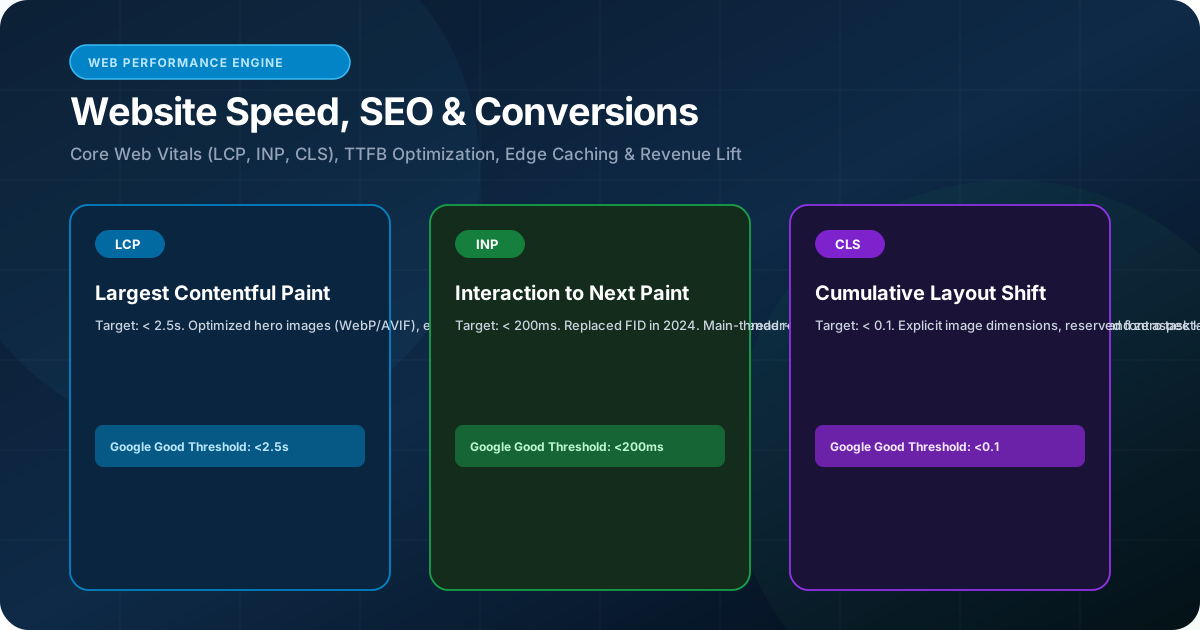
How Website Speed Affects SEO, User Experience, and Conversions
Discover how website speed impacts SEO, user experience, and conversions. Learn practical steps to optimize Core Web Vitals (LCP, INP, CLS) and accelerate load times.

Technical SEO Checklist: 25 Critical Fixes for Your Website
Use this comprehensive 25-point technical SEO checklist to fix crawl errors, optimize Core Web Vitals, resolve indexation issues, and boost Google rankings.
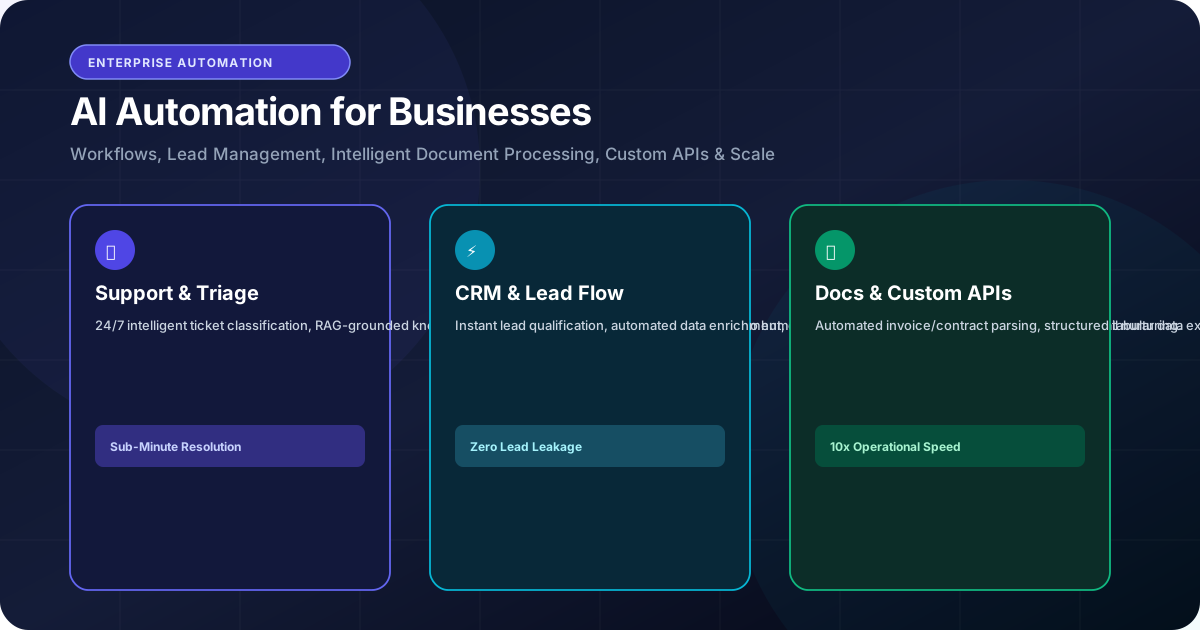
AI Automation for Businesses: How Companies Can Save Time and Scale Operations
Discover how AI automation for businesses saves time and scales operations. Learn practical use cases for CRM workflows, customer support, and API integrations.
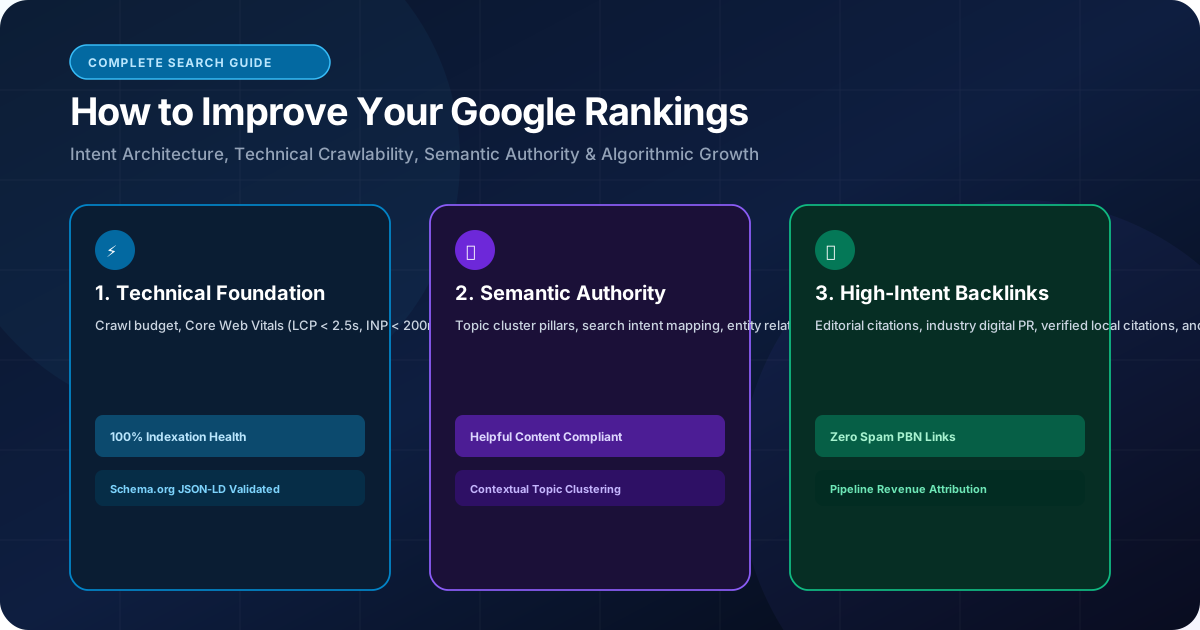
How to Improve Your Google Rankings: A Complete SEO Guide for Businesses
Learn how to improve Google rankings with this complete SEO guide for businesses. Discover proven strategies for technical SEO, content quality, and backlinks.