
How to Choose the Right Web Development Technology for Your Business
A pragmatic evaluation framework comparing React, Next.js, Node.js, Python, and modern database stacks for commercial software projects.

- 1. The 5-Point Technology Selection Framework
- 2. Frontend Stacks: React, Next.js, and Single Page Apps
- 3. Backend Engines: Node.js vs Python (FastAPI/Django)
- 4. Database Selection: SQL vs NoSQL vs In-Memory
- 5. Comprehensive Tech Stack Comparison Matrix
- 6. The Hidden Costs of Outdated or Hype-Driven Technology
- 7. RankVRA's Battle-Tested Production Recommendations
Every month, business executives and startup founders waste millions of dollars rebuilding software because their initial technology stack was selected for the wrong reasons. In some cases, an agency chose an obsolete platform like monolithic WordPress because it was easy for them to template out. In other cases, an over-enthusiastic developer chose an experimental, untested framework that became abandoned six months later. Choosing web development technology is not a cosmetic decision; it dictates your application's speed, hosting costs, security perimeter, developer hiring pool, and long-term valuation. This guide outlines a structured, business-first framework for selecting your web stack.
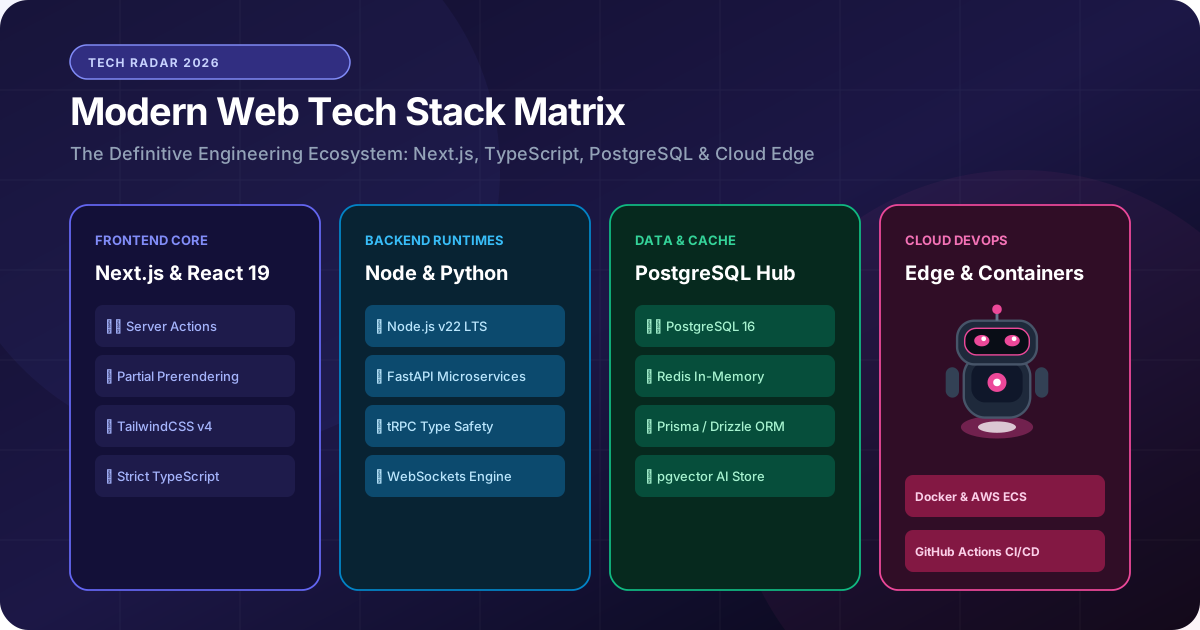
Choosing the right web development technology requires matching your business objectives to framework strengths: choose Next.js and React for SEO-sensitive, high-speed frontends; Node.js or Python (FastAPI) for scalable backend APIs; and PostgreSQL for robust relational data persistence.
1. The 5-Point Technology Selection Framework
Evaluate technologies through business fundamentals, not developer hype
Before arguing over programming languages, evaluate your project against five objective operational criteria:
1. Search Engine Discoverability: Does your platform require organic Google search visibility? If yes, purely client-side Single Page Applications (SPAs) like vanilla React or Vue will penalize you. You require Server-Side Rendering (SSR) via Next.js.
2. Interactive Complexity: Is your project an informational brochure, or does it feature complex multi-step forms, real-time dashboards, and collaborative workflows?
3. Concurrency & Throughput: How many simultaneous users, database reads, and API calls will the platform handle under peak loads?
4. Ecosystem Longevity & Talent Availability: Can you easily hire competent engineers in your domestic and international markets (US, UK, India, Canada) who know this language, or are you dependent on a niche framework with an aging community?
5. Security & Regulatory Compliance: What level of data protection (HIPAA, GDPR, PCI-DSS) is mandatory for your customer records?
2. Frontend Stacks: React, Next.js, and Single Page Apps
Why Next.js has become the de facto standard for commercial web applications
For modern frontend development, React remains the dominant library globally. However, how React is deployed makes all the difference:
• Vanilla Client-Rendered React (Vite / CRA): The user receives an empty HTML file, and their browser downloads megabytes of JavaScript before anything appears on screen. This results in poor First Contentful Paint (FCP) and makes search engine crawling unpredictable.
• Next.js App Router (Server-Side Rendering & Static Generation): The server renders full semantic HTML before sending it to the browser. Visitors see content in milliseconds, Google's crawlers index text effortlessly, and React hydrates interactivity in the background.
At RankVRA, our frontend development services prioritize Next.js because it delivers sub-second page transitions without sacrificing search ranking potential.
3. Backend Engines: Node.js vs Python (FastAPI/Django)
Choosing the optimal server runtime for your business domain
On the backend, two programming languages lead the modern enterprise landscape:
• Node.js / TypeScript: Built on Google's V8 JavaScript engine, Node.js excels at asynchronous, event-driven I/O. If your application handles thousands of concurrent WebSocket connections, real-time chat, or high-volume API requests, Node.js delivers blazing performance. Sharing TypeScript interfaces between frontend and backend reduces development bugs significantly.
• Python (FastAPI / Django): Python is the indisputable leader in data science, machine learning, and numerical computation. If your application incorporates AI automation & workflows, automated document parsing, or algorithmic analysis, Python FastAPI provides modern asynchronous endpoints with native OpenAPI validation.
Both technologies are battle-tested, highly supported, and backed by immense global developer communities.
4. Database Selection: SQL vs NoSQL vs In-Memory
Protecting data integrity with the right persistence layer
Software applications live and die by their database architecture. The most common mistake founders make is selecting a database based on trendiness rather than relational requirements.
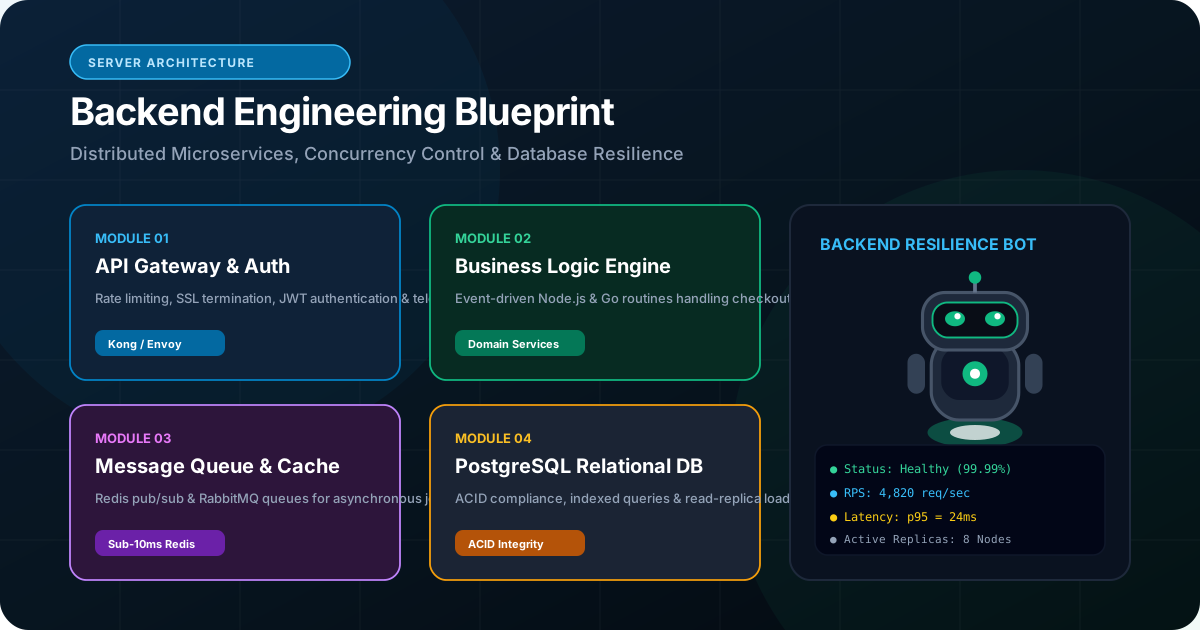
PostgreSQL is our primary recommendation for 90% of business applications. Its support for ACID transactions, robust foreign keys, complex analytical queries, and JSONB documents gives you the benefits of both SQL and NoSQL in a single, rock-solid engine.
Redis should accompany PostgreSQL as an in-memory caching layer. By storing user session states and frequently requested read-heavy data in Redis RAM, you prevent redundant database queries and achieve sub-50ms API response times.
5. Comprehensive Tech Stack Comparison Matrix
Side-by-side evaluation of leading modern web development technologies
The following matrix summarizes the architectural trade-offs across the most prevalent web development technologies in 2026:
| Technology / Framework | Layer | Primary Strength | Best Suited For | SEO Capability |
|---|---|---|---|---|
| Next.js 15+ / React 19 | Frontend / Full-Stack | Hybrid SSR/SSG, Sub-second LCP | B2B Websites, Portals, SaaS | World-Class (Full Pre-rendering) |
| Vite + React SPA | Frontend | Ultra-fast developer feedback | Internal Tools Behind Logins | Poor (Requires Client JS Execution) |
| Node.js (Express / Nest) | Backend API | High I/O concurrency, TypeScript | Real-Time Microservices, REST APIs | N/A (Backend Service) |
| Python (FastAPI) | Backend API | Async speed, automatic Swagger, AI | AI-Powered Apps, Data Pipelines | N/A (Backend Service) |
| PostgreSQL | Database | ACID transactions, relational integrity | Core Business Data, Payments, ERPs | N/A (Storage Tier) |
| Redis | Cache & Session | Sub-millisecond memory lookups | API Rate Limiting, User Sessions | N/A (In-Memory Tier) |
7. RankVRA's Battle-Tested Production Recommendations
The exact engineering stack we deploy for national and global clients
Based on our experience engineering commercial systems like the Capital & Co Insurance platform and E-Biozone, our standard production recommendation consists of:
• Frontend: Next.js App Router with TypeScript, Tailwind CSS, and Server Components for instant LCP.
• Backend: Node.js or Python FastAPI microservices with strict Zod/Pydantic validation schemas.
• Database: Managed PostgreSQL (Supabase or AWS RDS) with Prisma ORM and automated migration versioning.
• Caching & Queues: Redis for session management, BullMQ for background job orchestration.
• Deployment: Vercel or AWS ECS with automated CI/CD GitHub workflows and zero-downtime rollouts.
The Bottom Line & Next Steps
The right web development technology is the one that solves today's business needs without restricting tomorrow's growth. By anchoring your technology choices in established standards—React, Next.js, Node.js, Python, and PostgreSQL—you insulate your business from developer churn, guarantee sub-second user performance, and build on an enterprise-grade foundation. Contact RankVRA to discuss the optimal technical architecture for your next web project.
Questions Business Leaders Ask About web development technology
Should a new business choose WordPress or custom Next.js?▾
If you only need a simple, low-traffic local blog with zero custom functionality, WordPress can suffice. However, for ambitious businesses requiring sub-second mobile speeds, high security, custom client portals, and superior search rankings, custom Next.js is vastly superior.
Is Python better than Node.js for web development?▾
Neither is universally better. Node.js excels when your frontend is written in TypeScript and you want unified language sharing across the stack. Python (FastAPI) is superior if your application relies heavily on machine learning, AI agents, document processing, or mathematical algorithms.
Can we migrate our existing website to Next.js without losing SEO rankings?▾
Yes. In fact, migrating to Next.js typically boosts rankings due to improved Core Web Vitals. The key is implementing strict 1-to-1 301 URL redirects, matching metadata structures, and ensuring zero broken links during launch.

Written by Naveen Panchal
AuthorFounder & Lead Technical Architect, RankVRA
Naveen Panchal is the Founder and Technical Director of RankVRA. He specializes in full-stack web engineering, Next.js architecture, and high-performance digital systems for clients across the US, UK, Canada, and India.
Explore Core Commercial Capabilities
Modern Next.js web application engineering
Sub-second React & Next.js user interfaces
Node.js, Python & scalable database architectures
Unified frontend and backend systems
Core Web Vitals & speed engineering
- Vercel: Next.js Documentation & ArchitectureOfficial Reference
- React Core Team: React Official DocumentationOfficial Reference
- FastAPI: FastAPI Framework DocumentationOfficial Reference
- OpenJS Foundation: Node.js Official DocumentationOfficial Reference
Evaluate the Right Stack for Your Project
Avoid expensive architectural mistakes. Consult with RankVRA to determine the exact frameworks, databases, and deployment infrastructure that match your budget and scalability goals.
Related Growth Blueprints
Explore more strategic articles from the RankVRA engineering desk.
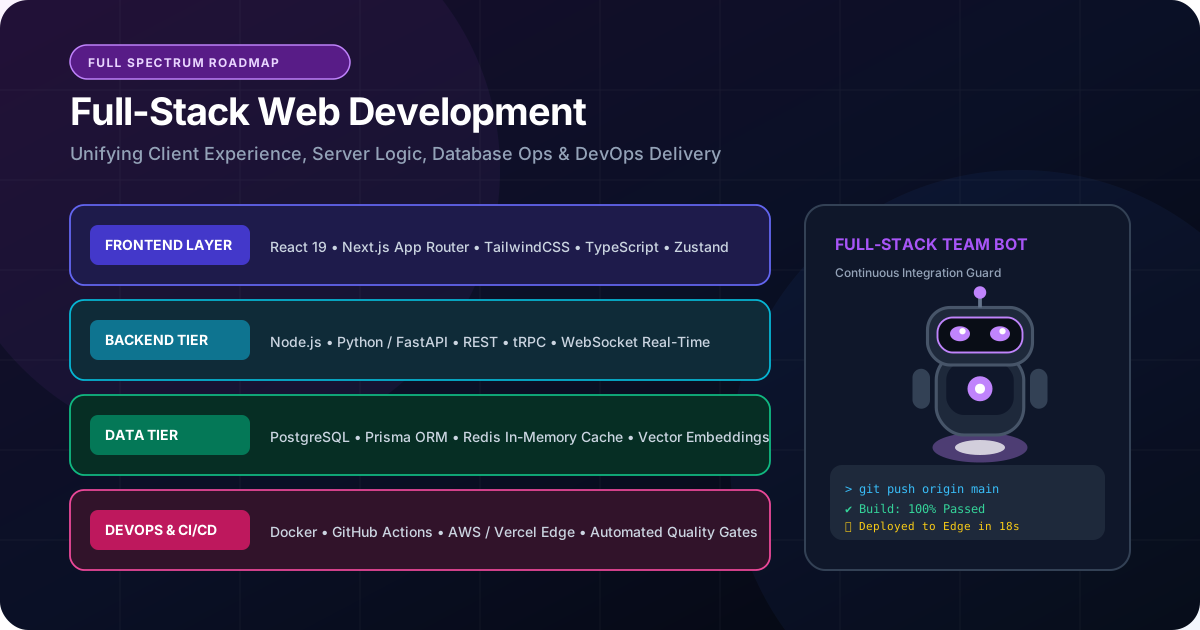
What Is Full-Stack Web Development? Frontend, Backend and APIs Explained
Demystify full-stack web development. Learn how frontend interfaces, backend servers, relational databases, and REST APIs connect to deliver business web platforms.
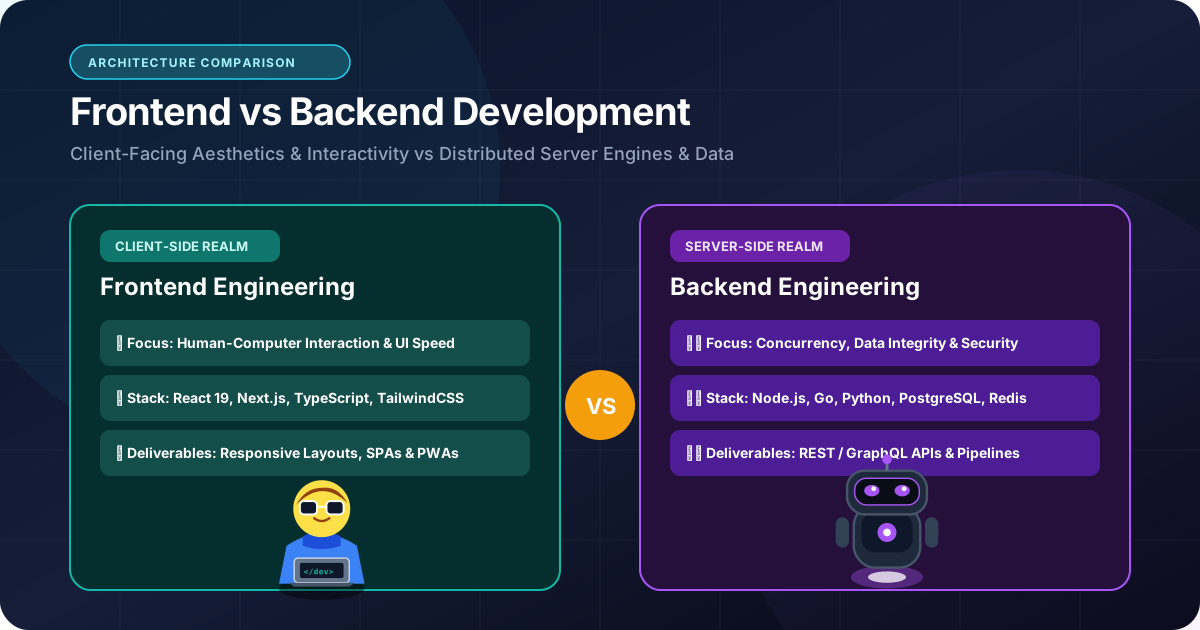
Frontend vs Backend Development: What Does Your Business Actually Need?
Understand the practical differences between frontend and backend development. Discover which layer drives user conversion vs data security, and how to allocate your budget.
How to Build a Scalable Web Application for a Growing Business
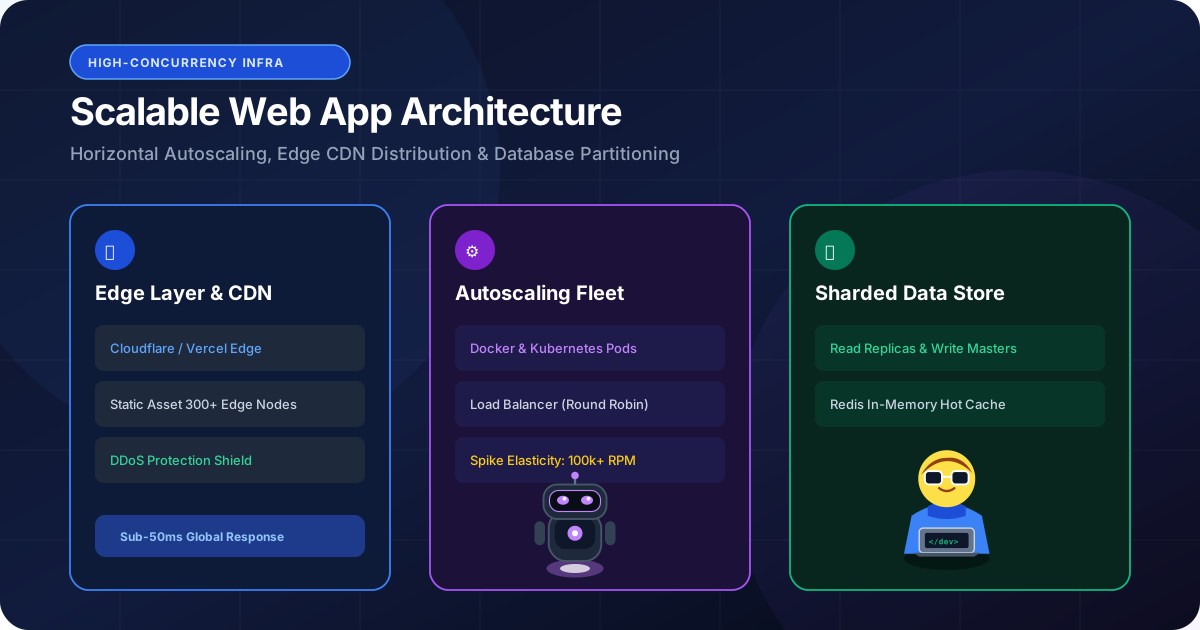
Learn how to architect scalable web applications. Discover proven strategies for horizontal scaling, database read replicas, Redis caching, and zero-downtime growth.