
What Is Full-Stack Web Development? Frontend, Backend and APIs Explained
A founder's architectural guide to how modern web applications function across client browsers, server runtimes, databases, and API pipelines.

- 1. The Anatomy of a Full-Stack Web Application
- 2. The Frontend: What the User Experiences
- 3. The Backend: Where Business Logic Lives
- 4. The API Bridge: How Data Travels
- 5. Data Persistence: Relational vs Document Databases
- 6. Monolith vs Decoupled Full-Stack Architecture
- 7. Common Architectural Mistakes Founders Make
- 8. The Full-Stack Technical Evaluation Checklist
When business leaders set out to build a modern digital product—whether an enterprise client portal, an e-commerce platform, or an internal operations dashboard—they frequently encounter the term 'full-stack web development'. In software sales meetings, agencies use it to pitch all-in-one capabilities. But what does full-stack development actually mean in production? More importantly, why should a business owner care whether their software partner understands the full stack rather than just stitching together visual templates? This guide breaks down the four core layers of full-stack engineering, explains how data moves from user clicks to server databases, and provides a framework for evaluating technical architecture before writing a single line of code.
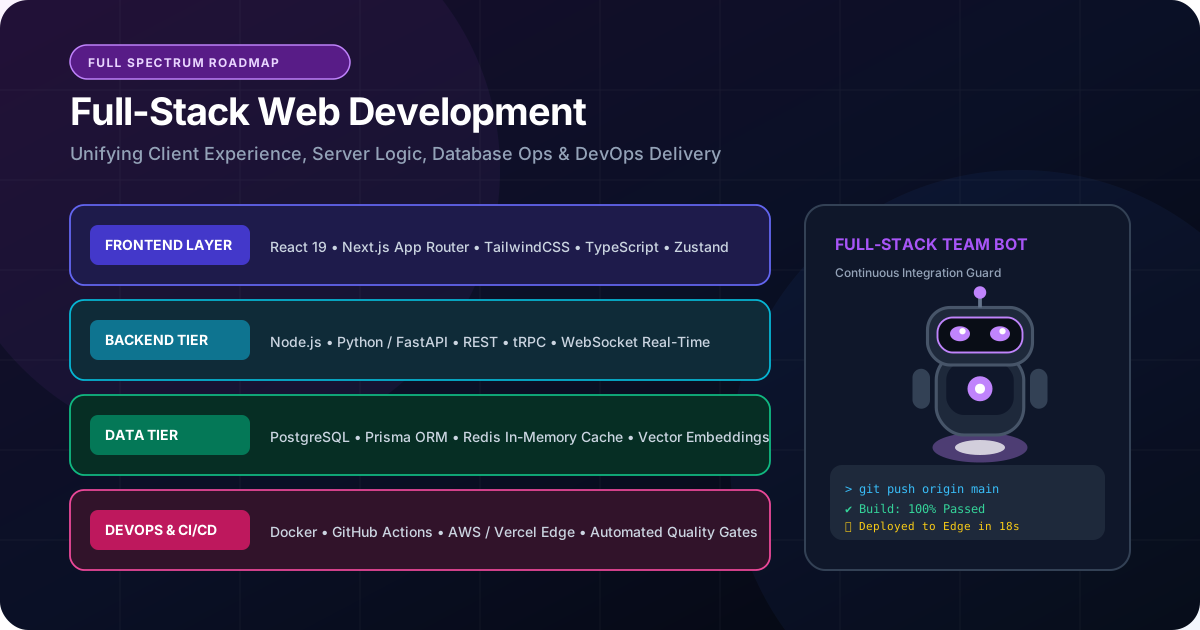
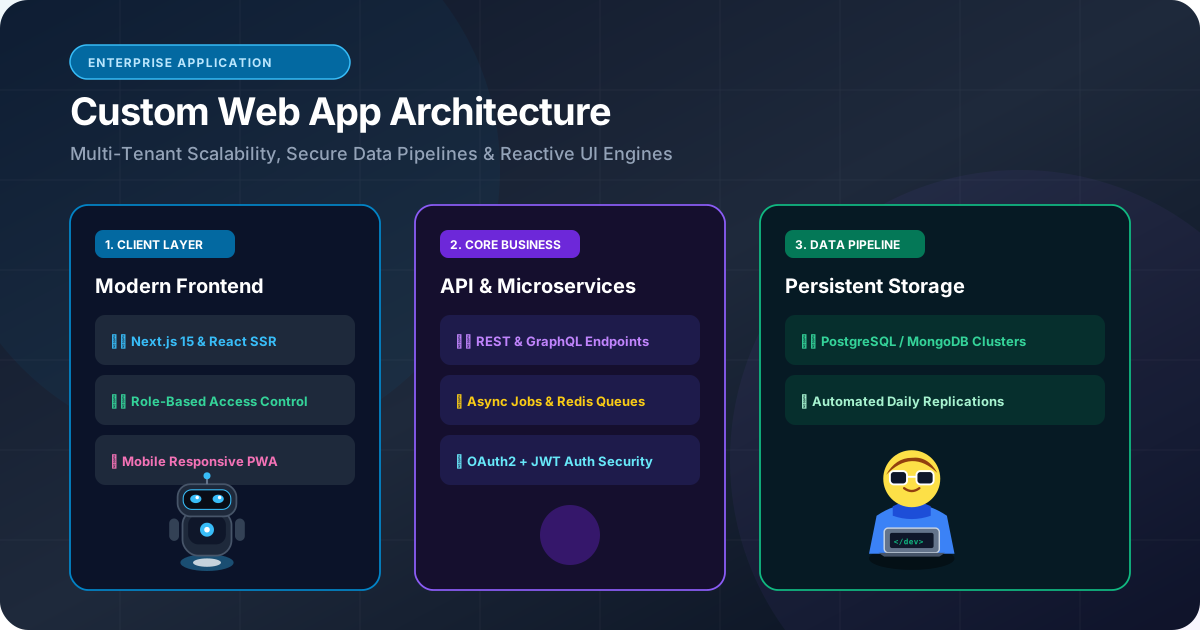
Full-stack web development encompasses the entire lifecycle of building a digital application: the user-facing frontend (HTML, CSS, React/Next.js), the server-side backend (Node.js, Python, logic execution), the persistence database (PostgreSQL, Redis), and the API layer that orchestrates data flow between them.
1. The Anatomy of a Full-Stack Web Application
The four interconnected tiers that turn code into an operational business asset
Every modern web application—from a banking portal to RankVRA's custom web applications—is composed of four distinct engineering layers operating in unison.
1. The Presentation Tier (Frontend): The graphical interface rendered inside the user's web browser or mobile viewport.
2. The Application Logic Tier (Backend): The secure server environment where authentication, business rules, calculations, and integrations execute.
3. The API (Application Programming Interface) Bridge: The structured communication protocols that transfer data securely between the frontend and backend.
4. The Data Persistence Tier (Database): The storage engine that permanently records user records, transactions, audit logs, and configuration state.
A full-stack engineer or engineering agency possesses the systems-level capability to architect, write, test, and deploy across all four tiers, ensuring that decisions made on the frontend do not compromise database integrity or backend security.
A common pitfall is hiring separate frontend and backend agencies who blame each other when API latency spikes or authentication fails. A unified full-stack approach guarantees shared architectural ownership and strict interface contracts.
2. The Frontend: What the User Experiences
Beyond visual styling: DOM performance, bundle size, and Core Web Vitals
The frontend is everything a customer, partner, or team member interacts with directly. In early web eras, frontends were static HTML files styled with basic CSS. Today, enterprise frontends are sophisticated client applications built with frameworks like React 19 and Next.js.
Modern frontend engineering solves three critical business challenges:
• Rendering Speed & Core Web Vitals: Delivering Largest Contentful Paint (LCP) under 1.2 seconds and Interaction to Next Paint (INP) under 50ms so users never experience sluggish button taps.
• State Management & Interactivity: Tracking user session states, form inputs, dynamic filtering, and live notifications without requiring full-page reloads.
• Universal Accessibility (a11y): Ensuring semantic HTML, screen-reader compatibility, and fluid mobile responsiveness across viewports ranging from 375px mobile screens to 4K desktop displays.
- Server Components (SSR/SSG): Rendering HTML on the server to deliver instant initial page loads and effortless search indexing.
- Client Hydration: Selectively attaching JavaScript interactivity only where user actions require dynamic updates.
- Design System Primitives: Utilizing consistent, accessible component libraries (Tailwind CSS, Radix UI) for uniform enterprise branding.
3. The Backend: Where Business Logic Lives
Protecting proprietary algorithms, security policies, and financial data
While the frontend lives in the public eye on the client's browser, the backend is a private, fortified computing environment running on secure cloud infrastructure. The backend is where critical commercial transactions occur.
When a user submits an insurance quote or registers an account, the frontend cannot be trusted to calculate prices or grant administrative permissions, because client-side JavaScript can be intercepted or manipulated in the browser developer tools. The backend development layer enforces absolute truth.
Key responsibilities of backend systems include:
• Authentication & Session Authorization: Validating cryptographic JSON Web Tokens (JWT) or secure HTTP-only cookies to ensure users can only access their authorized data.
• Complex Business Logic: Computing policy rates, generating PDF invoices, applying volume discounts, and orchestrating multi-step approval workflows.
• Asynchronous Background Jobs: Handing off resource-heavy tasks—such as sending batches of notification emails or generating monthly financial summaries—to background task workers (Redis, BullMQ, Celery) so the user never waits.
4. The API Bridge: How Data Travels
REST vs GraphQL and contract-driven data exchange
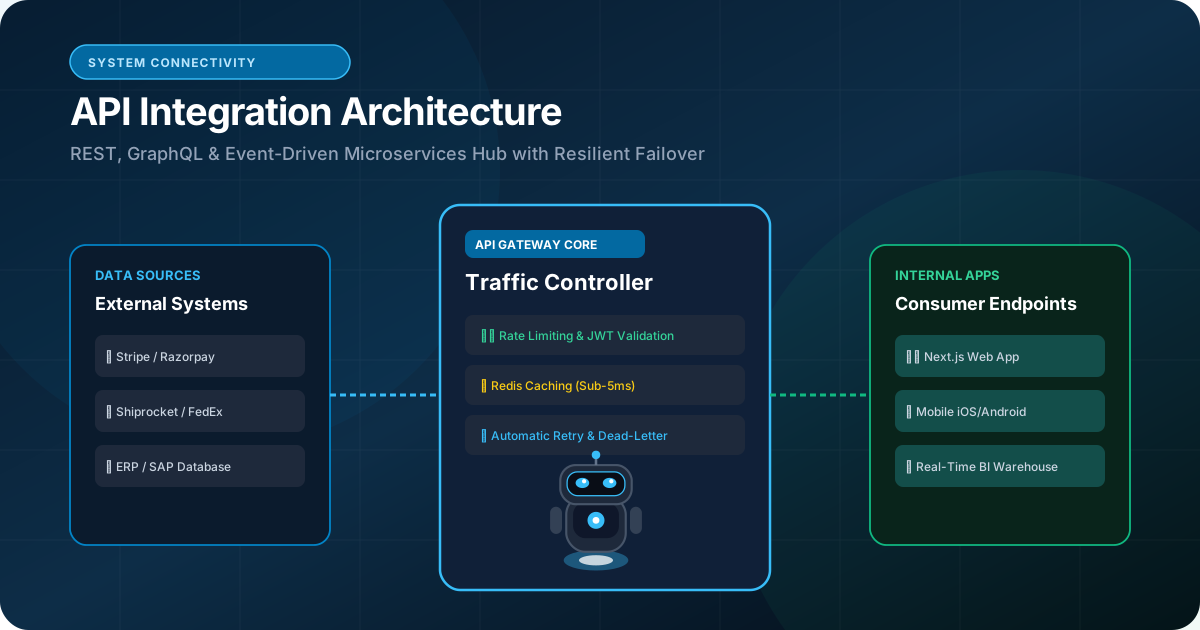
The API (Application Programming Interface) is the courier service between the client application and the backend database. When a user clicks 'Submit Claim', the frontend formats the form fields into a JSON payload and dispatches an HTTP POST request across the network to an API endpoint.
In modern API development & integration, two primary paradigms dominate:
• REST (Representational State Transfer): The battle-tested standard using standard HTTP verbs (GET, POST, PUT, DELETE) organized around predictable resource URIs (e.g., /api/v1/orders/123). REST is simple to cache at the CDN edge and universally supported.
• GraphQL: A query language developed by Meta that allows the frontend to request the exact data fields needed in a single query, preventing over-fetching on mobile networks.
Regardless of protocol, professional full-stack development relies on strict contract validation (using tools like TypeScript and Zod) so both frontend and backend adhere to identical data shapes.
5. Data Persistence: Relational vs Document Databases
Why choosing the wrong database architecture creates technical debt
All data submitted through a web application must be durably stored. In full-stack web engineering, choosing between relational (SQL) and document (NoSQL) databases is one of the most consequential decisions a technical architect makes.
• Relational Databases (PostgreSQL, MySQL): Data is organized into structured tables with strict columns, data types, and foreign-key relationships. Relational engines enforce ACID compliance (Atomicity, Consistency, Isolation, Durability), making them essential for financial records, e-commerce orders, and B2B workflows.
• Document Databases (MongoDB): Data is stored in flexible JSON-like documents. While helpful for rapid prototyping with unstructured data, document stores require application-level schema enforcement and can lead to data integrity anomalies at enterprise scale.
| Feature / Metric | Relational (PostgreSQL) | Document (MongoDB) | In-Memory (Redis) |
|---|---|---|---|
| Primary Data Model | Structured Tables & Foreign Keys | Hierarchical BSON Documents | Key-Value & In-Memory Hashes |
| ACID Transaction Guarantees | Strict & Native at Database Engine | Configurable (Requires Sharding Care) | Atomic Key Operations |
| Best Commercial Use Case | B2B Portals, Financial Ledger, E-commerce | Unstructured Logs, CMS Prototypes | Session Store, Caching, Rate Limiting |
| Complex Join Performance | Extremely Fast via Composite Indexes | Slow / Application-Level Aggregations | Sub-Millisecond Single Lookups |
| Data Integrity Protection | Database-Enforced Foreign Keys | Application Code Responsibility | Volatile or Ephemeral Storage |
6. Monolith vs Decoupled Full-Stack Architecture
Aligning architectural complexity with organizational scale
In full-stack engineering, how you package and deploy code matters as much as the code itself. Two dominant patterns exist:
1. Modern Integrated Full-Stack (Next.js App Router): Frontend and backend server actions coexist in one unified TypeScript codebase. Deployment is instantaneous, types are shared end-to-end, and development velocity is exceptionally high for startups and mid-sized businesses.
2. Decoupled Frontend + Microservices API: A standalone React or Vue frontend communicates with separate backend services written in Node.js, Python, or Go. This pattern is ideal for large enterprise engineering teams with independent deployment cadences.
7. Common Architectural Mistakes Founders Make
Costly traps that lead to complete code rewrites
Over years of engineering production applications—such as the Sterling Wholesale Insurance Portal and Capital & Co Insurance—we have observed four recurring mistakes:
• Leaking Business Logic to the Client: Placing discount calculations or validation checks solely on the frontend, allowing savvy users to bypass restrictions by inspecting network requests.
• Neglecting Database Indexing: Building an application that tests well with 50 test users but slows to a crawl once the database table reaches 100,000 records because foreign keys lack composite indexes.
• Skipping Automated API Contracts: Manually updating frontend forms when backend fields change, causing unexpected runtime crashes in production.
• Treating Security as an Afterthought: Storing authentication tokens in localStorage instead of secure HttpOnly cookies, exposing user accounts to Cross-Site Scripting (XSS) exfiltration.
8. The Full-Stack Technical Evaluation Checklist
10 verification points before greenlighting a web development project
Before signing a contract with a full-stack engineering partner, evaluate whether their proposal addresses each of these architectural requirements:
1. End-to-End Type Safety: Does the stack use TypeScript across both client components and server endpoints?
2. Database Normalization: Has the partner designed a schema diagram with foreign-key constraints and index strategies?
3. Server-Side Rendering: Will public pages be pre-rendered for search engine crawlers and sub-second mobile LCP?
4. Secure Authentication: Are sessions protected by HttpOnly, Secure, SameSite=Strict cookies with CSRF defense?
5. Rate Limiting: Is there an in-memory Redis layer to prevent brute-force login attempts and API abuse?
6. Documented API Endpoints: Does the backend generate OpenAPI/Swagger documentation?
7. Environment Secret Isolation: Are API keys and database credentials strictly managed via private cloud environment variables?
8. Automated Migration Scripts: Can database changes be rolled forward and backward safely without data loss?
9. Real User Monitoring: Are error telemetry (Sentry) and performance tracking integrated?
10. Code Repository Ownership: Will your business own 100% of the GitHub repository, deployment pipelines, and database credentials?
The Bottom Line & Next Steps
Full-stack web development is not a buzzword; it is the discipline of creating harmonious, reliable digital systems where user interface design, server-side computation, and database durability reinforce each other. Whether you are engineering a custom client portal, launching a new SaaS product, or modernizing an existing business platform, partnering with engineers who understand the entire stack ensures your application scales efficiently without painful rewrites. Explore RankVRA's full-stack engineering services or schedule a consultation with our technical team today.
Questions Business Leaders Ask About full stack web development
What is the difference between a full-stack developer and specialized frontend/backend engineers?▾
A full-stack developer has comprehensive knowledge across client-side UI, server logic, databases, and deployment pipelines. Specialized engineers focus deeply on one layer (e.g., deep CSS animation or database query plan optimization). Full-stack engineers excel at architecting cohesive systems and building products rapidly from scratch.
Is Next.js considered a full-stack framework?▾
Yes. Next.js App Router is a true full-stack framework. It enables developers to write client-side UI components, server-side rendered pages, and secure backend Server Actions/API route handlers within a single unified TypeScript project.
How long does it take to build a custom full-stack web application?▾
A streamlined MVP full-stack application (such as an internal operations dashboard or client portal) typically takes 4 to 8 weeks to architect, build, and deploy. Complex enterprise applications with multiple third-party integrations and multi-tenant architectures generally require 10 to 16 weeks.
Which database should our business use for a new web application?▾
For 90% of business applications, PostgreSQL is the gold standard. It provides rock-solid ACID transactions, advanced relational integrity, JSONB support for semi-structured data, and unparalleled ecosystem reliability.

Written by Naveen Panchal
AuthorFounder & Lead Technical Architect, RankVRA
Naveen Panchal is the Founder and Technical Director of RankVRA. He specializes in full-stack web engineering, Next.js architecture, and high-performance digital systems for clients across the US, UK, Canada, and India.
Explore Core Commercial Capabilities
Custom Next.js & React website engineering
Sub-second UI hydration & responsive UX
Node.js, Python, and scalable database architecture
End-to-end web application engineering
REST, GraphQL & third-party business automation
B2B portals, wholesale dashboards & client software
- Mozilla Developer Network: MDN Web Docs: Web Architecture OverviewOfficial Reference
- OWASP Foundation: OWASP Top 10 Security RisksOfficial Reference
- Google Chrome Team: web.dev: Core Web Vitals GuidesOfficial Reference
- PostgreSQL Global Development Group: PostgreSQL Official DocumentationOfficial Reference
Architect Your Full-Stack Web Application
Speak directly with Founder & Technical Architect Naveen Panchal to review your project scope, evaluate tech stack options, and establish a clear engineering roadmap.
Related Growth Blueprints
Explore more strategic articles from the RankVRA engineering desk.
How to Choose the Right Web Development Technology for Your Business
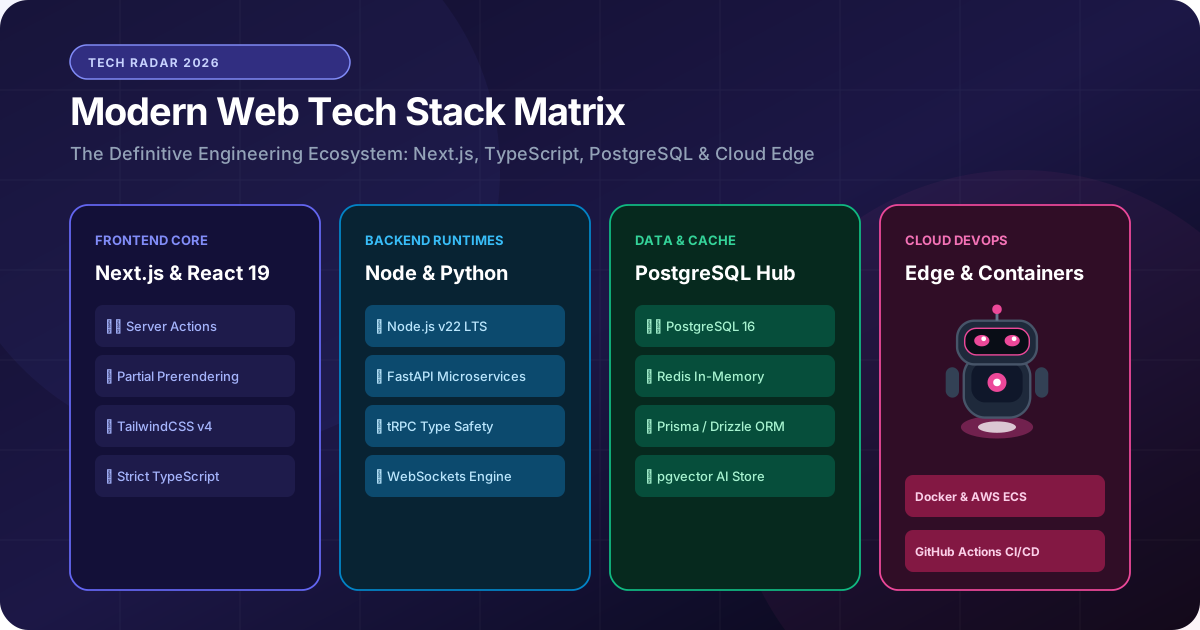
Avoid costly technical debt. Learn how to select the right web development stack (Next.js, React, Node.js, Python, PostgreSQL) based on speed, scale, and business ROI.
Frontend vs Backend Development: What Does Your Business Actually Need?
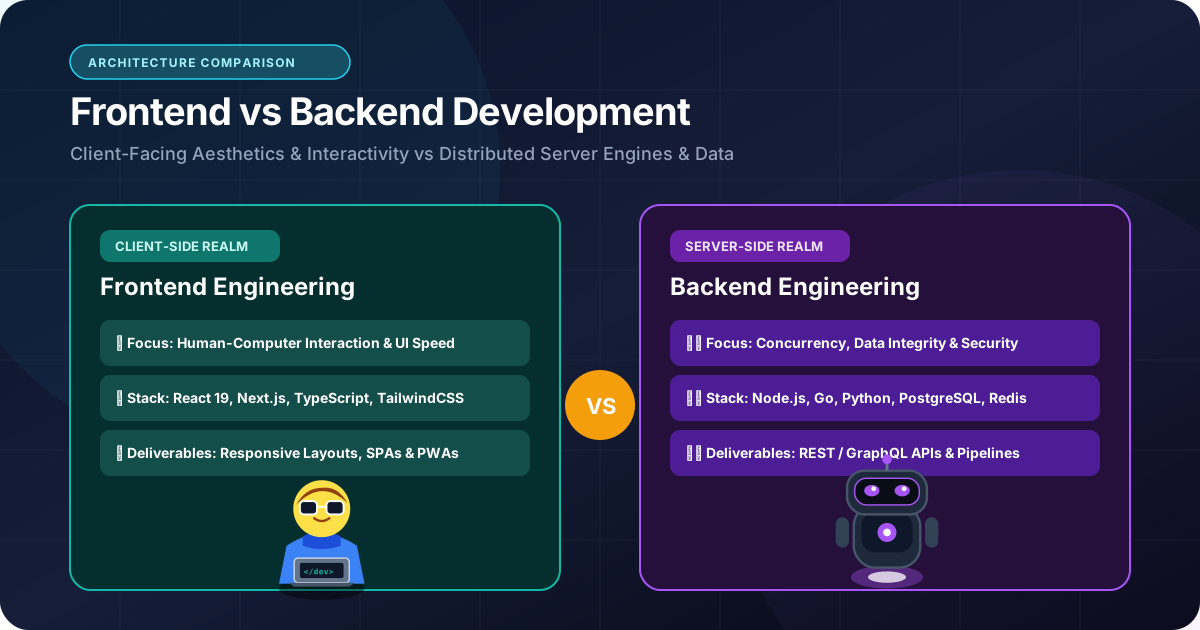
Understand the practical differences between frontend and backend development. Discover which layer drives user conversion vs data security, and how to allocate your budget.
Custom Web Application Development: When Should a Business Build a Custom Web App?
When should a business build custom web applications instead of subscribing to SaaS? Learn how custom portals, wholesale dashboards, and bespoke workflows deliver compounding ROI.