
How to Integrate Payment Gateways Into a Website or Web Application
A technical guide to Stripe, Razorpay, and PayPal: tokenization, webhooks, idempotency, and PCI-DSS compliance.

- 1. The Anatomy of Modern Payment Gateway Integration
- 2. Selecting the Right Gateway: Stripe vs Razorpay vs PayPal
- 3. Tokenization & PCI-DSS Compliance Demystified
- 4. The 4-Step Payment Intent & Webhook Lifecycle
- 5. Gateway Comparison Matrix: Fees, Currencies & Features
- 6. Dangerous Payment Integration Mistakes to Avoid
- 7. Engineering Automated Recurring Subscriptions
Collecting revenue is the lifeblood of every commercial web application. Yet, integrating online payments is far more complex than embedding a checkout button on a webpage. In modern web engineering, a payment integration must handle multi-currency pricing, credit card tokenization, fraud scoring (3D Secure), sales tax calculations, asynchronous webhook receipts, and recurring subscription prorations—all while strictly adhering to international payment card industry regulations (PCI-DSS). An amateurish payment integration leads to abandoned carts, failed customer transactions, and severe regulatory liability if credit card numbers are accidentally stored in your database. This guide breaks down how payment gateways function under the hood and provides an engineering blueprint for integrating gateways like Stripe and Razorpay securely.
Payment gateway integration connects your web application to financial clearing networks (Stripe, Razorpay, PayPal) using client-side tokenization (Elements/Checkout SDKs), secure server-side Payment Intents, and cryptographic webhook verification—allowing you to collect one-time payments and recurring subscriptions without storing sensitive credit card numbers on your servers.
1. The Anatomy of Modern Payment Gateway Integration
How funds move securely from a customer's bank to your commercial account
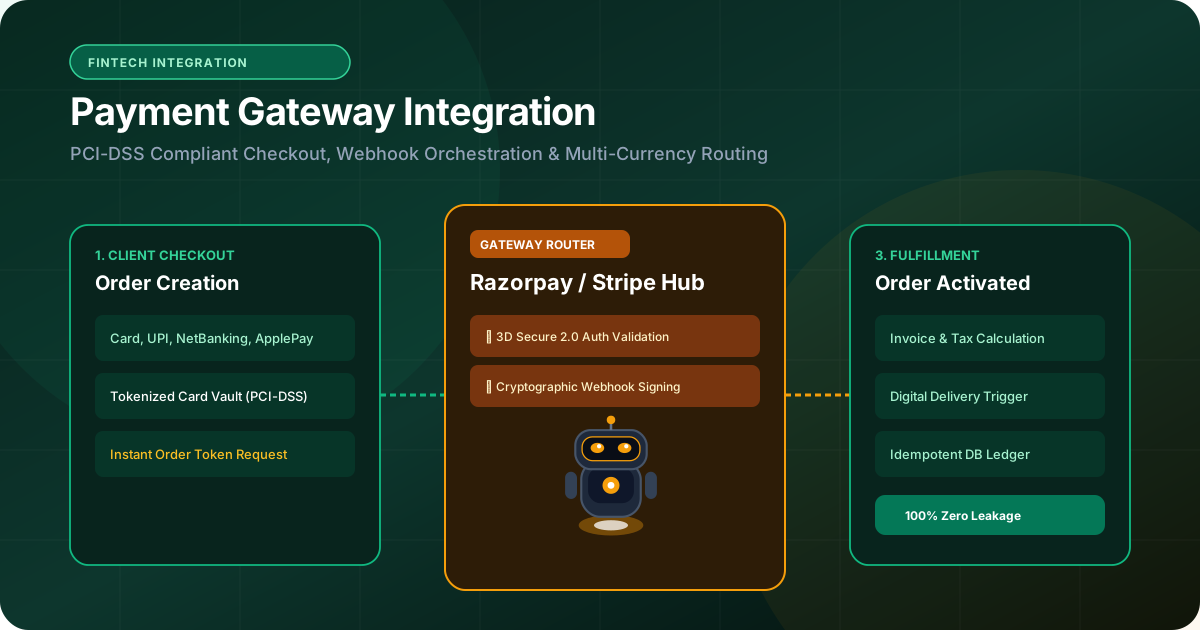
A payment gateway is an encrypted cloud service that bridges your web application with the customer's financial institution (issuing bank) and your commercial merchant bank (acquiring bank).
In modern e-commerce development and custom web application development, the process follows strict separation of concerns:
The customer's sensitive payment credentials (card numbers, CVV) are never sent to your server. Instead, they are collected directly inside a secure, sandboxed iframe hosted by the payment processor (such as Stripe Elements or Razorpay Checkout).
The processor encrypts the card data and returns a safe, temporary 'Token' or 'Payment Method ID' to your application. Your backend server then uses that token to authorize the charge, completely shielding your business from handling raw card data.
2. Selecting the Right Gateway: Stripe vs Razorpay vs PayPal
Choosing the optimal processor based on geography, currencies, and business model
Choosing the right payment gateway depends primarily on where your customers and business entities reside:
• Stripe (Best for US, UK, Canada & Global SaaS): Stripe is the undisputed global benchmark for developer experience, documentation, and subscription billing. It supports 135+ currencies, automated tax calculations (Stripe Tax), local payment methods (Apple Pay, Google Pay, ACH, SEPA), and exceptional fraud prevention (Stripe Radar).
• Razorpay (Best for Indian Domestic & NRI Commerce): Razorpay is the dominant payment engine across India. It provides flawless support for UPI (Google Pay, PhonePe, Paytm), Indian NetBanking across 50+ banks, EMI options, and compliant recurring mandates (e-mandates via RBI guidelines).
• PayPal / Braintree (Best for Secondary Global Checkout): PayPal remains a widely trusted payment method for international consumer buyers who prefer not to enter card details on newer websites. Offering PayPal alongside credit cards consistently recovers 10% to 15% of checkout abandonment.
3. Tokenization & PCI-DSS Compliance Demystified
How to achieve PCI-DSS SAQ-A compliance with zero regulatory overhead
The Payment Card Industry Data Security Standard (PCI-DSS) imposes severe financial penalties on businesses that store, process, or transmit raw credit card details insecurely.
By utilizing modern client-side tokenization (such as Stripe Elements or Razorpay Custom Checkout), your web application achieves the simplest compliance tier: PCI-DSS SAQ A.
Because sensitive card digits touch only the processor's audited vaults, your company is exempt from expensive annual on-site forensic audits, complex network segmentation rules, and massive compliance retainers.
4. The 4-Step Payment Intent & Webhook Lifecycle
The asynchronous architecture that guarantees orders are never lost
Senior engineers never mark an order as 'Paid' based solely on a frontend browser response. A user's mobile battery could die, or their internet could drop the exact millisecond after payment approval.
A rock-solid API integration follows a strict 4-step lifecycle:
1. Payment Intent Creation: When the user clicks 'Proceed to Checkout', your backend creates a Payment Intent on Stripe with the exact calculated order amount in cents ($50.00 = 5000), returning a clientSecret to the frontend.
2. Client Confirmation & 3DS Challenge: The frontend SDK securely confirms the payment with the customer's bank, prompting for biometric or 3D Secure SMS OTP if required.
3. Asynchronous Webhook Dispatch: Upon successful clearance, Stripe's servers send an encrypted, cryptographically signed webhook (event: payment_intent.succeeded) directly to your backend server endpoint.
4. Signature Verification & Fulfillment: Your backend validates the HMAC SHA-256 webhook signature, marks the order as 'Paid' in your PostgreSQL database, and triggers confirmation emails and invoice generation.
5. Gateway Comparison Matrix: Fees, Currencies & Features
Side-by-side technical and financial comparison of leading payment providers
The table below details standard rates and architectural capabilities across major gateways:
| Feature / Metric | Stripe | Razorpay | PayPal |
|---|---|---|---|
| Primary Geographic Focus | USA, Canada, UK, Europe, Global SaaS | India Domestic & Cross-Border Export | Global Consumer / North America / Europe |
| Domestic Card Fees | ~2.9% + 30¢ per successful charge | ~2.0% + GST (UPI often 0% or flat rate) | ~3.49% + 49¢ per transaction |
| Supported Currencies | 135+ Currencies with automated conversion | 100+ Currencies (INR native optimization) | 25+ Major Currencies |
| Key Payment Methods | Credit/Debit, Apple Pay, Google Pay, ACH, SEPA | UPI, Cards, NetBanking, Wallets, EMI | PayPal Balance, Pay in 4, Major Cards |
| Subscription Engine | Stripe Billing (World-class prorations & portals) | Razorpay Subscriptions (RBI compliant e-mandates) | PayPal Recurring Subscriptions |
| Webhook Security | Cryptographic HMAC SHA-256 Signatures | HMAC SHA-256 Secret Signatures | Webhook ID & Certificate Verification |
6. Dangerous Payment Integration Mistakes to Avoid
Costly errors that cause chargebacks, duplicate charges, and broken checkouts
Avoid these common payment integration pitfalls:
• Trusting the Frontend with Pricing: Never pass the item price from client-side JavaScript to the payment gateway. A malicious user can intercept the request and change a $500 order to $5. Always calculate prices securely on the backend.
• Neglecting Idempotency Keys: If a network glitch causes a user to tap 'Pay' twice, missing idempotency keys can result in the customer being billed double, triggering angry chargebacks.
• Missing Webhook Event Handlers: Failing to handle charge.refunded, customer.subscription.deleted, or payment_intent.payment_failed events, causing your database records to fall out of sync with actual bank receipts.
7. Engineering Automated Recurring Subscriptions
Automating customer upgrades, downgrades, and failed payment recovery (dunning)
For SaaS development and membership platforms, payment integration requires automated subscription lifecycle handling:
• Self-Service Customer Portals: Allowing customers to update their credit cards, view past PDF invoices, and change subscription tiers without contacting support.
• Automated Dunning & Smart Retries: When a monthly renewal charge fails due to an expired card, the system automatically sends automated notification emails and retries the charge at optimal intervals over 7 days before suspending account access.
• Prorated Billing Computations: Calculating exact pro-rata credits when a customer upgrades from a $50/mo plan to a $150/mo plan midway through a billing cycle.
The Bottom Line & Next Steps
A secure, frictionless payment integration is the bridge between customer interest and cash in the bank. By implementing tokenized client checkouts, robust server-side payment intents, cryptographic webhook verification, and automated subscription engines, you provide buyers with a trustworthy purchasing experience while completely insulating your company from security liabilities. If your business needs to integrate Stripe, Razorpay, or custom checkout workflows, consult with the engineering team at RankVRA.
Questions Business Leaders Ask About payment gateway integration
Can our web application accept international payments from the US, UK, and Canada?▾
Yes. By integrating Stripe or Razorpay's international payment processing, your web application can accept payments in USD, EUR, GBP, CAD, and 100+ currencies with automated currency conversion and settlement into your commercial business bank account.
How long does it take to integrate a payment gateway into a custom web app?▾
A standard one-time checkout integration typically takes 3 to 5 engineering days. A comprehensive subscription billing engine with multi-tier pricing, self-service customer portals, and automated dunning workflows generally requires 1 to 2 weeks of dedicated development and sandbox testing.
Do we need an SSL certificate for payment processing?▾
Yes. Running an active TLS/SSL certificate (HTTPS) is legally mandatory under PCI-DSS regulations. Payment gateways will refuse to operate in live production mode if requests originate from unencrypted HTTP domains.

Written by Naveen Panchal
AuthorFounder & Lead Technical Architect, RankVRA
Naveen Panchal is the Founder and Technical Director of RankVRA. He specializes in full-stack web engineering, Next.js architecture, and high-performance digital systems for clients across the US, UK, Canada, and India.
Explore Core Commercial Capabilities
High-speed storefronts & payment checkout engineering
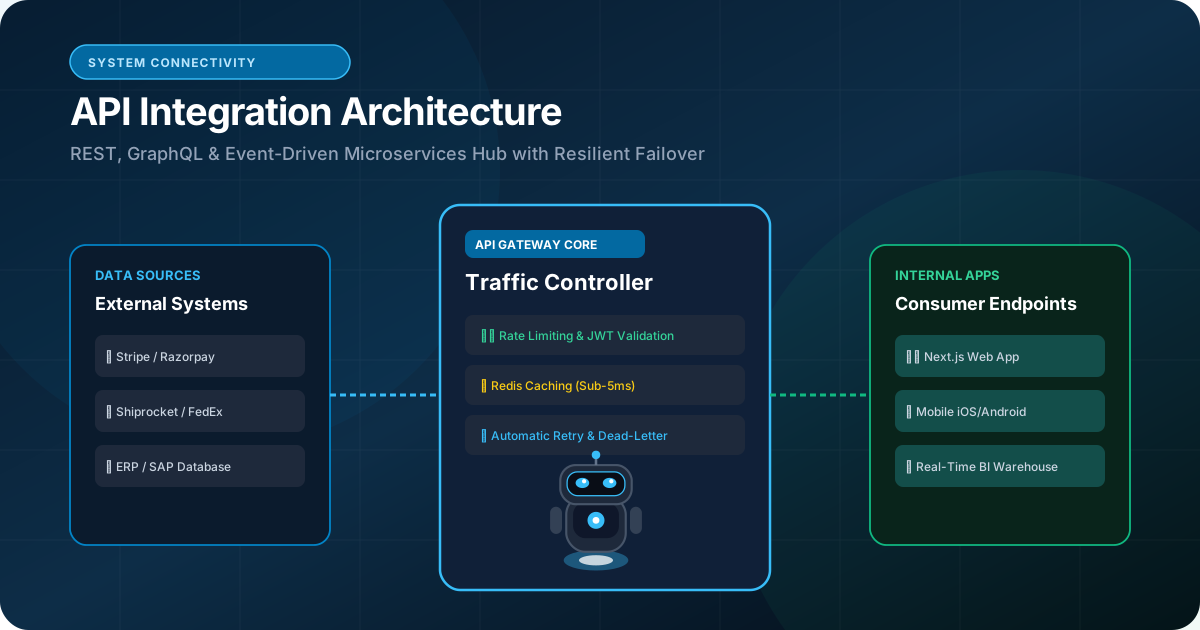
REST, GraphQL & payment gateway automation
Bespoke business portals & operational software
Multi-tenant software with automated Stripe Billing
Zero-trust session security & PCI compliance
- Stripe Developer Platform: Stripe Payment Intents & Webhooks DocumentationOfficial Reference
- Razorpay Developers: Razorpay Standard Checkout & Webhooks GuideOfficial Reference
- PCI Security Standards Council: PCI Security Standards Council: SAQ A GuidelinesOfficial Reference
Discuss Payment Integration
Need to integrate Stripe, Razorpay, recurring subscription billing, or multi-currency checkout into your website or web application? Speak with RankVRA to architect a secure payment pipeline.
Related Growth Blueprints
Explore more strategic articles from the RankVRA engineering desk.
eCommerce SEO India: The Ultimate Playbook to Scale Organic Revenue in 2026
Master eCommerce SEO in India. Learn advanced faceted navigation crawling, product schema, programmatic category pages, and outranking Amazon and Flipkart.
How to Build a Secure Business Web Application: The Enterprise Hardening Guide
Learn how to build secure business web applications. Defend against OWASP Top 10 vulnerabilities, secure API authentication, protect databases, and enforce zero-trust.
What Is SaaS Development? A Complete Guide to Building a SaaS Web Application
Learn how to build a scalable Software-as-a-Service (SaaS) web application. Master multi-tenant architecture, automated billing, role permissions, and product scalability.