
How to Choose a Web Development Company for Your Business: The Due Diligence Guide
A commercial evaluation framework covering portfolio audits, technical architecture, code ownership, security, and post-launch SLAs.

- 1. The High Stakes of Choosing a Web Development Partner
- 2. The 5 Agency Archetypes in the Global Market
- 3. Conducting Technical Due Diligence: 7 Sharp Questions
- 4. Code Ownership, IP Rights & Contract Protections
- 5. Comprehensive Web Development Partner Scorecard
- 6. Dangerous Red Flags That Signal Project Disaster
- 7. The RankVRA Production Standard & Next Steps
Selecting a web development company is one of the most critical commercial decisions an executive, founder, or marketing director will make. Choose the right partner, and you gain an ultra-fast, high-converting digital platform that scales your pipeline revenue, protects customer records, and operates as a valuable corporate asset for a decade. Choose the wrong agency, and you enter a frustrating spiral of missed deadlines, bloated buggy code, poor mobile speed, hidden costs, and eventual project abandonment—forcing you to pay another firm to rebuild the application from scratch. In markets spanning the United States, United Kingdom, Canada, India, and global commercial hubs, the web development landscape is saturated with thousands of agencies promising the world. This guide outlines an exhaustive due diligence framework to help you evaluate technical competence, verify genuine experience, and select a web development partner that delivers measurable business growth.
Choosing the right web development company requires looking beyond slick sales decks: evaluate their engineering depth (custom Next.js/React code vs bloated WordPress templates), verify genuine live client case studies, demand 100% intellectual property and repository ownership, inspect their cybersecurity and Core Web Vitals standards, and confirm structured post-launch SLAs.
1. The High Stakes of Choosing a Web Development Partner
Why your website is your company's most valuable commercial employee
Your website or web application is not a passive digital brochure; it is your 24/7 global sales director, client onboarding portal, and institutional brand ambassador.
When prospective enterprise clients or high-ticket consumers search for your services, your digital platform creates their primary impression. If your website takes 4 seconds to load, breaks on smartphone screens, or looks dated, buyers immediately question your operational competence.
Furthermore, for businesses building custom client portals, wholesale submission tools, or SaaS platforms, the software directly impacts daily operational cash flow.
Treating web development as a cheap commodity outsourced to the lowest bidder is one of the costliest mistakes a business can make.
2. The 5 Agency Archetypes in the Global Market
Understanding the different tiers of development providers and their trade-offs
The web development market generally divides into five distinct agency profiles:
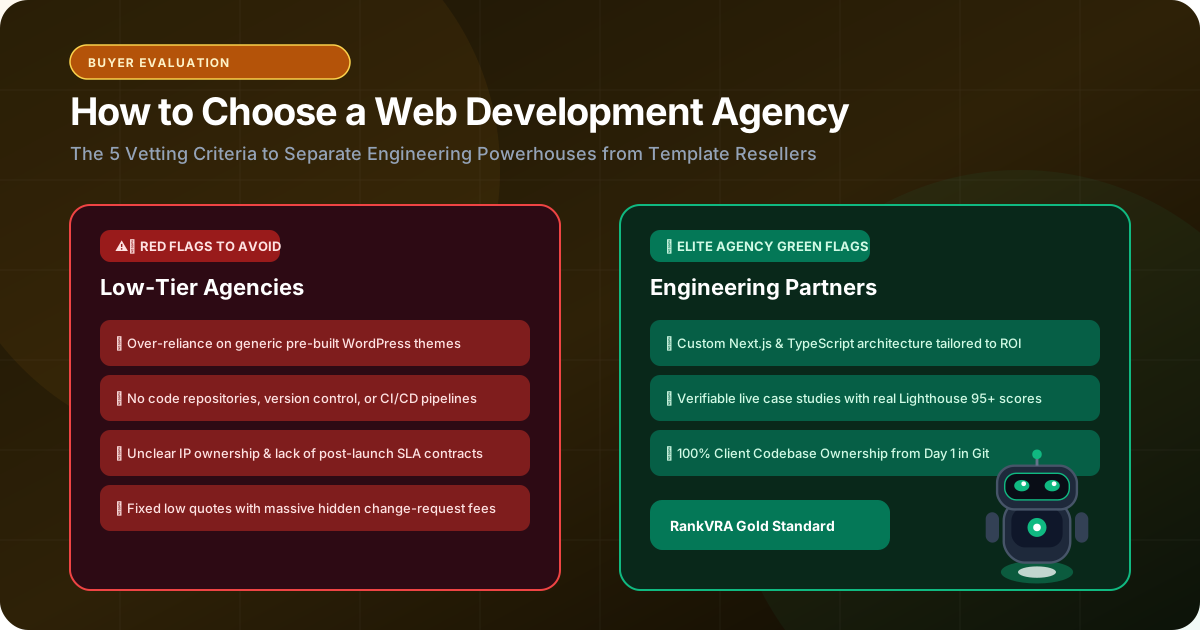
1. The Dirt-Cheap Template Shop ($500–$2,000): Relies on heavily bloated WordPress or PHP themes purchased off marketplace sites. They write zero custom code, install 40 conflicting plugins, and abandon the site the moment you request custom business logic.
2. The Generic Digital Marketing Agency ($3,000–$8,000): Primarily focuses on graphic design and social media ads. Web development is a secondary sideline handled by junior interns using basic site builders (Wix, Squarespace, or basic Elementor).
3. The Elite Boutique Engineering Firm (RankVRA) ($10,000–$60,000): Senior full-stack software engineers specializing in custom Next.js, React, Node.js, and PostgreSQL architectures. They engineer bespoke solutions tailored precisely to business workflows, with 100% code ownership, sub-second speeds, and direct founder-level technical consulting.
4. The Massive Offshore Dev Farm: Employs hundreds of junior coders with layers of non-technical account managers. Suffers from severe communication lag, high developer turnover, and bloated hourly billing.
5. The Enterprise Global Systems Integrator ($150,000+): Multi-national consultancies (Accenture, Deloitte). Exceptional capability, but burdened by massive corporate overhead, slow delivery cycles, and pricing out of reach for mid-market companies.
3. Conducting Technical Due Diligence: 7 Sharp Questions
Separate genuine software engineers from sales-pitch agencies
Before signing a contract, look past the slick PDF pitch deck and ask these seven technical questions:
1. 'What specific technology stack will you use, and why is it superior for our project?' (Red flag: 'We use whatever is easiest.' Green flag: 'We recommend Next.js App Router for sub-second LCP and PostgreSQL for relational transaction integrity.')
2. 'Can we inspect the live Google PageSpeed Insights and Core Web Vitals scores of three websites you recently built?' (Run their portfolio links through pagespeed.web.dev; if their past client sites score 40 on mobile, your site will score 40 as well.)
3. 'Will our company own 100% of the GitHub repository, database schemas, and cloud deployment keys from day one?' (Never accept an agency that holds code hostage under proprietary licenses.)
4. 'How do you handle backend security and OWASP Top 10 vulnerabilities?' (They should immediately articulate HttpOnly cookies, parameterized ORMs, and rate limiting.)
5. 'Do you write strictly typed TypeScript across the full stack?' (TypeScript eliminates hundreds of common runtime errors.)
6. 'What is your structured QA and automated testing process before launch?' (They should describe unit testing, end-to-end integration tests, and multi-device viewport testing.)
7. 'What does your post-launch Service Level Agreement (SLA) cover?' (Confirm guaranteed response times for bug fixes, security patches, and automated daily database backups.)
4. Code Ownership, IP Rights & Contract Protections
Ensuring your business retains 100% legal ownership of your digital assets
A major hazard in software outsourcing is ambiguous intellectual property agreements. Some low-tier agencies include clauses stating that the software framework or proprietary plugins remain the property of the agency, requiring you to pay perpetual monthly licensing fees.
At RankVRA, our commercial contract standard is absolute: Upon project completion and milestone clearance, 100% of all intellectual property, source code, database architectures, graphics, and documentation belong exclusively to your company.
Ensure your contract explicitly stipulates:
• Full source code repository transfer (GitHub / GitLab).
• Direct ownership of all cloud hosting accounts (Vercel, AWS, Supabase, Cloudflare).
• Zero proprietary vendor lock-in or recurring software usage royalties.
5. Comprehensive Web Development Partner Scorecard
An objective evaluation scorecard for comparing agency proposals
Use this weighted scorecard when evaluating multiple development proposals:
| Evaluation Criteria | Weight | What to Look For | Warning Signs |
|---|---|---|---|
| Technical Stack & Engineering Depth | 25% | Modern Next.js, React, Node.js, Python, PostgreSQL | Outdated PHP templates, bloated WordPress plugins |
| Verified Live Case Studies | 20% | Verifiable live production URLs with real client results | Only static image mockups or dead portfolio links |
| Performance & Core Web Vitals | 15% | Verified 90+ mobile PageSpeed scores and sub-1.2s LCP | Sluggish mobile performance (>3s load times) |
| Security & Data Protection | 15% | OWASP Top 10 compliance, HttpOnly auth, strict CSP | No clear answers on authentication or database security |
| Code Ownership & IP Terms | 15% | 100% client IP transfer in contractual writing | Agency retains codebase rights or proprietary lock-in |
| Communication & Process | 10% | Direct access to senior engineers; clear milestones | Non-technical account managers filtering all dialogue |
6. Dangerous Red Flags That Signal Project Disaster
Walk away immediately if an agency exhibits any of these behaviors
Throughout our industry, failed development projects almost always exhibit early warning signs:
• Red Flag 1: Guaranteeing Fixed Delivery in Unrealistic Timelines (e.g., 'We will build your entire custom portal in 7 days!'). Complex software requires disciplined architecture, modeling, and QA. Rushed builds guarantee catastrophic bugs.
• Red Flag 2: Refusing to Share Live Client References or Case Studies. A reputable firm proudly showcases live production platforms (like Capital & Co Insurance or the Sterling Wholesale Insurance Portal).
• Red Flag 3: The 'Yes to Everything' Salesperson. If an agency agrees to every complex feature request without asking challenging questions about database relationships, API limits, or budget feasibility, they do not understand software engineering.
• Red Flag 4: Lack of Written Milestone Specifications. If a proposal lists high-level bullet points without detailed functional specifications, scope creep and billing disputes are inevitable.
7. The RankVRA Production Standard & Next Steps
How RankVRA partners with ambitious national and international businesses
RankVRA was founded on a singular engineering philosophy: Eliminate the bloat, middleman friction, and broken promises of traditional agencies.
When you partner with RankVRA for web development services:
• Direct Senior Technical Access: You consult directly with Founder & Lead Technical Architect Naveen Panchal—not non-technical account managers.
• 100% Custom Next.js Architecture: We write clean, accessible, type-safe TypeScript code with zero bloated templates and zero unnecessary plugins.
• Sub-Second Speed Guarantee: Every application is engineered for flawless Google Core Web Vitals and blistering mobile responsiveness.
• 100% Code & IP Ownership: Complete transfer of GitHub repositories, database schemas, and cloud deployment pipelines upon launch.
• Transparent Milestone Billing: Predictable fixed-scope pricing with deliverables tied to verified functional milestones.
The Bottom Line & Next Steps
Choosing a web development company is an investment in your company's operational future. By demanding technical depth, verifying real production performance, securing complete code ownership, and partnering with experienced engineers who understand business ROI, you build a digital asset that drives commercial growth for years to come. If you are ready to evaluate your web development project with an engineering team that puts performance and transparency first, schedule a consultation with RankVRA today.
Questions Business Leaders Ask About web development company
How much does it typically cost to work with a professional web development company?▾
High-performance custom web development projects typically range from $5,000 to $15,000 for bespoke corporate marketing platforms, and $15,000 to $60,000+ for custom web applications, client portals, and multi-tenant SaaS platforms. Costs are structured around functional scope, complexity, and integrations.
Can RankVRA work with clients located internationally (US, UK, Canada)?▾
Yes. A significant portion of RankVRA's engineering work is delivered for international clients across the United States, United Kingdom, and Canada (including enterprise insurance platforms like Capital & Co Insurance and the Sterling Wholesale Insurance Portal). We utilize asynchronous video updates, clear GitHub milestones, and overlapping communication windows.
What happens after our website or web application launches?▾
We provide comprehensive post-launch support, including 30 days of complimentary hypercare bug monitoring, followed by optional structured monthly Service Level Agreements (SLAs) covering uptime monitoring, security patching, database backups, and ongoing feature development sprints.

Written by Naveen Panchal
AuthorFounder & Lead Technical Architect, RankVRA
Naveen Panchal is the Founder and Technical Director of RankVRA. He specializes in full-stack web engineering, Next.js architecture, and high-performance digital systems for clients across the US, UK, Canada, and India.
Explore Core Commercial Capabilities
Custom Next.js & React website engineering
Bespoke business portals & operational software
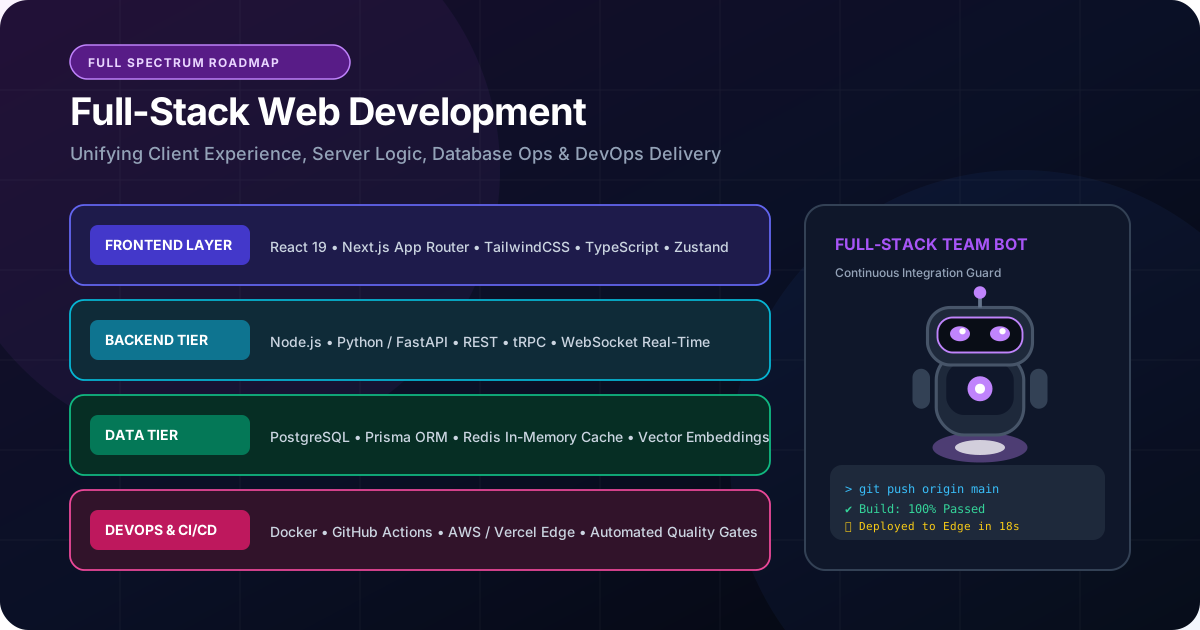
Sub-second React & Next.js user interfaces
Node.js, Python & scalable database architecture
Unified client-to-database engineering
Core Web Vitals & speed engineering
- World Wide Web Consortium: W3C Web Standards & ArchitectureOfficial Reference
- OWASP Foundation: OWASP Software Security Verification StandardOfficial Reference
- Google Search Central: Google Search Central: Hiring an SEO & Web Development AgencyOfficial Reference
Get a Free Web Development Consultation
Planning a new web application, client portal, or website redesign? Speak directly with RankVRA Founder & Lead Technical Architect Naveen Panchal to review your project scope, evaluate tech options, and receive a transparent architectural blueprint.
Related Growth Blueprints
Explore more strategic articles from the RankVRA engineering desk.
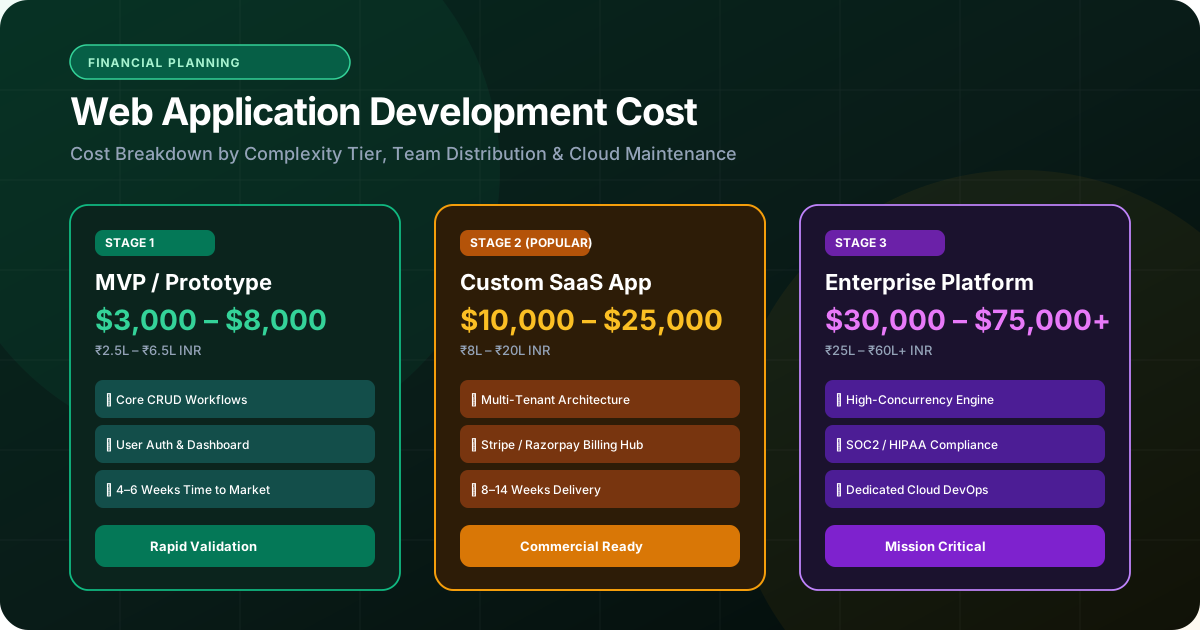
How Much Does Custom Web Application Development Cost? The Definitive Business Guide
Understand what dictates custom web application development cost. Learn the real factors—complexity, integrations, databases, and security—that determine software investment.
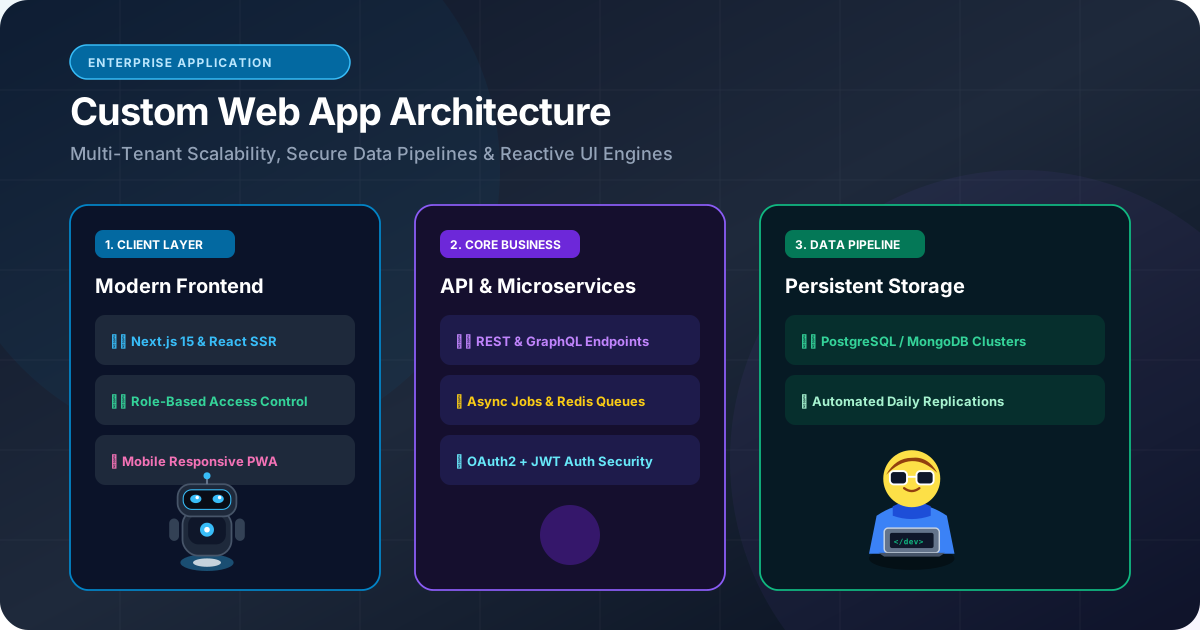
Custom Web Application Development: When Should a Business Build a Custom Web App?
When should a business build custom web applications instead of subscribing to SaaS? Learn how custom portals, wholesale dashboards, and bespoke workflows deliver compounding ROI.
What Is Full-Stack Web Development? Frontend, Backend and APIs Explained
Demystify full-stack web development. Learn how frontend interfaces, backend servers, relational databases, and REST APIs connect to deliver business web platforms.