
What Is Backend Development and Why Is It Important for Modern Web Applications?
An authoritative guide to server runtimes, database architecture, API security, and high-concurrency computation.

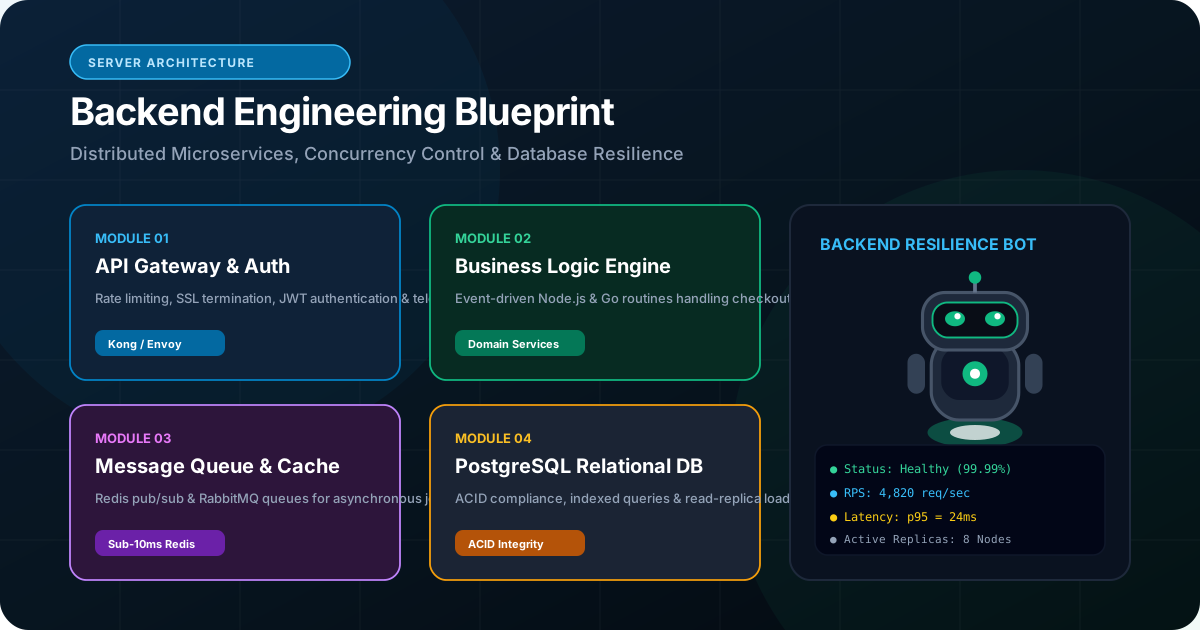
- 1. The True Definition of Backend Development
- 2. The 5 Core Responsibilities of Modern Backend Systems
- 3. Backend Runtimes: Node.js vs Python (FastAPI/Django)
- 4. Database Architecture: Relational Schemas & In-Memory Caching
- 5. Backend Security: OWASP Top 10 Hardening & Zero-Trust
- 6. Handling High Concurrency: Queues, Workers & Caching
- 7. The Business Owner's Backend Architecture Checklist
When business leaders interact with digital technology, they naturally focus on what they can see: sleek visual layouts, smooth typography, and responsive mobile animations. But in reality, the user interface accounts for only a fraction of a software system's complexity. Beneath the surface lies the engine that makes the entire platform function: the backend. If your backend is poorly engineered, your website will suffer from sluggish database queries, security vulnerabilities, lost customer orders, and catastrophic downtime when traffic surges. Understanding backend development allows founders, CTOs, and commercial executives to make informed technology investments, protect proprietary data, and build platforms capable of supporting millions in enterprise revenue.
Backend development is the server-side engineering that powers web applications behind the scenes. It manages data storage, complex business rules, user authentication, third-party API communication, and cybersecurity—ensuring that the user-facing frontend functions securely, accurately, and rapidly under heavy load.
1. The True Definition of Backend Development
The invisible computing foundation that orchestrates logic, data, and security
Backend development refers to everything that occurs on the server, in the database, and across external API networks to power a web application.
When a customer navigates to your web platform, their browser downloads the visual frontend. But the moment they log into an account, submit a payment, search a product catalog, or request an insurance quote, the browser must communicate with a secure server environment.
The backend validates the user's identity, queries the database, runs business calculations, updates transaction records, triggers background tasks, and formats the result as a secure JSON response. Because the backend runs in a protected cloud environment that the public cannot inspect directly, it is the sole repository of absolute operational truth.
2. The 5 Core Responsibilities of Modern Backend Systems
What backend engineers actually build to protect and scale your company
Enterprise backend engineering encompasses five mission-critical domains:
1. Identity & Session Authorization: Managing cryptographic tokens (JWT), multi-factor authentication (MFA), and Role-Based Access Control (RBAC) so that customers, brokers, staff, and administrators can only view data appropriate to their clearance.
2. Business Logic Execution: Implementing your company's proprietary pricing algorithms, order fulfillment workflows, and tax compliance calculations with mathematical certainty.
3. Data Persistence & Integrity: Designing normalized database schemas that record financial ledgers, inventory counts, and customer histories with strict ACID transaction guarantees.
4. API Gateway & Microservice Orchestration: Exposing structured REST or GraphQL endpoints that allow frontends, mobile apps, and third-party enterprise tools to communicate seamlessly.
5. Asynchronous Task Processing: Offloading computational bottlenecks—such as processing high-resolution media, generating PDF statements, or syncing CRM webhooks—to background worker queues so server response times remain under 100 milliseconds.
3. Backend Runtimes: Node.js vs Python (FastAPI/Django)
Selecting the optimal language and server framework for your commercial domain
While dozens of server languages exist, modern enterprise web development centers primarily on two dominant ecosystems:
• Node.js & TypeScript (NestJS, Express, Next.js Server Actions): Node.js uses an event-driven, non-blocking I/O model that makes it exceptionally lightweight and fast for high-concurrency applications, real-time messaging, and high-volume REST APIs. Using TypeScript on both the frontend and backend eliminates serialization bugs and accelerates feature velocity.
• Python (FastAPI, Django): Python is the global standard for data analysis, mathematical modeling, and artificial intelligence. When building applications that incorporate AI automation & machine learning, automated document ingestion, or complex algorithmic parsing, Python FastAPI provides asynchronous execution speed, native OpenAPI documentation, and strict Pydantic type safety.
4. Database Architecture: Relational Schemas & In-Memory Caching
Why PostgreSQL + Redis forms the backbone of reliable enterprise applications
A web application is only as resilient as its underlying database. In commercial systems, we prioritize a tiered data architecture:
• Persistent Relational Tier (PostgreSQL): PostgreSQL is the most advanced open-source relational database in the world. It provides robust foreign-key constraints, sophisticated query planners, table partitioning for billions of rows, and JSONB columns for flexible semi-structured data.
• In-Memory Caching Tier (Redis): Redis stores frequently accessed data in server RAM. By caching active user sessions, permissions matrices, and high-traffic catalog queries in Redis, your server returns data in sub-millisecond speeds and shields the primary PostgreSQL database from query overload.
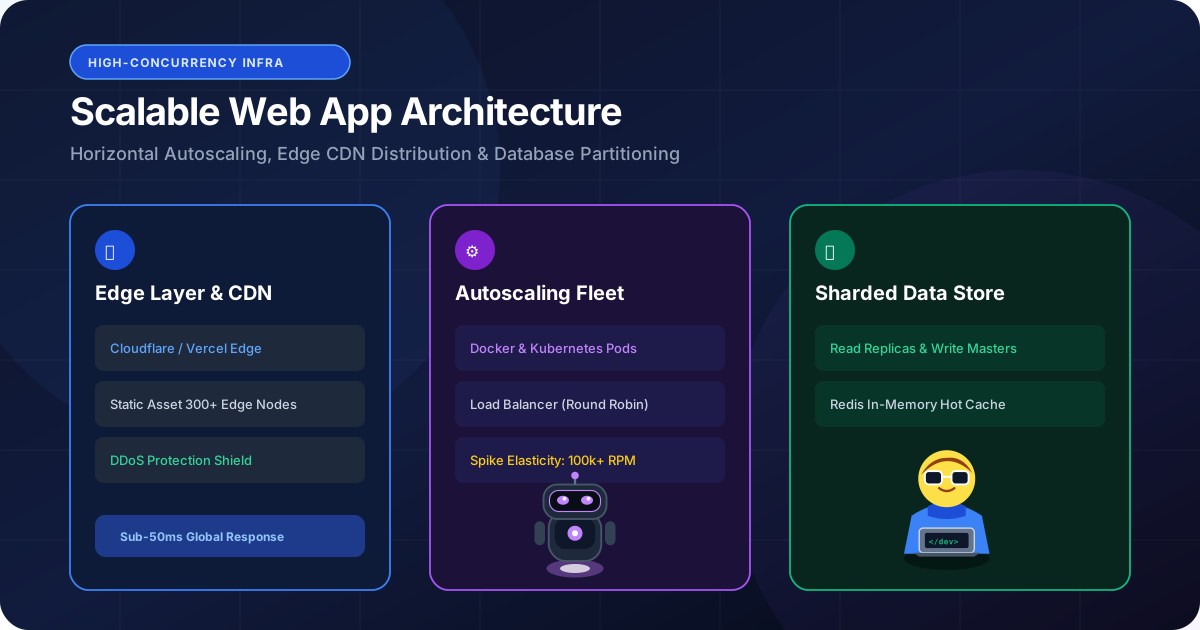
| Component Layer | Primary Technology | Key Commercial Benefit | Alternative Options |
|---|---|---|---|
| Server Runtime | Node.js (TypeScript) / Python (FastAPI) | High concurrency, type safety, rapid API development | Go (Golang), Java Spring Boot |
| Primary Relational DB | PostgreSQL | Rock-solid ACID compliance, complex relational queries | MySQL, MariaDB |
| In-Memory Cache | Redis | Sub-millisecond latency for sessions, rate limits, queues | Memcached, Dragonfly |
| ORM / Query Builder | Prisma / SQLAlchemy | Compile-time schema safety, automated migrations | TypeORM, raw SQL pools |
| Job / Task Queue | BullMQ / Celery (Redis backed) | Non-blocking background processing of heavy workloads | RabbitMQ, AWS SQS |
| Container Deployment | Docker + AWS ECS / Cloud Run | Predictable immutable builds, auto-scaling clusters | Kubernetes (K8s), Bare Metal VMs |
5. Backend Security: OWASP Top 10 Hardening & Zero-Trust
Defending proprietary databases and customer records against cyber attacks
Data breaches can destroy brand reputation and lead to massive regulatory fines. Professional web security engineering enforces strict defenses:
• SQL Injection Elimination: Never concatenating raw strings into SQL queries. Utilizing parameterized queries and modern ORMs (Prisma, SQLAlchemy) so malicious user inputs cannot alter database query logic.
• Cryptographic Password Hashing: Storing passwords using slow, computationally expensive hashing algorithms (bcrypt or Argon2id) with unique cryptographic salts, rendering compromised credential lists useless to hackers.
• Secure Session Cookie Architecture: Issuing authentication tokens inside HttpOnly, Secure, SameSite=Strict cookies. This prevents malicious JavaScript running in the browser from accessing user session keys.
• API Rate Limiting: Deploying token-bucket rate limiters in Redis to block brute-force password guessing, credential stuffing, and scraping bots.
6. Handling High Concurrency: Queues, Workers & Caching
Ensuring your application maintains sub-100ms response times during traffic spikes
When hundreds or thousands of users access your platform simultaneously, naive backend code degrades rapidly. Senior backend architects implement three scaling mechanisms:
1. Connection Pooling: Maintaining a managed pool of database connections (using tools like PgBouncer) so thousands of concurrent requests share database threads without exhausting server memory.
2. Decoupled Asynchronous Workers: When a user triggers an action that takes more than 100ms—such as generating a complex PDF quote or syncing with an external CRM—the backend immediately acknowledges the user and passes the task to a background worker queue (BullMQ). The user experiences instantaneous responsiveness.
3. Database Indexing & Query Profiling: Continuously analyzing slow query logs (EXPLAIN ANALYZE) and adding composite indexes to frequently queried columns, reducing database execution times from 2,500ms to 4ms.
7. The Business Owner's Backend Architecture Checklist
8 critical verification points before launching your digital platform
Before launching any custom software or web application, verify that your backend engineering partner has addressed these operational requirements:
• Automated Database Migrations: Can schema updates be applied and rolled back seamlessly without downtime or data corruption?
• Automated Daily Backups: Are encrypted point-in-time database backups stored across geographically separated cloud regions?
• Error Logging & Telemetry: Is Sentry or Datadog tracking uncaught backend exceptions in real time with automated developer alerting?
• Environment Secret Segregation: Are API keys and database credentials strictly isolated from source code repositories?
• Comprehensive Unit & Integration Tests: Are critical financial calculations, authentication middleware, and API endpoints verified by automated CI/CD test suites?
• Documented OpenAPI Schemas: Does the backend produce interactive Swagger/OpenAPI documentation for frontend and mobile engineers?
• CORS & Header Security: Are Cross-Origin Resource Sharing (CORS) rules strictly restricted to your authorized domains?
• Scalable Cloud Provisioning: Is the backend containerized with Docker, enabling effortless horizontal scaling as traffic multiplies?
The Bottom Line & Next Steps
Backend development is the invisible powerhouse of modern business software. A beautiful user interface may attract a prospective client, but it is a robust, secure, and rapid backend that processes their transactions, protects their confidential records, and ensures your application scales without crashing. When commissioning web development, demand senior backend architectural expertise from day one. Contact RankVRA to evaluate and architect your backend infrastructure.
Questions Business Leaders Ask About backend development
Can an existing slow backend be optimized without a complete rebuild?▾
Yes. In most cases, slow backends suffer from unindexed database queries, missing caching layers, or synchronous blocking tasks. By profiling database queries, introducing Redis caching, and offloading heavy tasks to asynchronous background queues, we frequently improve API response times by 5x to 10x without rewriting core business logic.
What is the difference between a REST API and a GraphQL API on the backend?▾
REST APIs use standardized HTTP endpoints (e.g., /api/orders) that return fixed data structures. GraphQL allows the frontend client to query multiple resources in a single request and specify exactly which fields it needs. REST is simpler to cache and secure, while GraphQL is ideal for complex data graphs with diverse mobile clients.
How do you ensure our backend database complies with data protection regulations?▾
We implement database encryption at rest (AES-256), TLS 1.3 encryption in transit, strict Role-Based Access Control, automated audit logging of all sensitive record modifications, and automated daily encrypted backups in compliance with GDPR and industry standards.

Written by Naveen Panchal
AuthorFounder & Lead Technical Architect, RankVRA
Naveen Panchal is the Founder and Technical Director of RankVRA. He specializes in full-stack web engineering, Next.js architecture, and high-performance digital systems for clients across the US, UK, Canada, and India.
Explore Core Commercial Capabilities
Scalable Node.js, Python & database architecture
Zero-trust session security & vulnerability remediation
Complete client-to-database engineering
REST, GraphQL & third-party business automation
Custom business portals & operational software
- OWASP Foundation: OWASP Top 10 Web Application Security RisksOfficial Reference
- PostgreSQL Global Development Group: PostgreSQL Architecture & Reliability DocumentationOfficial Reference
- OpenJS Foundation: Node.js Performance & Best PracticesOfficial Reference
Talk to a Backend Development Expert
Need to architect a high-throughput API, optimize an existing slow database, or secure your company's server infrastructure? Consult with lead technical architect Naveen Panchal.
Related Growth Blueprints
Explore more strategic articles from the RankVRA engineering desk.
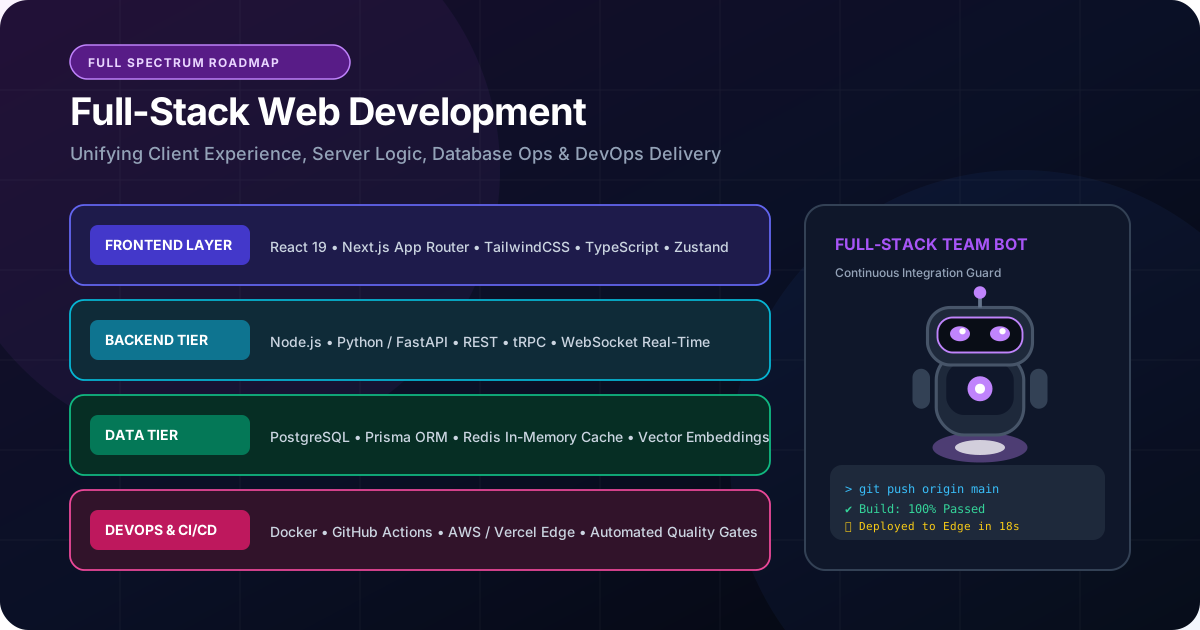
What Is Full-Stack Web Development? Frontend, Backend and APIs Explained
Demystify full-stack web development. Learn how frontend interfaces, backend servers, relational databases, and REST APIs connect to deliver business web platforms.
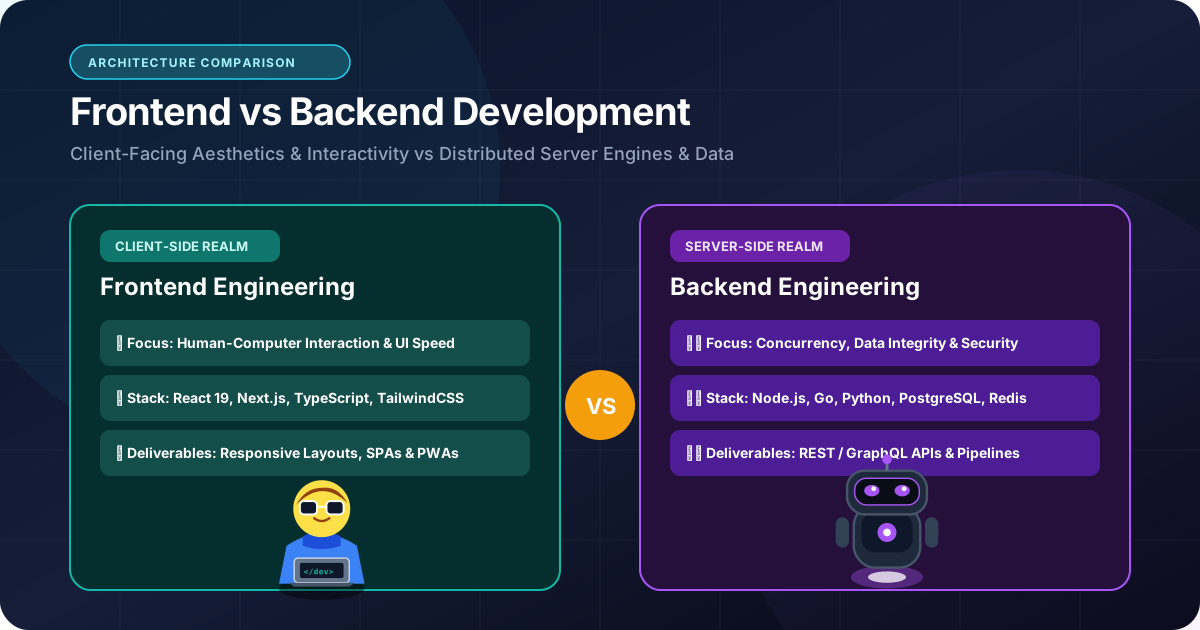
Frontend vs Backend Development: What Does Your Business Actually Need?
Understand the practical differences between frontend and backend development. Discover which layer drives user conversion vs data security, and how to allocate your budget.
How to Build a Scalable Web Application for a Growing Business
Learn how to architect scalable web applications. Discover proven strategies for horizontal scaling, database read replicas, Redis caching, and zero-downtime growth.