
How API Integration Can Connect Your Website With Business Tools
A practical guide to connecting CRMs, ERPs, payment gateways, and WhatsApp automation directly to your digital web platform.

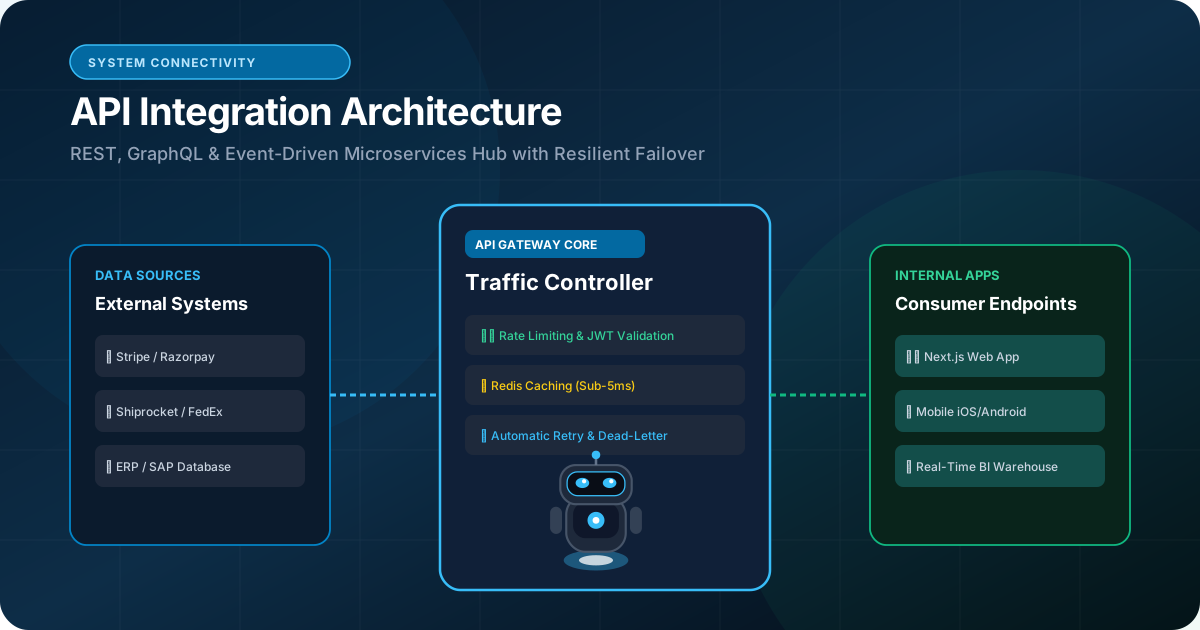
- 1. How API Integration Works in Modern Web Applications
- 2. The 4 Essential API Integrations Every Business Needs
- 3. Webhooks vs Polling: Real-Time Event Architecture
- 4. Engineering API Resilience: Retries, Idempotency & Security
- 5. Popular Business Tools & Integration Protocols
- 6. The Operational Cost of Unintegrated Digital Systems
- 7. RankVRA's Step-by-Step API Integration Playbook
In a modern organization, business software is rarely centralized in a single tool. Your sales team lives in HubSpot or Salesforce; your finance department relies on QuickBooks or Xero; your warehouse operates on a custom ERP; and your marketing runs through Google Ads and email platforms. The critical operational question is: How does your website communicate with these tools? When a high-ticket commercial lead submits a proposal request at 10 PM, does an employee have to manually re-type that data into your CRM the next morning, or does an automated API pipeline instantly route the lead, enrich their contact profile, and notify your sales team in seconds? This guide explains how API integration transforms isolated websites into automated revenue engines.
API integration connects your website or web application directly to external business software—such as CRMs, payment gateways, ERPs, and messaging APIs—allowing data to flow automatically in real time without human intervention or manual data entry.
1. How API Integration Works in Modern Web Applications
Standardized protocols enabling distinct software platforms to exchange data securely
An API (Application Programming Interface) is a set of standardized rules, endpoints, and data contracts that allow two disparate software platforms to communicate.
In modern API development & integration, communication follows a predictable cycle:
1. Event Trigger: A customer completes a transaction or submits a form on your web application.
2. Request Dispatch: Your server packages the customer data into a standardized JSON payload and transmits an encrypted HTTPS request to the external software's API endpoint.
3. Server Processing: The external software verifies authentication headers (API keys or OAuth2 bearer tokens), processes the payload, and executes the action (e.g., creates a new deal record).
4. Acknowledgment & Sync: The external server returns a status response (e.g., 200 OK or 201 Created), which your application logs to confirm completion.
Because this exchange occurs in milliseconds across secure cloud networks, data across your entire software ecosystem remains synchronized in real time.
2. The 4 Essential API Integrations Every Business Needs
Where automated data connections deliver the highest operational leverage
While thousands of specialized tools offer APIs, four core categories deliver immediate commercial value for expanding companies:
• CRM & Lead Routing (HubSpot, Salesforce, Zoho): Instantly syncing inbound website inquiries into active sales pipelines, applying lead scoring rules, and automatically assigning accounts to reps based on territory or deal size.
• Payment Gateways (Stripe, Razorpay, PayPal): Processing credit cards, ACH transfers, and recurring subscription billings directly inside your web application without redirecting buyers to clunky third-party checkout pages.
• Instant Messaging & WhatsApp Cloud API: Leveraging AI automation workflows to send instant order confirmations, document links, or automated lead triage messages directly to the customer's WhatsApp within 30 seconds of form submission.
• Accounting & ERP Sync (QuickBooks, NetSuite): Creating synchronized invoices, recording revenue recognition, and updating inventory counts automatically whenever a sale closes.
3. Webhooks vs Polling: Real-Time Event Architecture
Why event-driven webhooks outperform traditional scheduled queries
Historically, software connected via 'polling'—your server queried an external system every 5 minutes: 'Are there any new orders yet?' Polling is wasteful, burns server resources, and introduces artificial latency.
Modern web engineering utilizes Webhooks (reverse APIs). Instead of constantly asking, your application registers a dedicated webhook listener URL with the external service. When an event happens—such as Stripe successfully capturing a $5,000 policy renewal payment—Stripe immediately pushes the event payload directly to your server.
Your application receives the notification in under 100 milliseconds, verifies the cryptographic signature, and updates customer account access immediately.
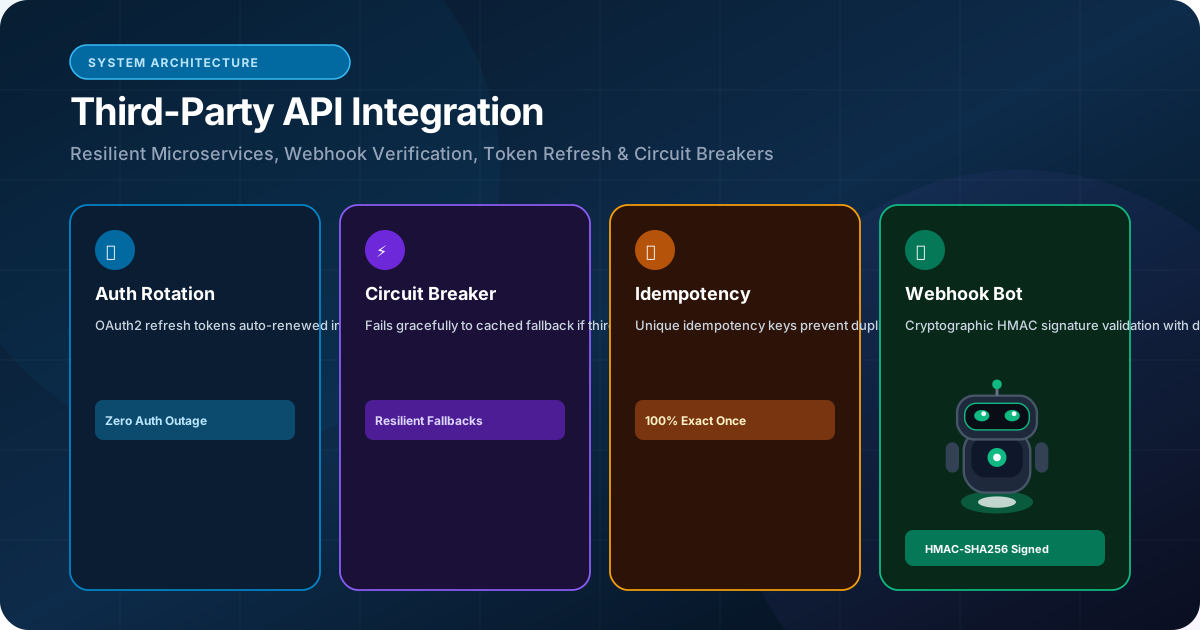
4. Engineering API Resilience: Retries, Idempotency & Security
Protecting data pipelines against network drops and third-party downtime
Beginner developers often write simple API calls that fail silently when an external vendor experiences a temporary outage. Professional full-stack web engineering demands resilient architecture:
• Idempotency Keys: Ensuring that if a network glitch causes an API call to send twice, the payment gateway or CRM knows it is the same transaction and avoids charging the customer twice or creating duplicate lead records.
• Exponential Backoff & Retry Queues: If an external API returns a 503 Service Unavailable or 429 Too Many Requests status, our background worker queue (BullMQ/Redis) automatically pauses and retries the request after 2, 4, 8, and 16 seconds.
• Cryptographic Webhook Verification: Verifying HMAC SHA-256 signatures on every incoming webhook to prevent malicious actors from spoofing payment confirmations or injecting unauthorized records.
5. Popular Business Tools & Integration Protocols
Standard integration protocols across leading enterprise software suites
The table below illustrates common business software categories, their primary API architectures, and standard integration use cases:
| Software Category | Representative Tools | Primary Protocol | Standard Integration Use Case |
|---|---|---|---|
| Payment Processing | Stripe, Razorpay, Authorize.Net | REST + Signed Webhooks | Tokenized Card Vaulting, Subscriptions, Refund Automation |
| CRM & Sales | Salesforce, HubSpot, Pipedrive | REST & GraphQL | Two-Way Contact Sync, Deal Stage Updates, Lead Attribution |
| Instant Communication | WhatsApp Cloud API, Twilio | REST + Event Webhooks | Automated Lead Qualification, SMS/WhatsApp OTP, Alerts |
| Accounting & ERP | QuickBooks, Xero, NetSuite | REST + OAuth2 | Automated Invoice Generation, Tax Compliance, Ledger Sync |
| Logistics & Shipping | FedEx, DHL, Shiprocket | REST APIs | Live Shipping Rate Quotes, Label Creation, Tracking Webhooks |
| AI & Machine Learning | OpenAI, Google Gemini, Anthropic | REST Streaming APIs | Automated RFP Document Parsing, Support Chatbots |
6. The Operational Cost of Unintegrated Digital Systems
Why manual data hand-offs cost businesses tens of thousands annually
When software systems operate in silos, the financial cost is staggering:
• Delayed Lead Response: Studies consistently prove that reaching out to an inbound commercial lead within 5 minutes results in 21x higher qualification rates than waiting 30 minutes. If your website forms sit in an email inbox until someone notices them, you are losing high-ticket clients to competitors.
• Human Data Entry Errors: Typographical errors in phone numbers, mailing addresses, or invoice line items lead to failed shipments, lost deals, and customer dissatisfaction.
• Wasted Payroll: Paying skilled administrative staff $25 to $50 per hour simply to re-type data between web forms and internal databases is an enormous waste of human capital.
7. RankVRA's Step-by-Step API Integration Playbook
A disciplined 5-stage engineering workflow for rock-solid system connectivity
When RankVRA builds API integrations for clients across the US, UK, Canada, and India, we follow a strict implementation protocol:
1. API Contract Definition: Mapping every data field between the source and destination schemas, including fallback values for missing attributes.
2. Authentication & Credential Vaulting: Storing API secrets and OAuth2 refresh tokens in encrypted cloud key vaults (AWS Secrets Manager or Vercel Environment Variables)—never hardcoded in source repositories.
3. Staging Sandbox Testing: Simulating success, failure, timeout, and rate-limit scenarios using vendor test API environments before touching production data.
4. Webhook Receiver Hardening: Implementing Redis-backed asynchronous worker queues to acknowledge incoming webhooks in under 50ms while processing heavy tasks in the background.
5. Telemetry & Alerting: Configuring automated error notifications (via Sentry or Slack webhooks) so our engineering team is alerted immediately if an external vendor API degrades.
The Bottom Line & Next Steps
In modern commerce, your website is not an isolated brochure; it is the front door of an automated operational ecosystem. By engineering resilient API integrations, you bridge the gap between customer interactions, sales pipelines, payment collection, and internal enterprise tools. Stop losing time and money to manual data entry. Discuss your API integration requirements with RankVRA today.
Questions Business Leaders Ask About API integration
Can any website be integrated with external software via APIs?▾
Yes, provided the website's backend allows custom code execution and the external software offers documented API access. Modern platforms built with Next.js, Node.js, or Python can integrate with virtually any third-party system that supports REST, GraphQL, or webhooks.
What is the difference between Zapier/Make and custom API integration?▾
No-code tools like Zapier are useful for simple, low-volume automations. However, they impose recurring per-task fees, introduce noticeable delays (often 5 to 15 minutes), struggle with complex business logic, and lack advanced data encryption. Custom API integration executes in milliseconds, costs nothing in per-task fees, and gives your business 100% control over data flow.
What happens if a third-party API goes down?▾
In professionally engineered applications, third-party downtime does not crash your website. Inbound requests are safely stored in a durable Redis queue. As soon as the external service recovers, our automated worker retries the requests with zero data loss.

Written by Naveen Panchal
AuthorFounder & Lead Technical Architect, RankVRA
Naveen Panchal is the Founder and Technical Director of RankVRA. He specializes in full-stack web engineering, Next.js architecture, and high-performance digital systems for clients across the US, UK, Canada, and India.
Explore Core Commercial Capabilities
REST, GraphQL & third-party business automation
WhatsApp Business API & intelligent workflow bots
Custom business portals & operational software
Node.js, Python & scalable microservices
Complete client-to-database engineering
- OWASP Foundation: OWASP API Security Top 10 GuidelinesOfficial Reference
- Stripe Developer Platform: Stripe Webhook Best Practices & IdempotencyOfficial Reference
- Meta for Developers: Meta WhatsApp Business Cloud API DocumentationOfficial Reference
Discuss Your API Integration Requirements
Connect your website directly to your CRM, ERP, payment gateway, or WhatsApp automation pipeline. Speak with RankVRA's engineering team to architect a seamless, resilient integration.
Related Growth Blueprints
Explore more strategic articles from the RankVRA engineering desk.
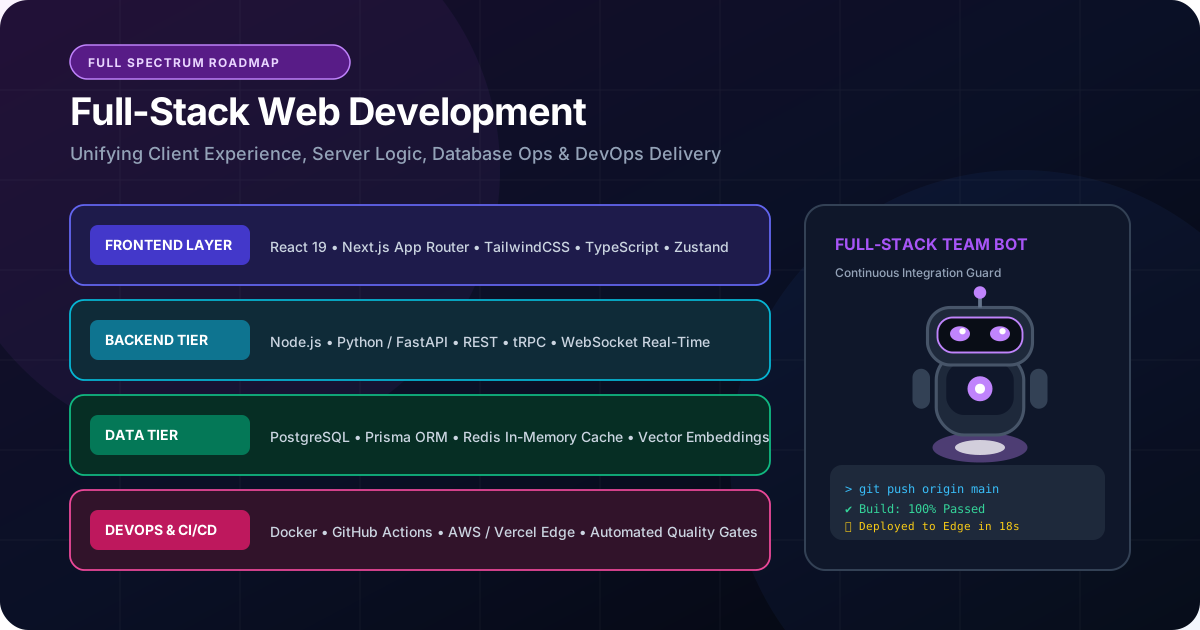
What Is Full-Stack Web Development? Frontend, Backend and APIs Explained
Demystify full-stack web development. Learn how frontend interfaces, backend servers, relational databases, and REST APIs connect to deliver business web platforms.
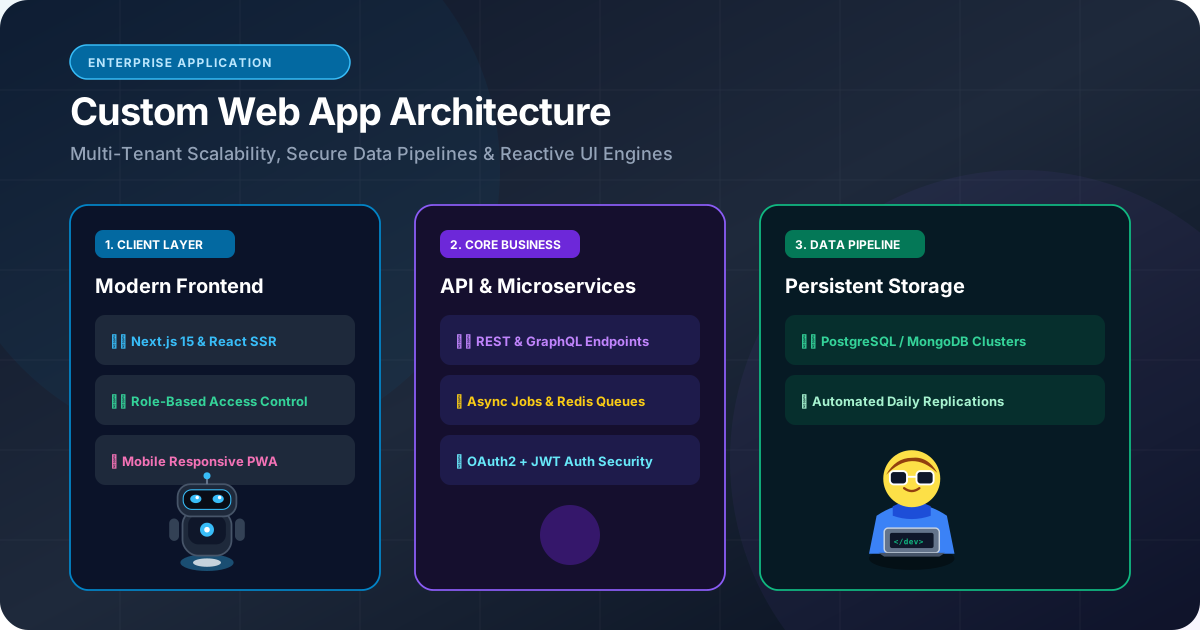
Custom Web Application Development: When Should a Business Build a Custom Web App?
When should a business build custom web applications instead of subscribing to SaaS? Learn how custom portals, wholesale dashboards, and bespoke workflows deliver compounding ROI.
How Third-Party API Integrations Improve Business Automation: A Technical Deep Dive
Discover how third-party API integrations eliminate operational silos, automate lead routing, sync enterprise ERPs, and scale business efficiency.