
Custom Software vs SaaS: What Should Your Business Build or Buy?
An executive framework for choosing between off-the-shelf subscriptions, customized SaaS, bespoke internal software, or building your own commercial SaaS product.

- 1. The Modern Build vs Buy Dilemma
- 2. The 4 Strategic Software Paths Available to Enterprises
- 3. The 8-Point Strategic Evaluation Matrix
- 4. When Buying SaaS Is the Economically Rational Choice
- 5. When Custom Software Engineering Delivers Asymmetric ROI
- 6. Transitioning from Internal Tool to Commercial SaaS Product
- 7. The Executive Build vs Buy Decision Framework
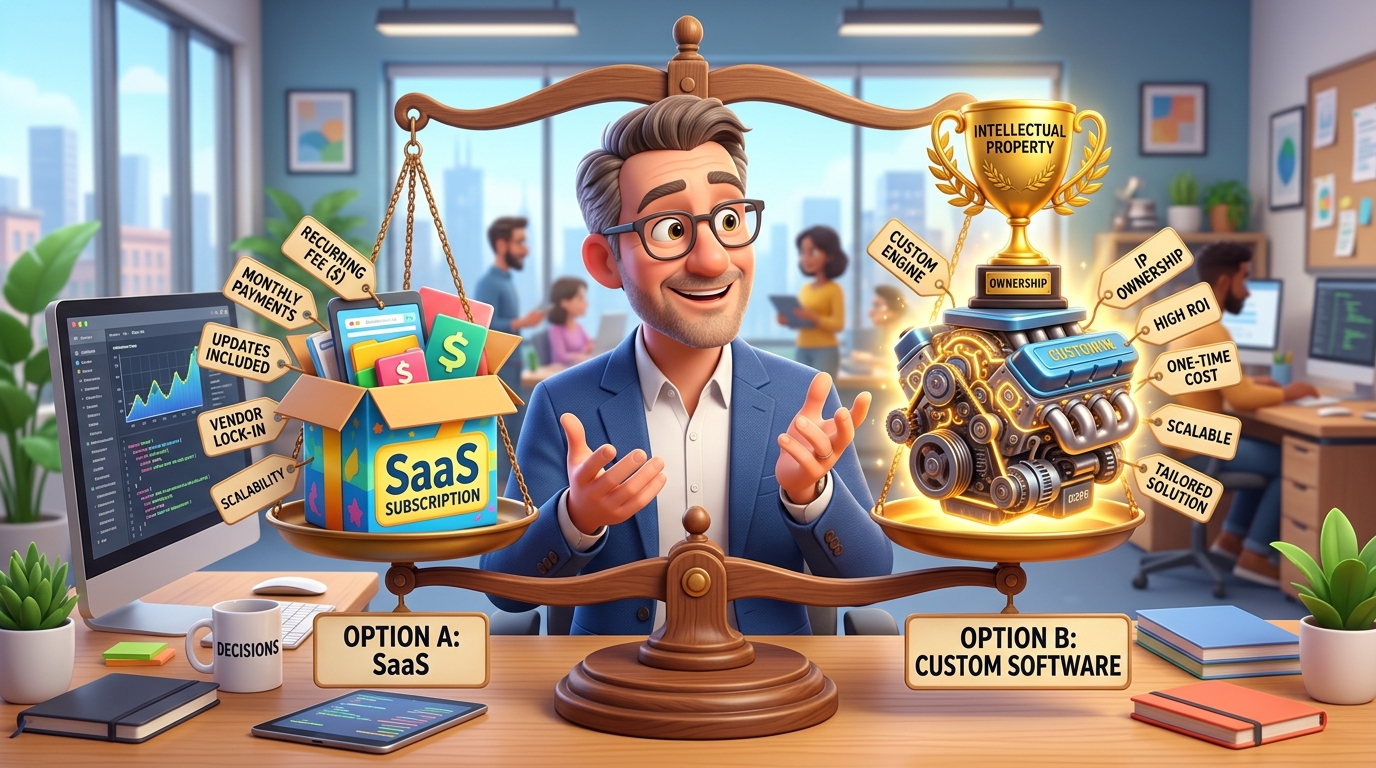
Every expanding enterprise eventually arrives at a critical technology crossroads: Should we subscribe to an existing Software-as-a-Service (SaaS) platform, attempt to customize an off-the-shelf tool, or invest capital in building proprietary custom software? In boardrooms and executive committees, this decision is often framed as an emotional battle between immediate speed and total control. Finance leaders point to the low initial cost of SaaS subscriptions, while operational leaders complain that generic software forces employees into clunky, inefficient workarounds that degrade customer service. Compounding the complexity, forward-thinking founders often realize that the internal software they need could actually be packaged and sold as an independent commercial SaaS product. In this guide, RankVRA's SaaS development team provides an objective, financial, and architectural framework to help you navigate the build vs buy landscape.
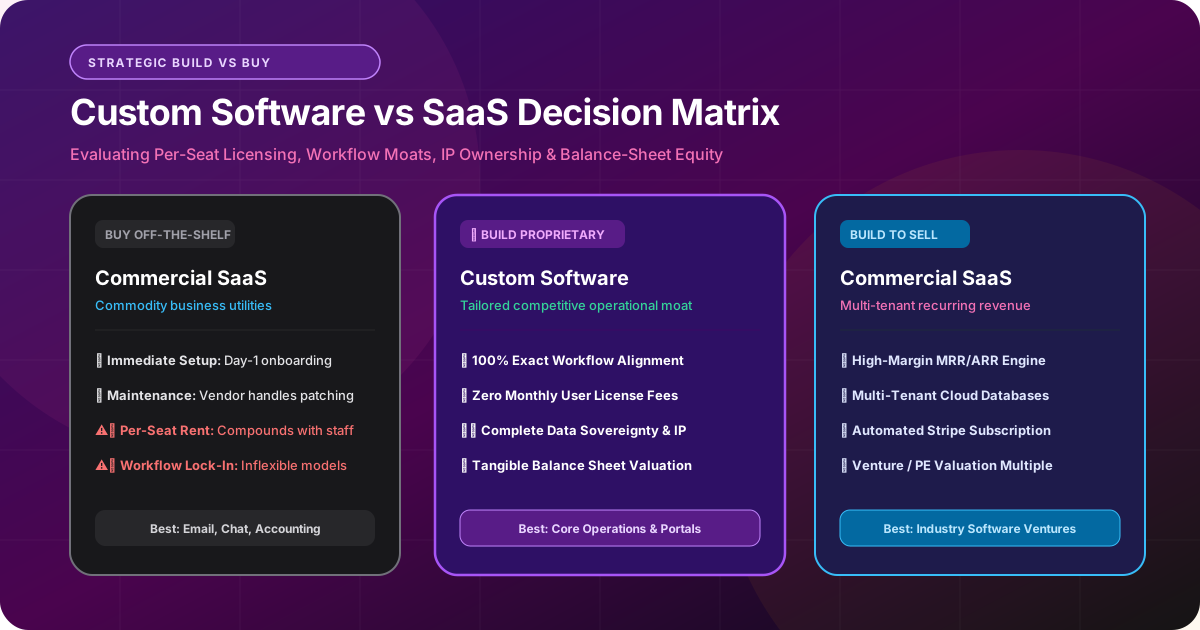
Buy commercial SaaS for standardized, commodity operational functions where software does not provide a competitive differentiator (e.g., corporate email, payroll, team messaging). Build custom software when your operational workflows represent your company's proprietary competitive moat, when per-seat SaaS subscription fees compound uncontrollably, when strict data sovereignty is legally required, or when you are building a commercial software product to monetize across your industry.
1. The Modern Build vs Buy Dilemma
Moving past superficial software comparisons to true economic impact
In early software eras, building custom applications was an exorbitant endeavor reserved for Fortune 500 corporations with multi-million dollar IT budgets. Small and mid-market companies had no choice but to adopt whatever standardized off-the-shelf software existed.
Today, the economics of software development have transformed. Modern serverless cloud infrastructure (AWS, GCP, Vercel), modular open-source component libraries, and AI-accelerated engineering workflows have reduced custom software development timelines by 60% compared to a decade ago.
At the same time, commercial SaaS products have become increasingly expensive. Software vendors frequently implement aggressive per-user, per-month pricing tiers, arbitrary API rate limits, and annual 10%–20% subscription price hikes that trap companies in expensive multi-year contracts.
Choosing between SaaS and custom code is not about ideology; it is about calculating total cost of ownership (TCO), risk mitigation, and competitive differentiation.
2. The 4 Strategic Software Paths Available to Enterprises
Understanding the full spectrum of modern software procurement
When addressing a business process bottleneck, leadership teams can pursue four distinct paths:
1. Off-the-Shelf SaaS: Subscribing to existing commercial software (like Google Workspace, Slack, or QuickBooks) and utilizing its features as designed with zero custom code.
2. Customized SaaS Platform: Adopting an enterprise SaaS system (like Salesforce or Microsoft Dynamics) and hiring certified consultants to configure complex custom fields, automations, and third-party plugins.
3. Proprietary Custom Software: Contracting an engineering partner like RankVRA to architect a bespoke web application or internal dashboard engineered 100% around your company's proprietary workflows and data models.
4. Building a Commercial SaaS Product: Architecting a multi-tenant cloud software application designed not only to automate internal operations, but to be monetized as a subscription product sold to other businesses in your industry.
3. The 8-Point Strategic Evaluation Matrix
Comparing the core vectors of software longevity and commercial leverage
We analyze custom software against off-the-shelf SaaS across 8 critical dimensions:
| Evaluation Vector | Off-The-Shelf SaaS | Custom Software Development |
|---|---|---|
| Initial Upfront Investment | Very Low (Monthly subscription / setup fee) | Moderate to High (Initial engineering investment) |
| Long-Term 3-5 Year Cost | Compounds rapidly as headcount grows | Flat hosting & maintenance; zero per-seat licensing |
| Workflow Alignment | Rigid; forces business into vendor conventions | 100% exact alignment with proprietary operations |
| Data Sovereignty & Privacy | Data lives in multi-tenant vendor cloud | 100% private cloud ownership & database control |
| Third-Party Integration Freedom | Restricted by vendor API limits and tiers | Unlimited; custom microservices and webhooks |
| Time to Deployment | Immediate (Days to weeks of onboarding) | Phased rollout (8 to 18 weeks of development) |
| Maintenance & Patching | Vendor handles all server infrastructure | Retained engineering partner manages SLA & updates |
| Company Enterprise Valuation | Subscription expense; zero balance-sheet value | Recognized as proprietary intellectual property (IP) |
4. When Buying SaaS Is the Economically Rational Choice
Commodity functions that should never be custom built
A universal engineering rule is: Never build what is already a commodity. Buying off-the-shelf SaaS is the superior decision when:
• The Workflow Is Non-Differentiating: Corporate email, employee payroll, standard accounting, and team video chat are identical across every industry. Building a custom email client or accounting ledger burns capital without providing any competitive edge.
• Regulatory & Tax Compliance Is Constantly Shifting: Handling global payroll taxes, local employment laws, or complex sales tax remittance requires massive legal teams. Tools like Gusto, Deel, and TaxJar are far cheaper to license than building in-house compliance engines.
• Early-Stage Idea Validation: Pre-revenue startups should always validate their sales process using off-the-shelf tools (like Airtable, HubSpot, or Notion) before writing custom code. Build only after your manual workflow has proven its market demand.
5. When Custom Software Engineering Delivers Asymmetric ROI
When proprietary software becomes an insurmountable competitive advantage
Building custom software becomes an operational and financial imperative when:
• The Workflow Is Your Core Competitive Moat: If your business wins deals because of a proprietary underwriting model, a unique manufacturing estimation algorithm, or a specialized logistics routing engine, forcing that process into a generic SaaS tool destroys your advantage.
• Per-Seat SaaS Licensing Has Become Absurd: If your organization has 150 employees paying $120/month per seat for a customized CRM or ERP, you are spending over $215,000 every year in recurring software rent. A custom application built for $60,000 pays for itself in less than four months and saves hundreds of thousands over a 5-year horizon.
• Vendor Lock-In & Feature Creep: Many SaaS platforms suffer from 'bloatware'—you pay for 500 features your team never uses, while the 3 features you desperately need sit perpetually on the vendor's roadmap.
• Strict Industry Compliance & Air-Gapped Security: Highly regulated enterprises (defense, healthcare, institutional finance) cannot legally store sensitive client records in multi-tenant public SaaS environments.
Private equity firms and institutional acquirers place significantly higher EBITDA multiples on companies that own proprietary software infrastructure compared to competitors who run entirely on off-the-shelf SaaS subscriptions.
6. Transitioning from Internal Tool to Commercial SaaS Product
How established domain experts turn internal software into recurring revenue engines
Some of the world's most successful software products originated as internal tools built to solve a founder's specific industry headache. If your organization has spent years perfecting a proprietary operational workflow for insurance, commercial logistics, or education, chances are hundreds of other businesses in your vertical suffer from the exact same pain point.
With SaaS development, RankVRA engineers multi-tenant cloud applications from the ground up: complete with automated Stripe billing tiers, isolated tenant databases, self-service onboarding wizards, and role-based permissions.
Instead of your software remaining an internal cost center, it transforms into an independent recurring revenue engine with venture-scale enterprise valuation.
7. The Executive Build vs Buy Decision Framework
The 3-stage decision tree for leadership teams
Follow this decision tree during technology planning:
1. 'Does this software touch our core customer experience or operational moat?' If No -> Buy SaaS. If Yes -> Proceed to Step 2.
2. 'Does an existing commercial SaaS tool solve at least 85% of our requirements without clunky manual workarounds?' If Yes -> Buy SaaS and configure connectors. If No -> Proceed to Step 3.
3. 'Will our 3-year cumulative SaaS subscription costs exceed the initial development and maintenance investment of custom software?' If Yes -> Build Custom Software.
Key Strategic Takeaways
- Buy off-the-shelf SaaS for commodity operational functions like payroll, email, and internal team chat.
- Build custom software when your workflows represent your company's proprietary competitive moat.
- Calculate 3 to 5-year Total Cost of Ownership (TCO): recurring per-seat fees often exceed custom development investments.
- Custom software provides complete data sovereignty, zero vendor lock-in, and creates permanent enterprise IP valuation.
- Speak with [RankVRA's software engineering architects](/services/saas-development) to evaluate your build vs buy business case.
The Bottom Line & Next Steps
The decision between SaaS and custom software is not a question of technology; it is a question of business strategy. By licensing commodity software where standard solutions suffice and investing in custom software where proprietary workflows drive competitive advantage, forward-thinking enterprises maximize operational efficiency while building enduring commercial equity.
Questions Business Leaders Ask About custom software vs SaaS
How much does it cost to build custom business software?▾
A bespoke business application or internal operations tool typically ranges from $15,000 to $45,000 for mid-market systems with custom databases and role-based access. Multi-tenant commercial SaaS products or large-scale enterprise platforms range from $40,000 to $100,000+ depending on feature scope and third-party integrations.
How long does custom software development take?▾
A focused Minimum Viable Product (MVP) of a custom business application typically requires 8 to 14 weeks from architectural design to deployment. Enterprise platforms with complex legacy data migrations require 16 to 24 weeks.
Who maintains custom software after launch?▾
RankVRA provides dedicated Service Level Agreement (SLA) maintenance programs covering cloud infrastructure monitoring, database backups, automated security patching, framework upgrades, and continuous feature iterations.
Can custom software integrate with our existing accounting or ERP software?▾
Yes. Custom software is engineered with native API connectors and webhook listeners that synchronize data bi-directionally with QuickBooks, NetSuite, SAP, Salesforce, or proprietary internal databases.

Written by Naveen Panchal
AuthorFounder & Lead Technical Architect, RankVRA
Naveen Panchal is the Founder and Technical Director of RankVRA. He specializes in full-stack web engineering, Next.js architecture, and high-performance digital systems for clients across the US, UK, Canada, and India.
Explore Core Commercial Capabilities
Multi-tenant cloud applications, automated billing, and scalable SaaS platforms.
Bespoke business automation portals, dashboards, and internal tools.
High-performance server runtimes, database architecture, and microservices.
Explore real-world software architecture and deployment results.
- Gartner: Gartner Research: Evaluating Build vs Buy Software DecisionsOfficial Reference
- NIST: NIST Cloud Computing StandardsOfficial Reference
- OWASP: OWASP Software Component Security GuidelinesOfficial Reference
Evaluating a Custom Software or SaaS Project?
Schedule a confidential architectural discovery session with RankVRA. We will evaluate your operational workflows, audit recurring software costs, and deliver an objective build vs buy economic assessment.
Related Growth Blueprints
Explore more strategic articles from the RankVRA engineering desk.
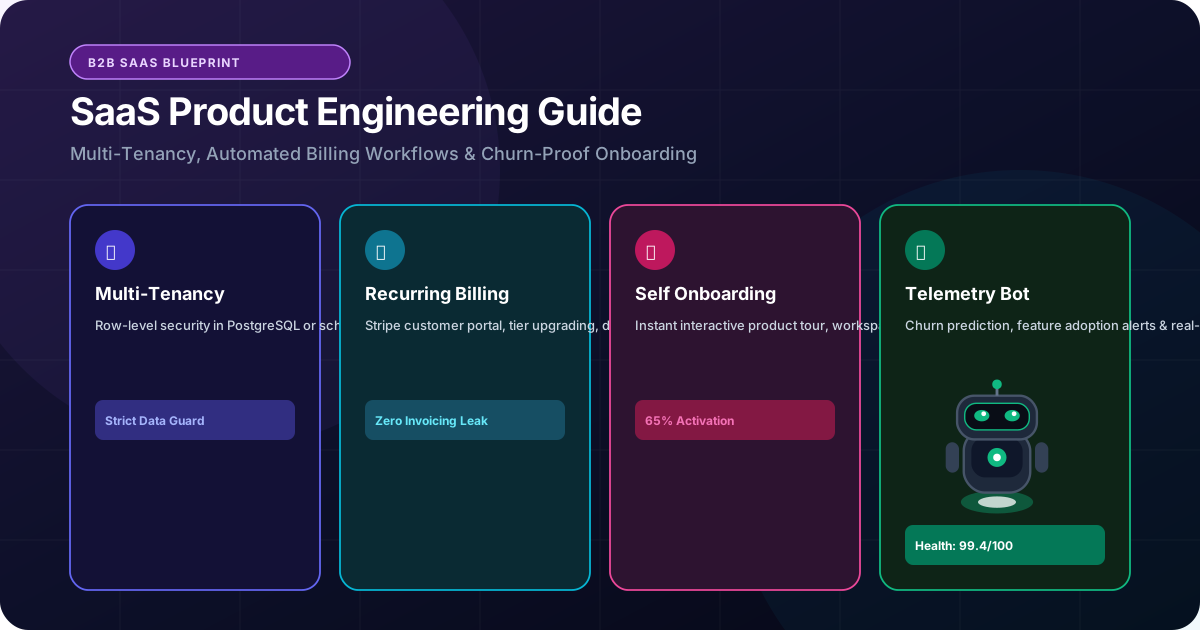
What Is SaaS Development? A Complete Guide to Building a SaaS Web Application
Learn how to build a scalable Software-as-a-Service (SaaS) web application. Master multi-tenant architecture, automated billing, role permissions, and product scalability.
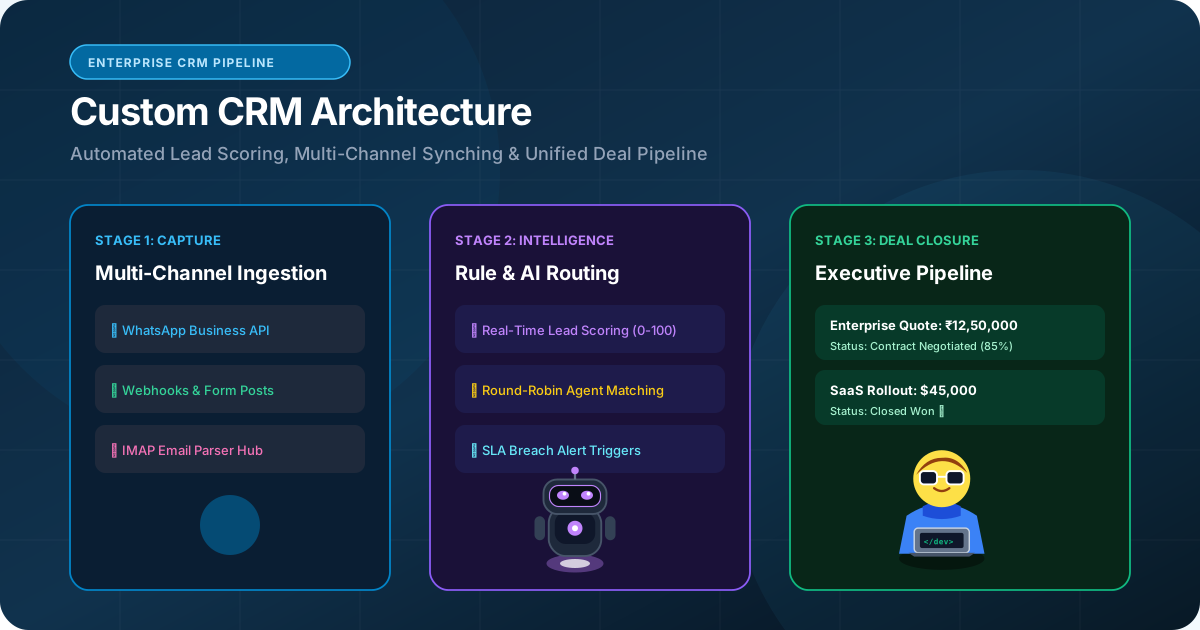
Custom CRM Development vs Off-the-Shelf CRM: Which Approach Fits Your Business?
Should your company build a custom CRM or subscribe to HubSpot/Salesforce? Compare total cost of ownership, workflow customization, data sovereignty, and business fit.
Custom Web Application Development: When Should a Business Build a Custom Web App?
When should a business build custom web applications instead of subscribing to SaaS? Learn how custom portals, wholesale dashboards, and bespoke workflows deliver compounding ROI.

How Much Does It Cost to Build a Business Website in 2026?
How much does a business website cost in 2026? Explore the real cost drivers—design complexity, page count, CMS, custom integrations, security, and maintenance.